
Your home's most critical asset isn't the kitchen renovation or the new deck; it's the invisible infrastructure buried in your backyard. When a septic field begins to fail, the primary concern isn't just the technical repair, but how to manage the investment without depleting your hard earned savings. Most rural property owners in North Central Alberta feel a heavy weight when they realize a system needs an upgrade, especially with the 2026 standards for pressurized distribution. It is natural to worry about how septic system financing will impact your monthly budget or if a failing system might suddenly tank your property's market value.
We understand that you need clear, manageable solutions rather than more stress. This guide details the most reliable ways to fund your replacement or repair in 2026, from leveraging home equity to navigating Alberta specific options like the SHARP program for seniors. You will discover how to obtain quick approvals and low monthly payments that keep your project on track. We will walk through the technical requirements and the financial pathways available to ensure your rural property remains a safe, high value asset. By the end, you'll see that a professional fix is always within reach, allowing you to focus on the long term security of your home.
Key Takeaways
- Protect your property's long-term market value by addressing wastewater infrastructure needs before they become emergency failures.
- Compare the speed of contractor-led payment plans against the lower rates of traditional bank loans to find the right septic system financing for your budget.
- Identify eligibility for Alberta-specific assistance, including the Seniors Home Adaptation and Repair Program (SHARP) and other rural infrastructure grants.
- Understand why a professional diagnostic report is the essential first step required by lenders to approve your funding application.
- Learn how to streamline the approval process by gathering specific property documentation and technical estimates required for rural investments.
Why Septic System Financing is a Vital Tool for Alberta Homeowners
Owning a rural property in Alberta brings a unique set of responsibilities, none more critical than managing your own wastewater infrastructure. When a system begins to show signs of age or failure, the financial weight can feel immediate and overwhelming. In our region, septic system financing acts as a specialized financial bridge between urgent utility needs and long-term fiscal health. It allows homeowners to address essential repairs or full system replacements through structured payment plans rather than depleting their emergency savings. By spreading the cost over time, you can ensure your home remains safe and functional without compromising your monthly cash flow.
Understanding how septic systems work helps clarify why these projects require significant capital. These aren't simple plumbing fixes; they are complex biological and mechanical systems that must meet strict provincial standards. Financing provides the flexibility to choose high-quality components and professional installation, which are the primary factors in a system's durability. Whether you are facing an unexpected equipment failure or planning a proactive upgrade to a modern pressurized system, having a clear funding strategy is the first step toward a permanent resolution.
The Financial Impact of a Failing Septic System
In the Edmonton Capital Region and surrounding counties like Parkland, a failing septic field is a significant liability that directly threatens your home equity. If you decide to sell your property, a non-compliant or malfunctioning system can stop a real estate transaction in its tracks. Most buyers and lenders now demand proof of a functional system before closing. Investing in a certified septic system repair restores your property's marketability and protects your investment. By securing financing early, you also avoid the "emergency premium" often associated with rushed, last-minute repairs during a crisis. A planned approach is always more cost-effective than a reactive one.
Financing as an Investment in Property Longevity
Modern wastewater technology, such as tertiary treatment systems, offers incredible environmental protection but comes with a higher price tag than older gravity-fed designs. When evaluating your options, it's helpful to compare the modest cost of loan interest against the massive expense of environmental remediation if a system leaks or the soil becomes contaminated. Financing allows you to install the most durable systems available in 2026, ensuring your property remains compliant with the Alberta Private Sewage Systems Standard of Practice for decades to come.
Securing favorable loan terms often depends on the quality of your initial information. Lenders and grant providers in Alberta require professional diagnostic reporting to approve septic system financing applications. A detailed inspection serves as technical proof of the project's necessity, giving financial institutions the confidence they need to release funds. We act as your partner in this process, providing the thorough documentation and clear estimates that help you navigate the path from a stressful system failure to a fully restored, high-value property.
Exploring Your Financing Paths: Contractor Plans vs. Traditional Loans
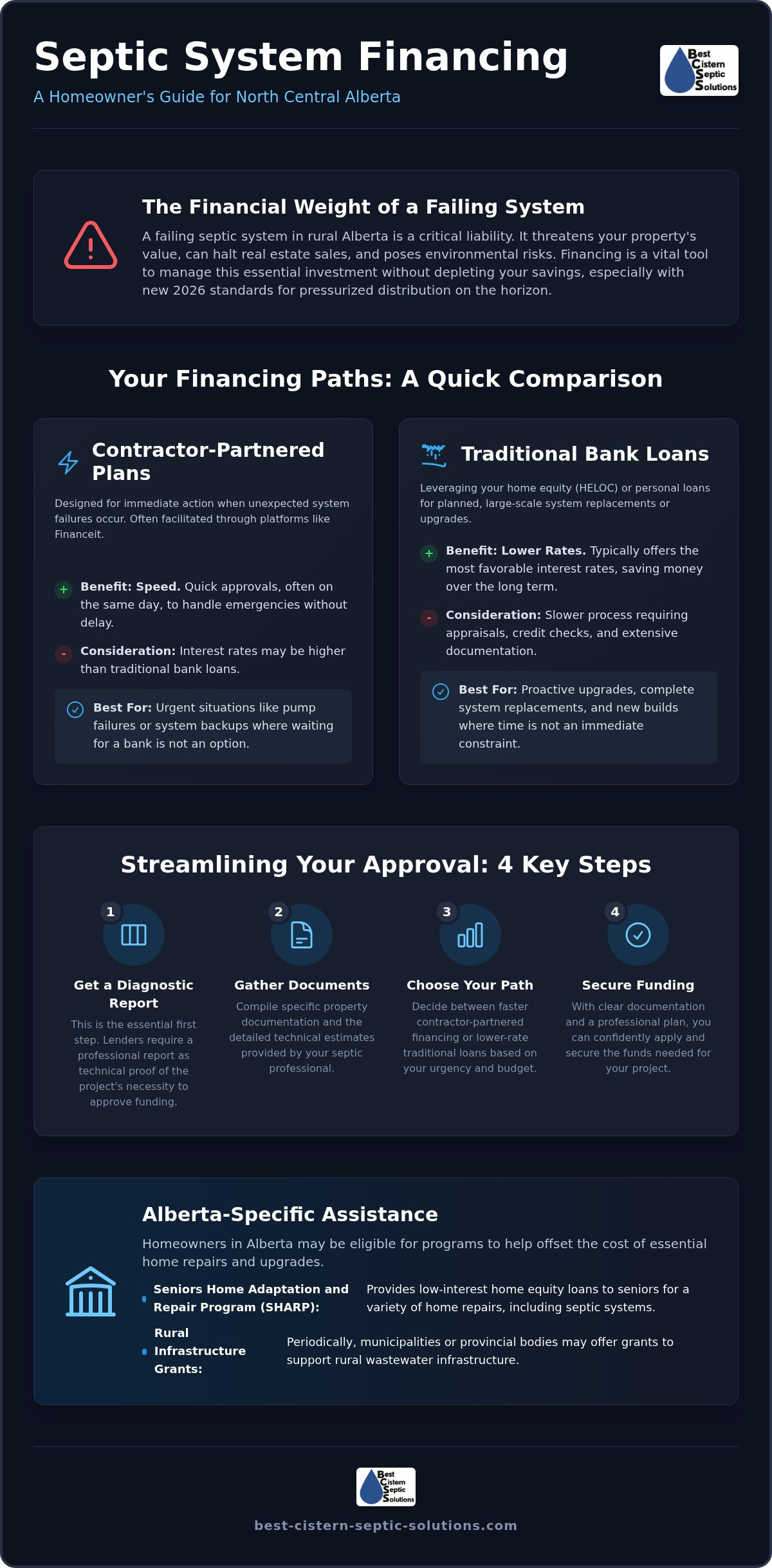
Choosing the right path for septic system financing depends on your timeline and your current credit profile. You have two primary routes: the speed of contractor-partnered programs or the lower interest rates associated with traditional banking. Each option serves a different need, whether you are dealing with a sudden effluent pump failure or planning a complete system overhaul to meet Alberta's Septic System Regulations. Understanding the nuances of these financial tools ensures you don't overpay for the capital you need to secure your property.
Contractor-Partnered Financing
Contractor-partnered financing, often facilitated through platforms like Financeit, is designed for immediate action. When a system fails unexpectedly, waiting weeks for a bank appraisal isn't always a viable option. These programs can provide approval in minutes, often right from your kitchen table. In 2026, standard interest rates for these loans typically range from 12.99% to 15.99%. While these rates are higher than a mortgage, they offer biweekly or monthly payment plans that fit neatly into a rural household budget.
A significant advantage of this path is the "Open Loan" structure. This means you can pay off the entire balance early without facing any penalties. It's a flexible solution for homeowners who want to start repairs today but plan to clear the debt once a seasonal bonus or tax refund arrives. Most Alberta homeowners with a fair to good credit score find these requirements straightforward and accessible.
Bank Loans and Home Equity Options
If your situation allows for a longer lead time, traditional bank loans and Home Equity Lines of Credit (HELOC) offer the most cost-effective rates. HELOCs in early 2026 start around 5.45% to 6.45%, making them a popular choice for a full septic field installation. You might also consider folding the project costs into a mortgage renewal, where fixed rates currently sit between 4.49% and 5.99%. These options require more paperwork, but the long-term interest savings are substantial.
Local credit unions in Leduc or Stony Plain often understand rural property needs better than national banks. They recognize that a functional system is essential for property preservation and are familiar with local permit costs, such as the $270 fee for disposal field replacement in Parkland County. Before you sign any loan documents, you can consult with our team for a diagnostic report to ensure your funding request covers the full scope of the required work. This professional documentation often helps lenders feel more confident in your application, leading to smoother approvals and a quicker start to your project.
Government Grants and Assistance for Rural Wastewater in Alberta
While most homeowners rely on private septic system financing, several government-backed programs exist to assist specific demographics with essential infrastructure costs. These programs are designed to ensure that rural properties remain safe and environmentally compliant, particularly when a system failure poses a direct health risk. Navigating these options requires a clear understanding of eligibility, as most assistance is targeted toward low-income households, seniors, or specific environmental conservation goals in North Central Alberta.
Navigating the CMHC RRAP in 2026
The Residential Rehabilitation Assistance Program (RRAP), managed through the Canada Mortgage and Housing Corporation (CMHC), remains a primary source of aid for rural repairs. This program is specifically designed for homeowners who lack the resources to fix major building deficiencies. Because a malfunctioning septic field is considered a significant health and safety hazard, it often qualifies for funding under the RRAP "On-Reserve" or "Secondary Suite" categories, depending on your property's designation.
To succeed with an RRAP application, documentation is your most powerful tool. Lenders and government agencies require a professional septic inspection that details the exact nature of the failure. This report must prove that the repair is not a cosmetic upgrade but a necessary intervention to restore sanitary conditions. Once you have this technical proof, you can proceed with the multi-step application process, which includes income verification and property tax assessments.
Local Environmental and Conservation Rebates
In counties like Sturgeon and Parkland, local initiatives sometimes focus on protecting sensitive watersheds. If your property is located near a lake or a protected water body, you may find targeted incentives for upgrading to advanced tertiary treatment systems. These systems provide a higher level of effluent purification, reducing the environmental footprint of your home. Additionally, if you are installing a new cistern as part of your wastewater overhaul, you should check for municipal water conservation credits that reward rural residents for reducing their reliance on local aquifers.
For many Alberta residents, the Seniors Home Adaptation and Repair Program (SHARP) is a more accessible route. This program provides up to $5,000 for low-income seniors to help with essential home repairs. RRAP funding is strictly for essential health-related septic failures. If you use your rural property for a home-based business, you should also discuss tax implications with a professional accountant. While personal home repairs aren't usually deductible, a portion of the maintenance or repair costs for shared utility systems may be eligible for business-use-of-home deductions, helping to offset the long-term cost of your investment.
How to Qualify and Apply for Septic Financing Quickly
Securing septic system financing is a logical, multi-step process that moves faster when you have your technical documentation ready. Unlike a standard home renovation loan, lenders for rural utilities often require specific proof that the proposed work meets provincial standards. Approaching this with a methodical mindset reduces the time between identifying a failure and breaking ground on a resolution. By following a structured application path, you can move from a stressful system alert to an approved funding plan in a matter of days.
The first and most critical step is obtaining a detailed diagnostic report and a written estimate. Lenders in North Central Alberta rarely approve funds based on a verbal quote. They require a professional breakdown of the project scope, including whether you need a full septic tank installation or a specific effluent pump replacement. Once you have this technical foundation, you can compare lenders based on your credit score and the urgency of the repair. Online applications for contractor-partnered financing often provide results in under an hour, while bank-led options like HELOCs may take several weeks to finalize.
Documentation You Will Need
Lenders require a comprehensive view of your financial health and property status. You should gather your proof of income, recent mortgage statements, and current property tax assessments from your respective county office in Parkland or Leduc. Most financial institutions also require two pieces of valid government identification to verify your residency in Alberta.
The "Septic Quote" is the piece of documentation that often trips up homeowners. A generic total price is rarely sufficient. Lenders demand a line-item breakdown of the field design and the specific components involved. This detail proves to the lender that the investment is being used for a compliant, long-term asset rather than a temporary fix. Providing a professional design plan early in the process demonstrates that the project is being handled by an expert, which can lead to more favorable loan terms.
What Lenders Look for in a Rural Property
When reviewing your application for septic system financing, lenders assess the risk associated with your specific property. They typically look for credit score thresholds; those with scores in the "good" to "excellent" range often qualify for unsecured personal loans with rates between 6.99% and 12.99%. Your debt-to-income ratio is also a major factor in determining your biweekly or monthly payment amounts. Lenders want to ensure the payments are manageable within your existing budget.
The age and condition of your existing system also matter. A system that has reached the end of its 20 to 30 year lifespan is viewed as a necessary infrastructure replacement, which is often easier to finance than a purely elective upgrade. Before you submit your final application, you should book a professional diagnostic inspection to ensure your funding request is accurate and complete. Having this professional report in hand shows lenders that you are a diligent property owner committed to maintaining the integrity of your home's essential services.
Securing Your Property with Best Cistern Septic Solutions
Navigating septic system financing is often the most stressful hurdle for rural homeowners facing an infrastructure failure. At Best Cistern Septic Solutions, we act as more than just installers; we are your technical partners in securing your property’s future. We understand that lenders require precise, authoritative documentation before they release funds for such a significant investment. Our team provides the professional diagnostic reports and line-item estimates that satisfy the rigorous demands of banks, credit unions, and private lenders. This level of transparency ensures your application moves through the approval process without unnecessary delays or requests for further clarification.
Our commitment to your property goes beyond the initial paperwork. We focus on providing durable, long-term septic solutions that integrate seamlessly with your home’s specific environmental needs. By using high-quality materials and modern pressurized distribution designs, we transform a stressful repair into a permanent asset. This proactive approach reduces the emotional weight of system maintenance, replacing worry with the confidence that your wastewater infrastructure is built to last for decades. We treat every project as a vital contribution to the safety and health of your household.
Expertise You Can Trust in Parkland County
We have a long history of serving the unique residential needs of Sturgeon, Leduc, and Strathcona Counties. Our deep familiarity with North Central Alberta's soil conditions and the latest 2026 provincial standards allows us to design systems that avoid the common pitfalls of premature soil failure. A professional installation is the best defense against future financial strain. By building a system that meets or exceeds current environmental regulations, you effectively prevent the need for emergency septic system financing in the future. We take pride in performing these essential, difficult tasks with a high level of sophistication, ensuring your utilities remain reliable and compliant.
Next Steps: From Inspection to Installation
Your journey to a secure property begins with a clear, professional assessment. We offer comprehensive site assessments in Spruce Grove and the surrounding Edmonton Capital Region to identify the exact requirements of your land. This initial visit allows us to create a technical roadmap for your project, which serves as the foundation for your funding application. We coordinate with you to ensure your lender has every detail they need to move forward with confidence.
Finalizing your cistern or septic project should be a moment of relief rather than a source of debt-related anxiety. Our methodical process is designed to provide a complete, end-to-end service journey that prioritizes your peace of mind. Once the installation is complete, the invisible benefits of our work begin. You can rest easy knowing that the safety of your home is secured, the value of your property is preserved, and a professional fix has been permanently established.
Protecting Your Rural Property Investment
Securing the health of your wastewater system is a vital step in maintaining your home's long-term value and safety. By exploring the various paths for septic system financing, you've taken the first step toward a manageable resolution that protects your savings. Whether you choose a flexible contractor payment plan or leverage your home equity through a local credit union, the goal remains the same: a compliant, durable system that removes future worries. You don't have to navigate these technical and financial requirements on your own.
Our team provides the professional diagnostic reports that lenders in Parkland, Leduc, and Sturgeon Counties demand to approve your funding. We combine technical expertise with a grounded, neighborly approach to ensure your project meets all 2026 standards without the stress of navigating complex requirements alone. We take pride in helping you move from a failing system to a permanent, professional fix with complete transparency and care. Your property is a significant asset, and it deserves a wastewater solution that matches its value.
Ready to start your project? Contact Best Cistern Septic Solutions for a Professional Quote and Financing Guidance. You can feel confident that a reliable, high-performing septic system is well within your reach.
Frequently Asked Questions
Can I get financing for a septic system with a low credit score?
You can still access septic system financing even if your credit score isn't in the top tier. While traditional banks have strict thresholds, contractor-partnered programs often provide approvals for a wider range of credit profiles. These loans generally carry higher interest rates, often between 12.99% and 15.99% in 2026, but they allow you to address critical infrastructure needs immediately without waiting years to save the full amount.
How much are the typical monthly payments for a new septic field in Alberta?
Monthly payments depend on the total project cost and the repayment term you select with your lender. Most homeowners in Alberta opt for terms ranging from five to fifteen years to keep biweekly or monthly installments manageable. Structured payments allow you to preserve your cash flow while ensuring your property remains compliant with the Alberta Private Sewage Systems Standard of Practice without draining your emergency savings.
Does insurance cover septic system replacement or repair?
Standard home insurance policies typically don't cover the replacement or repair of a septic system due to age, wear, or soil failure. Coverage is usually reserved for sudden, accidental damage caused by a specific external force, such as a vehicle driving over the tank. It's best to review your specific policy or speak with your broker about adding a service line endorsement to protect against future mechanical failures.
Is there an interest-free financing option for septic systems?
Interest-free options are uncommon for large-scale utility projects in 2026. While some contractors may offer short-term promotional windows, such as "no payments for six months," the balance typically accrues interest if it isn't paid in full by the deadline. Choosing a loan with an open structure is often a better strategy. This allows you to pay off the principal early as funds become available without facing any penalties.
What is the fastest way to get approved for emergency septic funding?
The fastest path to funding is through contractor-led digital platforms that provide a decision in minutes after you submit your basic information. This speed is essential for emergency repairs where a failing effluent pump or blocked field threatens the safety of your household. Having your professional diagnostic report and written estimate ready ensures the application moves forward without the technical delays often found in traditional banking.
Are there specific grants for seniors needing septic repairs in Parkland County?
Low-income seniors in Parkland County can apply for the Seniors Home Adaptation and Repair Program (SHARP). This provincial initiative provides up to $5,000 in assistance for essential home repairs, which includes critical septic system fixes. To qualify, you must meet specific income thresholds and provide documentation showing that the repair is necessary for your continued safety and independence in your rural residential property.
Can I use a personal loan for both a cistern and a septic system?
You can absolutely use a single personal loan or HELOC to fund both a cistern installation and a septic system upgrade. Lenders view these as integrated property improvements that enhance the overall value and functionality of your rural investment. Providing a combined line-item estimate for both projects helps the lender understand the full scope of your utility needs, which often leads to a more streamlined approval process.
What happens if I cannot afford to fix my failing septic system?
Delaying a necessary repair can lead to environmental contamination, significant property value loss, and potential fines from your local municipality. In severe cases, a failing system can result in an "unfit for habitation" order from health authorities. Seeking septic system financing early allows you to implement a professional fix before a manageable problem turns into an expensive environmental crisis that threatens the safety of your home.


