
Imagine waking up on a -40°C morning in North Central Alberta only to find your taps bone dry because your water storage couldn't handle the deep freeze. It's a stressful scenario that many rural homeowners in Parkland or Leduc County fear, especially when dealing with the unpredictable pressure of heavy clay soils. You deserve a system that works as hard as you do, providing a clean and consistent supply without the constant worry of mechanical failure or frozen lines. Ensuring a successful underground water cistern installation is about more than just digging a hole; it's about engineering a thermal solution that stands up to our province's harshest conditions.
We understand that the technical requirements and local permit regulations can feel overwhelming, particularly with the updates brought by the 2026 Water Amendment Act. This guide simplifies the process, offering you a clear roadmap to a reliable potable water system. You'll learn the essential winter-proofing techniques to protect your investment, how to choose between concrete and polyethylene for durability, and the specific steps to remain in full compliance with Alberta Safety Codes. By the end of this article, you'll have the knowledge to secure a maintenance-free water supply that preserves your property's value for decades to come.
Key Takeaways
- Compare precast concrete and high-density polyethylene (HDPE) to determine the best material for durability in Alberta's heavy clay soil.
- Discover why the 8.5-foot burial depth is a non-negotiable requirement for a successful underground water cistern installation in the Edmonton Capital Region.
- Ensure your property remains in full compliance with the 2026 Alberta Safety Codes and specific county permitting regulations.
- Follow a professional step-by-step installation process that prioritizes site assessment and precision excavation to prevent system shifting.
- Learn how a regular maintenance schedule and smart sensor monitoring provide a safe, consistent, and worry-free water supply for your home.
Understanding Cistern Systems for Rural Alberta Properties
A modern cistern is much more than a simple tank; it's a sophisticated, potable water storage powerhouse designed to provide your household with a secure, pressurized supply. For many residents in Parkland and Strathcona Counties, a professional underground water cistern installation serves as the most reliable alternative to low-yield wells. While a well depends on the unpredictable recharge rate of an aquifer, a cistern offers total control over your inventory. This reliability directly impacts property value in the Edmonton region. Prospective buyers prioritize homes with proven, high-quality utility systems that won't fail during a dry spell.
When researching What is a Cistern?, you'll find they've evolved into high-tech assets. Professional installation is vital to prevent tank buoyancy. In areas with high water tables or heavy clay, an empty tank can actually float and shift if it isn't properly ballasted. This movement leads to catastrophic pipe failure, a risk our team eliminates through precise site engineering and specialized backfill techniques.
Truck-Fill vs. Trickle Systems: Which is Right for You?
Choosing the right delivery model depends on your local infrastructure. Both systems offer a definitive solution to water scarcity, but they require different configurations.
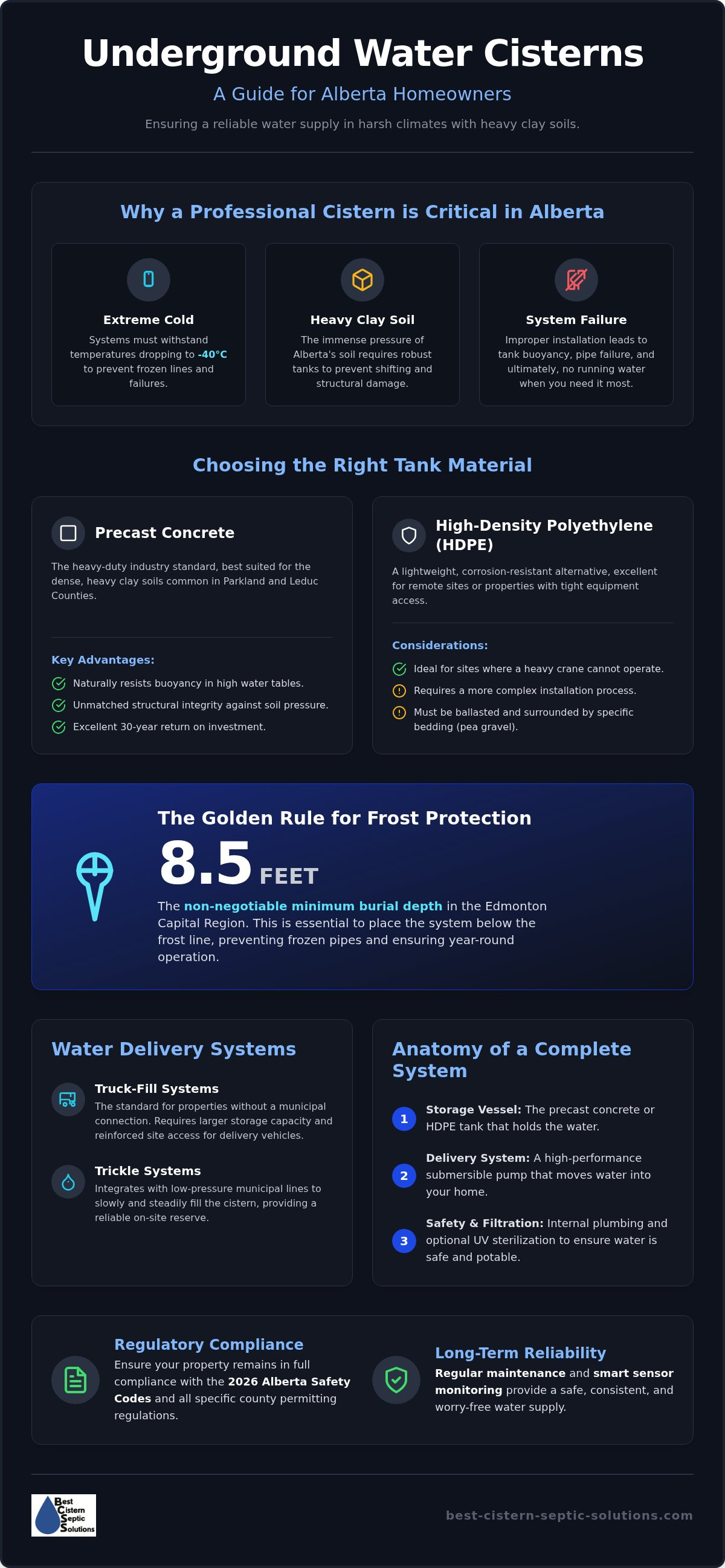
- Truck-Fill Systems: These are the standard for properties without any municipal connection. They require larger storage capacities to minimize the frequency of delivery from water hauling services.
- Trickle Systems: These integrate with low-pressure municipal lines. Instead of drawing directly from the line for peak demand, the municipal water fills your reservoir at a slow, steady rate.
Infrastructure needs vary between the two. Truck-fill systems need reinforced site access for large delivery vehicles. Trickle systems require specific float valves and backflow prevention to manage the slow-fill process safely. Both models provide the peace of mind that comes with a dedicated on-site reserve.
The Anatomy of a Potable Water Storage System
A complete underground water cistern installation involves three core components working in harmony. First is the storage vessel, typically constructed from precast concrete or high-density polyethylene. Second is the delivery system. This uses a high-performance submersible pump to move water from the tank into your home at a consistent pressure, mirroring the experience of a city connection.
The final safety stage includes internal plumbing and often a UV sterilization system. This ensures every drop reaching your tap is free from bacteria or sediment. For professional plumbing integration and mechanical support, Prodigy Mechanical offers the expertise needed to ensure your home's water infrastructure is both safe and efficient. Treating the cistern as an engineered system rather than just a container ensures long-term durability and household safety. By investing in a professionally designed system, you remove the stress of water management and focus on enjoying your rural property.
Selecting the right vessel for your underground water cistern installation is a decision that affects your property's utility for decades. In North Central Alberta, we primarily work with two materials: precast concrete and high-density polyethylene (HDPE). Both have their place, but the choice often comes down to your specific site conditions and long-term goals. A well-chosen tank isn't just a container; it's a permanent piece of infrastructure that secures your home's water independence.
Precast concrete remains the heavy-duty industry standard. It's ideally suited for the dense, heavy clay soils common in Parkland and Leduc Counties. Because concrete is inherently heavy, it naturally resists the "buoyancy" effect, staying firmly in place even during high water table seasons. Its structural integrity is unmatched. It can withstand significant lateral soil pressure and even vehicle surcharges if the tank is positioned near a driveway or parking area. For most permanent residential setups, concrete is the preferred asset because it typically wins the 30-year return-on-investment battle.
HDPE tanks offer a lightweight, corrosion-resistant alternative. These are excellent for remote sites or properties with tight access where a massive crane truck cannot safely maneuver to set a concrete tank. However, HDPE requires a more complex installation process. It must be surrounded by specific bedding materials like pea gravel to prevent the tank from deforming under the weight of the earth. Without this specialized support, the pressure from Alberta's shifting clay can cause plastic walls to bow or crack over time.
Sizing Your Cistern for Household Demand
Calculating your storage needs is about more than just daily averages. While the Government of Canada suggests an average usage of 251 litres per person, rural life often demands more. We recommend a minimum capacity of 1,500 to 2,500 gallons for most households. This extra volume isn't just for convenience; it's a safety requirement. Alberta winters frequently bring heavy snow and drifting that can delay water delivery trucks. A larger tank provides the "buffer days" needed to keep your taps running until the roads are cleared.
Pump Selection: Submersible vs. Jet Pumps
Your pump choice dictates the daily "feel" of your water system. Submersible pumps are our top recommendation for a professional underground water cistern installation. They operate silently from within the tank and are naturally protected from freezing. In contrast, jet pumps sit inside your mechanical room. While they're easier to reach, they're often noisy and require manual priming if the system loses pressure. We focus on matching pump horsepower to your home’s vertical rise to ensure that a shower upstairs feels just as powerful as one on the main floor. If you're unsure which configuration fits your property, a professional cistern installation assessment can provide the clarity you need.
Engineering for the Alberta Winter: Frost Protection and Depth
In North Central Alberta, winter is the ultimate test of any utility system. While generic guides often suggest a four-foot burial depth, local conditions in Parkland and Strathcona Counties demand a much more rigorous approach. A successful underground water cistern installation in our region follows the 8.5-foot burial rule. This specific depth places the core of your water storage well below the reach of the most aggressive frost penetration. Even when temperatures plummet to -40°C, the thermal mass of the surrounding earth keeps your water liquid and your pump functional.
We also utilize manhole extensions and high-density insulated lids to create a thermal break at the surface. These components prevent cold air from migrating down the riser and reaching the water inventory. Compacted backfill plays a dual role here. It provides structural stability and acts as a critical thermal insulator. By eliminating air pockets in the backfill, we ensure that the ground's natural heat is retained around the tank walls, providing a consistent environment for your potable water.
Insulation Strategies for Shallow Water Lines
Not every component can sit eight feet deep. For the lines connecting the tank to your home, we use rigid board insulation or closed-cell spray foam to provide a protective envelope. Heat tape installation is often a mandatory backup for Alberta homes, especially where lines must pass through shallower frost zones near foundation walls. The riser is the most vulnerable point of the entire system because it bridges the gap between the deep, warm earth and the frozen surface. We secure this transition with specialized insulation wraps to ensure that even during a prolonged cold snap, your access point remains functional.
Managing Ground Movement and Clay Soil Heaving
Alberta's heavy clay soils are notoriously restless. They expand and contract significantly during the spring thaw and fall freeze cycles. This heaving can snap rigid pipes or shift tanks if the site isn't engineered correctly. We use a thick layer of sand bedding to create a structural cushion for the tank. This allows for microscopic movements without compromising the vessel's integrity. This proactive approach to underground water cistern installation ensures the system remains a long-term asset.
Flexible connections are another non-negotiable feature for rural properties. These specialized fittings allow the plumbing to move independently of the tank during seasonal soil shifts. By preventing pipe shear, we eliminate one of the most common causes of system failure in rural utilities. This level of detail provides the peace of mind that your water supply will remain secure regardless of the weather or soil conditions.
The Step-by-Step Cistern Installation Process
Successful underground water cistern installation requires a methodical approach that prioritizes precision over speed. We treat each project as a long-term asset for your property, ensuring every mechanical component is positioned for decades of service. The journey begins with Phase 1: site assessment and utility locating. We coordinate with Alberta One Call to identify buried gas or power lines, ensuring the safety of your household and our crew. Phase 2 involves precision excavation. We don't just dig a hole; we create a stable, level foundation using compacted bedding to prevent the tank from shifting in Alberta's restless clay.
Phase 3 focuses on tank placement. We use specialized heavy equipment to lower the vessel into position, verifying its level status at every corner. This accuracy is vital for the long-term performance of your pump. Once set, we move to Phase 4: plumbing and electrical integration. This stage includes installing the submersible pump and running lines to the house. We conduct a full pressure test before burial to confirm that every connection is watertight. Finally, Phase 5 involves strategic backfilling and site restoration. We carefully compact the soil to maintain thermal integrity and ensure proper drainage away from the installation site.
Permits and Regulations in North Central Alberta
Managing the regulatory requirements is a vital part of our professional service. In North Central Alberta, all installations must adhere to the Alberta Private Sewage Systems Standard and the Safety Codes Act. Parkland County and Leduc County often have differing permit fee structures and submission requirements. Securing these permits isn't just a legal formality; it is a critical step for your home insurance compliance and protects your property's resale value. A final inspection by a certified safety codes officer provides the definitive proof that your system is safe and compliant.
Site Preparation: Access and Obstructions
Logistics can be challenging on rural sites, so we plan for every detail. We require clear access for large boom trucks and delivery trailers to set the tank safely. Managing the resulting soil piles is equally important to prevent runoff and maintain your property’s aesthetics during construction. If your project also requires a septic field installation, we can coordinate the excavation phases to minimize land disturbance. Planning these utilities together often results in a more cohesive and efficient site layout. If you are ready to begin, our team is here to provide a professional cistern installation assessment for your property.
Long-Term Reliability: Maintenance and Water Safety
A high-quality underground water cistern installation is a significant property asset, but its longevity depends on a proactive maintenance strategy. While the system is designed to be a "set and forget" utility, expert oversight ensures that your potable water remains safe for your family. We recommend a full professional cleaning every 2 to 3 years. This interval is critical because, over time, a thin layer of biofilm and fine sediment can accumulate on the tank floor and walls. If left unmanaged, this organic material can become a breeding ground for bacteria, compromising the cleanliness of your entire household supply.
Modern technology has simplified water management. While manual dipsticks are a reliable backup, many Alberta homeowners now opt for smart ultrasonic sensors. These devices provide real-time data on your water inventory, allowing you to schedule deliveries before your levels run low. For systems that integrate supplemental water sources, the "First Flush" principle is essential. This involves a mechanical diverter that discards the initial, often debris-laden runoff, ensuring that only the cleanest water enters your primary storage vessel.
The Professional Maintenance Checklist
Visual inspections are the first line of defense. We look for microscopic cracks in the tank walls or evidence of root intrusion, which can occur even in deep-set systems. We also test the pump draw and the pressure tank's bladder integrity. A failing bladder often leads to premature pump wear, a problem that is easily avoided through regular checks. Following any repair or entry into the tank, we implement strict chlorination protocols to disinfect the system and restore water safety. This methodical approach removes the guesswork from property care.
When to Call for a Professional Inspection
You should call for a professional inspection if you notice your pump "hunting" or cycling frequently when no water is running. This behavior often indicates a hidden line leak or a failing check valve. Changes in water taste, odor, or clarity are also immediate red flags that require expert assessment. You can schedule your cisterns maintenance to ensure decades of service. By treating your water system with the same care as your home's foundation, you secure a reliable utility that preserves your property's value and your family's health.
Securing Your Rural Water Future
Investing in a reliable water system is one of the most significant steps you can take to protect your rural lifestyle. By prioritizing high-quality materials like precast concrete and adhering to the 8.5-foot burial rule, you ensure your household remains functional even during the harshest Alberta winters. A professional underground water cistern installation provides more than just storage; it offers the security of a pressurized, potable supply that stands up to shifting clay and extreme frost. These systems are essential infrastructure that preserve your property's value while removing the daily stress of water management.
Our team specializes in Parkland, Leduc, and Sturgeon Counties, providing the grounded, professional advice you need to navigate local permits and technical requirements. You don't have to navigate these complex regulations alone. We focus on creating long-term assets that offer permanent solutions for rural homeowners. Every project we undertake is designed with durability and household safety as the core promise, ensuring a professional fix is always in place. If you are ready to secure a dependable, maintenance-free water source for your property, Request a Professional Cistern Installation Quote today. We look forward to helping you build a more resilient home.
Frequently Asked Questions
How much does a cistern installation cost in Alberta?
Professional costs depend on your specific site conditions, including soil type, tank material choice, and the complexity of your home's plumbing integration. A precise budget is best determined through a professional site assessment that considers excavation depth and utility locating requirements. While prices fluctuate, focusing on high-quality engineering ensures your system remains a durable asset. Proper installation doesn't just save money; it removes the risk of future failures, making it a sound long-term investment.
Can I use an underground cistern for both drinking water and irrigation?
You can certainly use your cistern for both potable needs and irrigation, provided the system is sized correctly. It's important to calculate your peak summer demand to ensure that watering your garden doesn't deplete the reserve needed for your household taps. Many homeowners install a dedicated outdoor hydrant connected to the cistern pump. This setup provides high-pressure water for landscaping while maintaining a clean, filtered supply for your indoor drinking water.
How deep does a cistern need to be buried in the Edmonton area?
For a reliable underground water cistern installation in the Edmonton area, we follow the 8.5-foot burial rule. This depth ensures the storage vessel sits safely below the reach of aggressive frost penetration. While some regions suggest shallower depths, our local climate requires this extra protection to prevent frozen lines and mechanical failure during -40°C cold snaps. Proper burial depth is your primary defense against winter utility interruptions.
Is a concrete cistern better than a plastic one for Alberta winters?
Precast concrete is generally considered the superior choice for Alberta’s heavy clay soils because of its durability and structural weight. Concrete tanks naturally resist the buoyancy issues that can occur in high water tables, staying firmly in place during seasonal thaws. While plastic tanks are easier to transport to remote sites, they require specialized bedding to withstand soil pressure. For most residential properties, concrete offers the best long-term return on investment and peace of mind.
How often should I have my potable water cistern cleaned?
You should have your potable water cistern professionally cleaned every 2 to 3 years to ensure water safety. This regular maintenance removes the biofilm and fine sediment that naturally accumulate on the tank's interior surfaces over time. Cleaning prevents bacterial growth and protects your pump from abrasive debris that can cause premature wear. Combining this cleaning with a visual inspection of the tank's integrity ensures your system continues to provide a safe, reliable supply.
Do I need a permit for a cistern installation in Parkland County?
Yes, you must obtain both plumbing and excavation permits before starting any work in Parkland County. These regulations fall under the Alberta Safety Codes Act and are designed to protect the integrity of your property's utilities. Professional installers manage these applications to ensure full compliance. Having these permits on file is also a critical requirement for maintaining your home insurance coverage and securing your property's future resale value; it's a vital step in the process.
What happens if my cistern runs dry during a delivery delay?
If your tank runs dry, your pump may continue to cycle while searching for water, which can lead to motor burnout. Most modern systems include a low-water shut-off switch or an alarm to prevent this mechanical stress. We recommend installing an ultrasonic sensor to monitor your levels in real-time. This technology allows you to schedule water deliveries in advance, avoiding the anxiety of a dry tank during Alberta's winter delivery delays.


