
You might think the ideal water storage capacity is based solely on your family's daily consumption, but the perfect tank size is actually determined by the gap between your usage and your local water hauler’s truck capacity. Learning how to choose a cistern size requires looking beyond the kitchen faucet and toward the specific logistics of rural Alberta life. We understand the frustration of running out of water during a busy long weekend or the annoyance of paying full price for a half-empty delivery. It is a common stressor for homeowners in Parkland or Leduc County, but it's a problem with a manageable, professional resolution.
This 2026 guide provides the exact math and local logistics needed to size a potable water system that ensures your family never runs dry. We will explore the latest provincial standards, the impact of our heavy clay soils on tank stability, and how to balance installation costs with long-term delivery efficiency. By the end, you'll have a clear path toward a secure, durable water source that adds long-term value to your property and peace of mind to your daily routine.
Key Takeaways
- Audit your household usage by balancing permanent residents and frequent guests against Canadian daily benchmarks for a precise water demand baseline.
- Learn how to choose a cistern size that aligns with local water truck capacities in the Edmonton region to ensure cost-effective, full-load deliveries.
- Factor in critical environmental variables like North Central Alberta’s frost line and clay soil density to prevent tank buoyancy or freezing.
- Identify the structural differences between potable cisterns and wastewater holding tanks to ensure your home remains compliant with 2026 safety standards.
- Discover why professional site assessments are essential for maintaining the balance between your water supply and your septic field's processing limits.
Understanding Potable Water Storage: Why Cistern Size Matters
A potable water cistern acts as the literal lifeline for rural properties across North Central Alberta. Unlike homes connected to a municipal grid, rural residents must manage every drop that enters their household. When you ask What is a Cistern?, it's best to view it as a high-integrity reservoir designed to keep your drinking water safe, clean, and accessible. Understanding how to choose a cistern size is as much about logistics as it is about math, ensuring your home remains a sanctuary rather than a source of stress.
The Role of a Cistern in Rural Alberta
In areas like Parkland County or Leduc County, groundwater can be unpredictable. Many homeowners find that local aquifers provide water with high mineral content or insufficient flow rates, making a well less than ideal. This is why cisterns for rural properties are considered a long-term asset for modern developments. They provide a controlled environment where you know the exact quality of your water. Because our local climate involves extreme temperature swings and deep frost lines, these systems must be engineered for durability. A well-sized system ensures that even during a deep freeze or a power outage, your family has a reliable supply ready for use.
Potable vs. Non-Potable Storage
It's vital to distinguish between a potable cistern and a wastewater holding tank. While they might look similar from the surface, their internal engineering and regulatory requirements are worlds apart. Potable tanks must be constructed from materials certified to the NSF/ANSI/CAN 61 standard, ensuring that contaminants do not leach into your drinking supply. In the Edmonton Capital Region, concrete is often the preferred material because its weight prevents shifting in our heavy clay soils. Using a tank designed for wastewater for your drinking supply is a safety risk that can lead to permanent system contamination.
When you begin to evaluate how to choose a cistern size, you must account for buffer capacity. This is the extra volume that protects you against the unexpected. If you have houseguests over a long weekend or if a heavy Alberta blizzard delays your water hauler by two days, that buffer is what keeps your taps running. Undersizing your tank often results in emergency delivery fees and the constant anxiety of a "low water" alarm. A professional installation balances your daily needs with the logistical realities of rural truck delivery schedules, providing a definitive fix for water security worries.
Calculating Your Household Demand (The People Math)
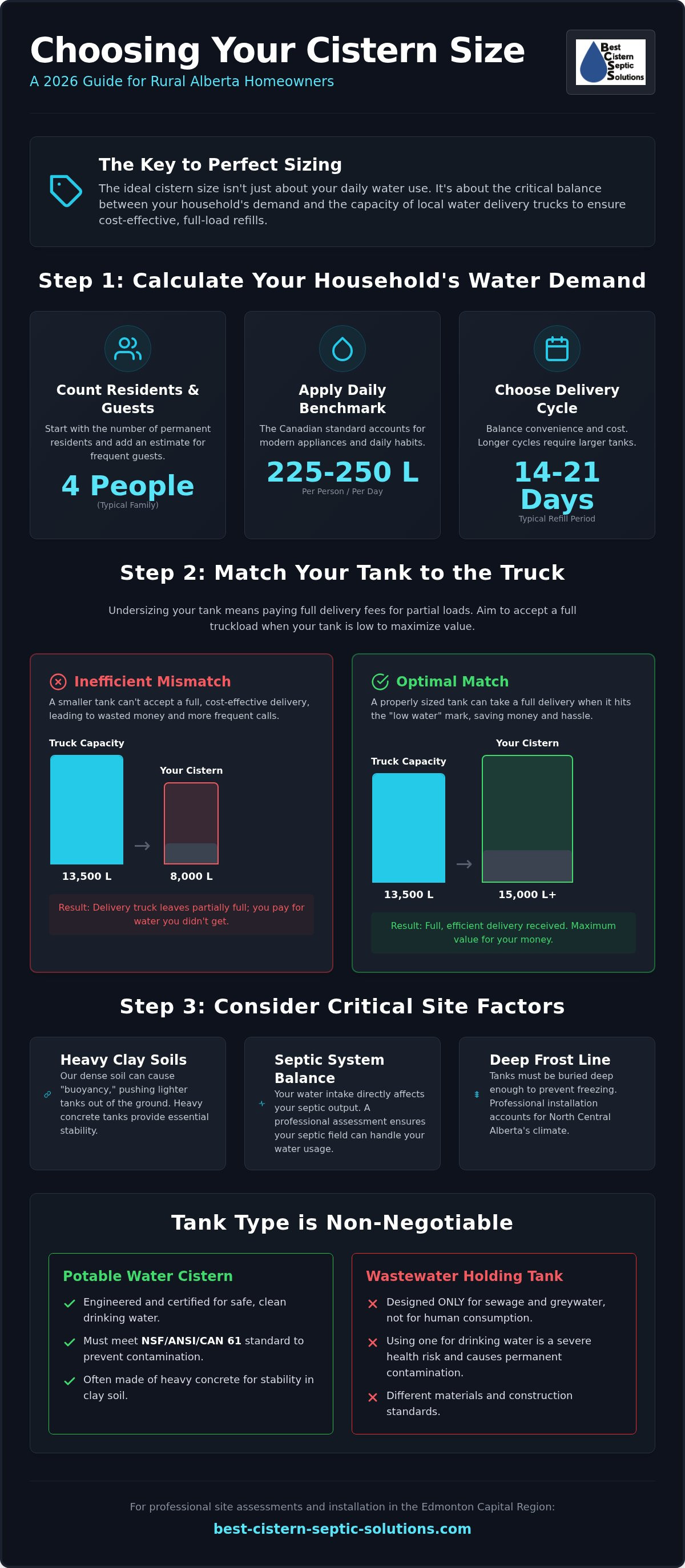
Determining how to choose a cistern size begins with an honest audit of your daily habits. It's easy to look at a monthly bill and guess, but rural living requires a more granular approach. Start by counting your permanent residents and adding a buffer for frequent weekend guests. In Canada, the standard benchmark for daily usage is 225 to 250 litres per person. This figure accounts for modern conveniences like multi-cycle dishwashers and high-efficiency laundry machines that older estimates often miss. While some resources, like this Rainwater Harvesting Guide, provide excellent baseline math for storage, your potable needs must prioritize consistent, high-volume availability.
Next, identify high-water appliances. Luxury rain showerheads or large soaking tubs can double your consumption in a single evening. Finally, decide on your desired delivery window. Most families in Parkland County aim for a 14-day cycle to balance delivery fees with tank volume. If you're unsure about your specific property needs, getting a professional cistern assessment can provide the clarity you need to move forward confidently.
Average Daily Consumption Benchmarks
The Standard Household Unit for water planning in Alberta typically assumes a four-person family requiring a reliable, consistent volume. Understanding septic systems and how they process this water is equally important, as every litre that enters your cistern eventually needs a place to go. Below is a breakdown of estimated needs based on the 225 to 250 litre per person standard.
| Household Size | Daily Demand (L) | 7-Day Total (L) | 14-Day Total (L) |
|---|---|---|---|
| 2 People | 450 – 500 | 3,150 – 3,500 | 6,300 – 7,000 |
| 4 People | 900 – 1,000 | 6,300 – 7,000 | 12,600 – 14,000 |
| 6 People | 1,350 – 1,500 | 9,450 – 10,500 | 18,900 – 21,000 |
Accounting for Peak Usage and Emergencies
Life doesn't always follow a schedule. A Christmas Dinner scenario, where the house is full of guests and the laundry never stops, can quickly drain an undersized tank. Many rural insurance policies also suggest a fire protection buffer, requiring additional storage beyond your drinking needs. You must also account for dead storage. This is the 10 to 15 percent of water at the bottom of the tank that the pump cannot reach without risking damage from sediment or air. Planning for these spikes ensures your system remains a durable asset rather than a source of worry.
The Water Hauler Factor: Matching Tank to Truck
While your daily consumption sets the baseline, the logistics of water delivery dictate your long-term operational costs. In rural Alberta, water haulers typically charge by the load rather than just by the gallon. This means that if a truck with a 2,500-gallon capacity arrives at your property, you'll likely pay for the full trip whether your tank can hold the entire volume or only half of it. Understanding how to choose a cistern size requires a shift in perspective. You aren't just buying storage; you're buying delivery efficiency.
A common mistake is installing a 1,500-gallon tank to save on initial installation costs. However, since most delivery trucks in the Spruce Grove and Edmonton region carry between 2,000 and 3,000 gallons, a small tank forces you into a cycle of short loads. You pay the same mobilization fee for 1,500 gallons as your neighbor pays for 2,500. Over a decade, these extra delivery fees can far exceed the initial cost of a larger concrete tank. Our efficiency goal is simple: your cistern should ideally hold at least 1.5 times a full truckload.
Calculating Delivery Efficiency
The truckload math is the most critical part of sizing your system. You never want to be completely empty when the truck arrives. A professional setup allows for a three-day reserve of water to remain in the tank while still having enough empty space to accept a full, cost-effective delivery. If your local hauler uses a 2,000-gallon truck and your family uses 150 gallons a day, you need at least 2,450 gallons of total capacity to avoid paying for unused truck space or risking a dry tap while waiting for the driver. This gap between your usage and the truck capacity is where your peace of mind lives.
Common Cistern Sizes in North Central Alberta
In Parkland and Leduc Counties, the 2,500-gallon preformed concrete tank is often the sweet spot for residential properties. It provides enough room for a standard truckload plus a safety buffer for those busy long weekends. For larger households or properties with high peak demands, a twin tank system may be the better resolution. This involves connecting two smaller tanks in series, which can sometimes be easier to install in tight sites or areas with high water tables. If you're ready to secure your home's water future, our cistern installation services provide the local expertise needed to match your tank perfectly to your household's specific rhythm.
Technical Site Factors: Soil, Depth, and Septic Balance
Determining how to choose a cistern size involves more than just calculating your family's water needs. You must also account for the physical environment where your system will live. In North Central Alberta, the ground itself dictates several non-negotiable technical requirements. From the depth of the frost line to the density of our local clay soils, these site factors are the difference between a system that lasts 50 years and one that fails in its first winter. A professional fix always begins with a thorough understanding of these environmental constraints.
Frost Protection and Burial Depth
The standard burial depth in Parkland or Leduc County is typically 8 to 10 feet. This ensures your potable water remains below the frost line, preventing the structural damage that occurs when a tank freezes and shifts. For properties where deep burial isn't possible, specialized high-density insulation is required to maintain system integrity. It's helpful to remember that septic field installation follows similar depth requirements to ensure the entire water cycle is protected from our harsh climate. Ensuring your cistern is deep enough is a long-term asset for your property's security.
Balancing with Your Septic System
There is a direct correlation between your cistern capacity and your septic system's health. We call this the 'Water In vs. Water Out' rule. If you install a massive cistern to maximize delivery efficiency but your septic field is undersized, you risk hydraulic overloading. This occurs when the volume of water leaving the house exceeds the soil's ability to absorb it. If you're already noticing slow drains or soggy patches on your lawn, you may need to look into septic system repair before increasing your water storage capacity. Holding tank owners need to be even more precise, as every extra gallon of water stored in the cistern is a gallon they must pay to have hauled away as wastewater.
Alberta's heavy clay soils present unique challenges, specifically buoyancy. During periods of high water tables, an empty or lightly weighted tank can actually lift or 'pop' out of the ground. This is a primary reason why we recommend preformed concrete tanks for rural Alberta properties. Finally, consider winter access. Your water hauler needs a clear, stable path to your fill pipe during a 2026 winter blizzard. A tank that is perfectly sized but inaccessible in the deep snow is of little use to your household. To ensure your system is balanced and secure, book a professional site assessment today.
Professional Installation: Ensuring Your 2026 Water Security
Once you have determined how to choose a cistern size based on your family's needs and local truck capacities, the focus shifts to the physical integrity of the system. A potable water cistern is a high-precision utility, not a weekend project. DIY sizing and installation often lead to structural failures, such as tank cracking from improper backfilling or contamination from unsealed access points. Professional installation ensures that the tank is set perfectly level on a compacted base, a critical step to prevent the shifting that often plagues rural properties in Alberta's heavy clay soils.
Maintenance is the second half of the water security equation. For a system to remain a long-term asset for your property, it requires professional cleaning and inspection every two years. This process removes sediment buildup and ensures that the NSF/ANSI/CAN 61 certified surfaces remain pristine. Moving beyond just understanding how to choose a cistern size, a professional installer provides a complete, end-to-end service journey that removes the invisible stress of utility management. This proactive approach transforms a complex mechanical system into a reliable, quiet part of your daily life.
Smart Monitoring and Alarms
Modern 2026 homeowners are increasingly opting for smart sensor integration. Ultrasonic level sensors can now sync directly to your smartphone, providing real-time data on your water volume and usage trends. This technology eliminates the need to manually check the tank and allows you to schedule deliveries with pinpoint accuracy. Low-level alarms are equally vital; they act as a safeguard to prevent pump burnout by cutting power before the water level drops too low. Our expertise in cistern pump selection and maintenance ensures that your internal hardware is as durable as the tank itself.
Choosing the Right Installation Partner
Best Cistern Septic Solutions brings deep local expertise to Parkland, Leduc, and Strathcona Counties. We understand that a cistern does not exist in a vacuum. It is part of a delicate home water cycle where storage capacity must balance perfectly with septic processing. By choosing a partner who manages both water in and water out, you ensure that your entire property development is stable and compliant with the latest Alberta regulations. We take pride in performing these essential, difficult tasks with sophistication and care, offering you the persona of a reliable neighbor who happens to be a technical expert. If you are ready to secure your household's future, Request a professional site assessment and cistern quote to find your definitive, professional fix.
Securing Your Home's Water Future
Choosing the right system for your rural property is about more than just volume. It's about creating a balance between your daily household rhythm and the logistical realities of North Central Alberta. You've learned that how to choose a cistern size requires matching your storage to local water truck capacities while respecting the limitations of your septic field. By accounting for the local frost line and the unique challenges of our clay soils, you transform a basic utility into a durable, long-term asset for your home.
Best Cistern Septic Solutions specializes in this precise integration of potable water and septic systems. We serve families across Parkland, Leduc, and Sturgeon Counties with a focus on reliability and professional transparency. Our team provides the local expertise needed to ensure your system performs perfectly in every season. A professional fix is always available to remove future worries and protect your household's safety.
Get a Professional Cistern Sizing Quote for Your Rural Property
A well-planned system offers peace of mind for decades to come. We're ready to help you build a more resilient and secure rural home.
Frequently Asked Questions
What is the most common cistern size for a family of four in Alberta?
A 2,500-gallon preformed concrete tank is the standard choice for a family of four. This volume provides a comfortable safety buffer for high-usage weekends while leaving enough empty capacity to accept a full, cost-effective delivery from local water haulers. It successfully balances the initial installation footprint with the long-term goal of minimizing annual delivery fees.
Can a cistern be too big for my property?
Yes, an oversized tank can lead to water stagnation if the volume isn't cycled frequently enough. When water sits for too long, chlorine residuals can drop, which may allow bacteria to grow and compromise your potable supply. Additionally, your septic field must be sized to handle the potential wastewater volume that a massive cistern can provide to the household.
How much water should I have left in my tank before I call for a delivery?
You should call for a delivery when you have roughly a three-day reserve remaining, which is about 750 litres for a typical family. This ensures your pump never pulls in sediment from the "dead storage" at the bottom of the tank. It also leaves enough empty space for a full 2,000-gallon truckload, ensuring you don't pay for a half-empty delivery.
Does the size of my cistern affect my home insurance in Parkland County?
It can, particularly if the tank includes a dedicated fire protection reserve. Many rural insurance providers view a large, reliable water source as a risk-mitigation feature that can potentially lower premiums. When researching how to choose a cistern size, it's wise to ask your agent if a specific volume is required to qualify for these safety-related discounts.
How do I calculate the roof area for a rainwater harvesting cistern?
Calculate the roof area by measuring the horizontal footprint of your home, multiplying the total length by the width. You don't need to account for the pitch of the roof, just the flat area that catches rain. In Alberta, a one-inch rainfall on a 1,000-square-foot roof can theoretically yield about 600 gallons of water for non-potable use.
What happens if my cistern is too small for my septic tank capacity?
An undersized cistern won't damage your septic tank, but it will significantly increase your household stress and operational costs. You'll be forced into a cycle of frequent, expensive water deliveries to keep the house functioning. Understanding how to choose a cistern size requires looking at your septic capacity to ensure your storage can keep up with the home's design flow.
How often should a potable water cistern be cleaned and inspected?
A potable system should be professionally cleaned and inspected every two years to maintain water safety. This process removes biofilm and sediment that can harbor bacteria or damage your internal pump components. Regular maintenance is a proactive step that ensures your water system remains a clean, durable asset for your property's long-term health.
Are plastic cisterns better than concrete tanks for Alberta soil?
Concrete is generally superior for the heavy clay soils and high water tables common in Parkland and Leduc Counties. The massive weight of a concrete tank acts as a natural anchor, preventing the tank from shifting or popping out of the ground due to buoyancy. While plastic is easier to transport, it often requires extensive anchoring and specialized backfill to survive Alberta's unique environmental pressures.


