
For many homeowners in North Central Alberta, the traditional well is no longer the gold standard for reliability. In fact, choosing a cistern as a primary water source often provides a more consistent and secure utility system than gambling on unpredictable groundwater levels. You likely understand the stress of watching a low-yield well struggle during a drought or worrying about the purity of your family's drinking water after a heavy spring melt. It is a common concern that can make rural living feel precarious rather than peaceful, especially when faced with the logistical hurdles of water hauling.
We believe that a properly engineered cistern system is a long-term asset that removes these uncertainties for good. This 2026 guide will walk you through the essential steps of implementing a high-performance water storage system designed specifically for our unique climate. You will learn how to navigate the recent 2026 updates to Alberta's Water Act, understand the critical importance of NSF/ANSI 61 certified components, and establish a maintenance routine that keeps your supply safe. From precise tank sizing to meeting Alberta Health Services testing standards, we provide the technical clarity you need to feel completely confident in your home's water security.
Key Takeaways
- Learn why utilizing a cistern as a primary water source provides superior control over water chemistry and consistent pressure compared to unpredictable rural wells.
- Understand the critical design specifications for the North Central Alberta climate, including the necessary 8-to-10-foot burial depth to ensure year-round frost protection.
- Discover the 2026 safety standards for potable water, including the essential roles of UV sterilization and professional cleaning every two years.
- Identify the ideal tank sizing for family homes to balance water security with the logistics of scheduled delivery.
- Recognize how professional installation and strategic site grading preserve your system's structural integrity and enhance your property's long-term value.
What Does It Mean to Use a Cistern as a Primary Water Source?
For many years, rural residents viewed cisterns as secondary backups to a traditional well. That perspective has shifted. Today, choosing a cistern as a primary water source is a deliberate strategy for homeowners in Parkland County and across North Central Alberta who prioritize consistency. A primary cistern system is designed to store the entirety of a household’s potable water. Whether that water is delivered by a professional hauling service or trickle-filled from a low-yield well, the cistern acts as the heart of the home's utility network. It ensures that every tap provides clean, pressurized water on demand, regardless of the conditions underground.
This shift toward primary storage systems has become standard in many new developments where local aquifers are either overtaxed or produce poor water quality. A modern system consists of four critical pillars: a secure external intake for filling, a reinforced storage tank, a high-performance cistern pump, and a dedicated filtration array. By moving away from direct well reliance, you gain total control over your water chemistry. You are no longer at the mercy of shifting water tables or seasonal sediment spikes. To better understand the historical evolution of these systems, you can explore the technical background of What is a Cistern?, but for the Alberta homeowner, the focus remains on modern reliability and property preservation.
Cisterns vs. Water Wells: The Alberta Reality
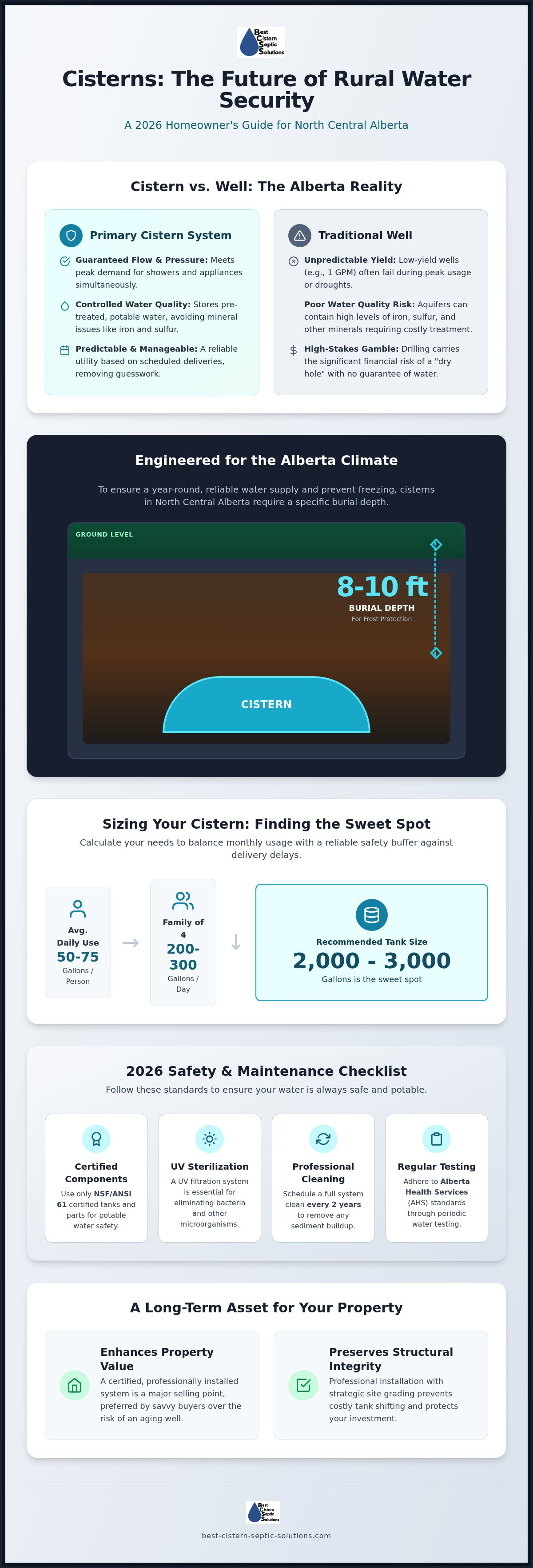
The primary advantage of a cistern is guaranteed flow. A well that produces only one gallon per minute (GPM) will often fail to meet the peak demands of a busy morning. In contrast, a 2,000-gallon cistern provides immediate, high-volume access for showers, appliances, and cleaning all at once. Beyond volume, many regional aquifers in Alberta contain high levels of iron, sulfur, or "sour" minerals that require expensive treatment. A cistern bypasses these issues entirely by storing pre-treated, potable water. This reliability significantly enhances property value, as savvy buyers prefer a certified, low-maintenance storage system over the "dry hole" risk of an aging well.
Potable Water Hauling in the Edmonton Region
In Leduc and Strathcona County, a robust network of bulk water haulers makes managing a primary water source straightforward. Most rural families find that a 2,000 to 3,000-gallon tank is the "sweet spot" for monthly usage. An average family uses approximately 50 to 75 gallons per person daily, meaning a single delivery can often sustain a household for several weeks. Establishing a relationship with a local hauler creates a predictable, manageable utility schedule. This methodical approach to water management provides the peace of mind that comes from knowing exactly how much water you have and exactly where it comes from.
Analyzing the Pros and Cons of Primary Cistern Systems
Deciding to use a cistern as a primary water source involves weighing immediate reliability against long-term logistics. Unlike drilling a well, which remains a high-stakes gamble in many parts of the Edmonton Capital Region, a cistern offers a predictable outcome. You aren't hoping for water; you are creating a vessel for it. This approach provides total control over your water chemistry. You won't have to battle the iron staining or sulfur odors common in regional aquifers. Instead, you receive pre-treated, potable water that is safe for your family from the moment it enters the tank.
However, this system does require a shift in mindset. You become the manager of your own utility. You must monitor water levels to prevent the cistern pump from running dry, which can lead to mechanical failure. You also rely on external delivery schedules. During heavy Alberta snowstorms or the spring thaw, road conditions can occasionally delay a hauler. A well-designed system accounts for these variables by sizing the tank to provide a generous buffer. This proactive management turns a potential vulnerability into a controlled, routine task.
Financial Comparison: Upfront vs. Long-term
The initial investment for a cistern is often lower than the cost of a deep well. Polyethylene tanks are a popular, cost-effective choice, while concrete tanks offer superior durability and weight to resist shifting in Alberta soils. While hauling fees are a recurring expense, they often balance out when you consider the hidden costs of a well. Well owners frequently spend thousands on reverse osmosis systems, water softeners, and chemical treatments to make their water palatable. With a cistern, your primary maintenance expense is a professional cleaning every two years to remove sediment. This simple step ensures the longevity of your system and the purity of your supply. If you are evaluating a property with an existing system, a professional diagnostic inspection can provide the clarity you need before finalizing a purchase.
The 'Water Security' Factor
In a climate prone to droughts and heatwaves, a cistern provides a defined safety net. A standard 2,000-gallon tank can sustain an average family for two to three weeks under normal conditions. In an emergency, careful conservation can extend that supply significantly. This level of transparency is the ultimate benefit. You know exactly how many gallons are available at any given moment. There is no guessing about the health of an invisible underground aquifer. This clarity replaces the fear of a dry tap with the quiet confidence of a managed resource.
Designing Your Cistern System for the Alberta Climate
In North Central Alberta, the environment demands more than just a standard storage tank. When you rely on a cistern as a primary water source, the engineering must account for extreme temperature swings and the unique characteristics of regional soil. A system designed for milder climates will often fail here. Success depends on precise burial depths, material durability, and a mechanical configuration that maintains household pressure without interruption. We focus on building a system that functions as a silent, invisible asset to your property, providing the same convenience as a municipal connection.
Tank sizing for a family home generally finds its "sweet spot" between 2,000 and 3,000 gallons. This volume provides a comfortable buffer for high-use periods while remaining manageable for standard hauling trucks. In terms of materials, concrete remains a preferred choice for many Parkland County residents. Its sheer weight provides a natural anchor against the expansive clay soils that can cause lighter plastic tanks to shift or "float" if they aren't properly secured. However, high-density polyethylene is a reliable alternative when installed with expert precision and the correct bedding materials to resist soil pressure.
Deep-Bury Installation Standards
Frost protection is the most critical factor in Alberta cistern design. While generic guides often suggest burying tanks just below a shallow frost line, our regional reality requires an 8-to-10-foot burial depth. This depth ensures the water remains at a stable temperature and prevents the structural damage caused by ground heaving. We also pay close attention to the access riser and hatch. Insulating these components is vital; without it, surface frost can creep down the riser and freeze the intake or the pump assembly. Proper venting is equally important. It allows for necessary air exchange while preventing contaminants or freezing air from compromising the water supply.
Pump and Pressure System Selection
The mechanical heart of your system is the cistern pump. For most residential applications, we recommend a submersible pump. These units sit inside the tank, making them virtually silent and highly efficient at pushing water into the home. Unlike jet pumps, they don't require priming and stay protected from the elements. To ensure system longevity, we always integrate a low-water cutoff switch. This simple device prevents the pump from running when the tank is empty, avoiding the high cost of a burned-out motor. Pairing the pump with a correctly sized pressure tank completes the system. This reduces how often the pump cycles on and off, which preserves the motor and provides a steady, city-like flow to every faucet in your house.
Maintenance and Safety: Ensuring Potable Quality
Maintaining a cistern as a primary water source isn't difficult, but it does require a methodical approach to ensure your family's safety. While older systems might have relied on simple settlement, the 2026 standard for rural Alberta focuses on multi-stage protection. This begins with a professional cleaning every two years. Over time, even the cleanest water deliveries leave behind trace amounts of sediment that can settle at the bottom of your tank. This buildup can create an environment where biofilm or bacteria might thrive. Removing this sediment preserves the integrity of your tank and the performance of your downstream filtration system.
Between professional cleanings, "shocking" the tank with chlorine is a vital skill for homeowners. This process involves adding a calculated amount of unscented bleach to disinfect the water supply after a new installation, a repair, or a positive bacteria test. It's a precise task that ensures the biological safety of your storage. However, chemical treatment is only one part of the equation. To maintain absolute peace of mind, your home needs a dedicated filtration array to handle the water as it moves from the tank to your tap. This proactive care transforms a simple tank into a sophisticated, reliable utility.
Water Filtration Arrays for Cisterns
A modern filtration setup acts as your final line of defense. It typically starts with a sediment filter to catch any fine particles or debris that might have entered during the hauling process. Next, a carbon filter improves the taste and removes any residual chlorine from the shocking process. The gold standard for safety is the UV sterilization light. This component neutralizes bacteria and viruses without changing the water's chemistry. Alberta Health Services recommends testing your water for bacteria twice a year and for chemicals and trace metals every three years. These regular checks, combined with a functioning UV light, ensure your supply remains pure and safe for consumption.
The Impact on Your Septic System
Many homeowners don't realize that their water supply and waste systems are deeply connected. Effective septic maintenance actually begins at the cistern. If your cistern has a slow leak or a malfunctioning float valve, it can cause a "phantom" water flow that never stops. This constant trickle can lead to a premature septic field failure by saturating the soil and preventing proper effluent treatment. Managing surge flows is equally important. Even if your tank is full, spreading out laundry and heavy water use prevents the septic system from being overwhelmed. Protecting both systems ensures the long-term health of your property. If you suspect your utility systems aren't working in harmony, you can schedule a professional septic and cistern inspection to identify potential issues before they become emergencies.
Professional Cistern Installation and Property Value
Professional installation is the foundation of a reliable utility system. While some property owners attempt a DIY approach, the heavy clay soils of North Central Alberta often lead to structural failure for the inexperienced. Without proper bedding and compaction, the extreme pressure of expanding clay can crack concrete or collapse polyethylene tanks. A professional cistern installation accounts for these soil dynamics, ensuring the tank stays level and intact for decades. We also prioritize site grading. By creating a gentle slope away from the access riser, we prevent surface runoff and contaminants from pooling near your water supply.
Choosing a cistern as a primary water source is a long-term commitment that directly impacts your home's resale value. In the rural real estate market, a documented maintenance history is a powerful asset. It proves to potential buyers that the system is safe, clean, and professionally managed. This transparency removes the "hidden risk" often associated with rural properties. A well-maintained system suggests a well-maintained home, providing peace of mind that translates into higher property appraisal values. It turns an essential utility into a verified selling point.
The Installation Timeline
The process begins with a thorough site assessment and the necessary permitting in Leduc, Sturgeon, or Parkland County. We handle the logistical details to ensure every setback and safety regulation is met. On day one, the excavation and bedding occur. This is a methodical process where we prepare the ground to support the weight of a full tank. Once the tank is placed and the connections are secured, we move to system commissioning. This involves a final disinfection and a test of the pressure system, ensuring your home has potable water immediately and without interruption.
Long-Term Property Preservation
Your cistern is more than just a tank; it's a pledge of self-reliance. By working with a neighborly expert who understands local environmental conditions, you avoid the stress of emergency water outages. We believe that a proactive approach to utility management is the best way to protect your household's safety and your property's integrity. When the job is done, the invisible benefit is the removal of future worries. You can live your rural lifestyle with the quiet confidence that your cistern as a primary water source is a robust, precision-engineered system that will serve your family for a lifetime.
Securing Your Family’s Future with Reliable Water Storage
Building a home in rural Alberta shouldn't mean compromising on the quality or consistency of your water supply. By choosing a cistern as a primary water source, you move beyond the unpredictability of regional aquifers and toward a system defined by precision and control. You now understand that a successful system relies on climate-specific engineering, from 10-foot burial depths to advanced UV sterilization. These aren't just technical details; they are the safeguards that ensure your home remains a sanctuary of health and safety through every winter storm and summer heatwave.
We take pride in performing these essential tasks with a high level of sophistication and care. Our team specializes in North Central Alberta’s unique soil conditions, providing a comprehensive approach that integrates your cistern and septic systems for long-term property integrity. This professional oversight removes the weight of future worries, allowing you to focus on the joys of rural living. Secure your rural water supply with a professional cistern installation from Best Cistern Septic Solutions. We are here to ensure your property remains a valuable, self-reliant asset for years to come.
Frequently Asked Questions
Is water from a cistern safe to drink as a primary source?
Yes, water stored in a cistern is safe for consumption when you source it from a licensed potable water hauler. Because the water is pre-treated and your system includes UV sterilization, it is often safer than untreated well water. You must simply maintain your filtration array and follow a regular testing schedule to ensure ongoing purity.
How much water does a family of four need in a cistern system?
A family of four typically requires a tank capacity between 2,000 and 3,000 gallons. This size accommodates the average daily use of 50 to 75 gallons per person while providing a safety buffer for delivery schedules. Using a cistern as a primary water source at this capacity ensures you won't run dry between scheduled hauls.
How do I prevent my cistern from freezing during an Alberta winter?
Preventing frost damage requires burying the tank at least 8 to 10 feet deep to stay below the Alberta frost line. You should also install an insulated riser and a secure, weather-stripped hatch to block cold air from entering the shaft. These steps maintain a stable internal temperature even during extreme cold snaps.
How often should a primary water cistern be cleaned and inspected?
You should schedule a professional cleaning and mechanical inspection every two years to remove sediment. In addition to this, Alberta Health Services recommends testing your water for bacteria twice a year. Regular inspections identify small issues with your pump or tank before they become expensive repairs.
What is the average lifespan of a concrete water cistern?
A high-quality concrete cistern can last between 30 and 50 years when installed correctly. Its durability makes it an excellent choice for the heavy clay soils found in Parkland and Leduc Counties. Regular maintenance and ensuring proper site drainage are the most effective ways to maximize this lifespan.
Can I collect rainwater in my primary potable cistern?
You should never mix harvested rainwater into a cistern as a primary water source intended for drinking. Rainwater can carry bird droppings, heavy metals, and environmental pollutants from your roof. Potable systems must remain closed to external runoff to meet health and safety standards for household use.
What happens to my cistern if the power goes out?
If the power fails, your cistern pump will stop, and you'll lose water pressure once the pressure tank empties. Most homeowners can still access a few gallons of water stored in the pressure tank, but a backup generator is necessary for long-term use. The water inside the cistern remains safe and stored; it just requires electricity to reach your taps.
Does a cistern affect my home insurance rates in rural Alberta?
Many insurance providers in rural Alberta view a professionally installed cistern as a lower risk than a low-yield well. A certified system with a documented maintenance history demonstrates that your home has a reliable, fire-safe water supply. Always provide your insurer with proof of professional installation to ensure your property is valued correctly.


