
Imagine walking out to your backyard only to find a persistent, soggy patch of grass where there should be dry ground. It is the moment every rural homeowner dreads, signaling that your aging infrastructure has finally reached its limit. Planning a septic system replacement in Alberta is a significant undertaking that impacts both your property value and your daily peace of mind. It is natural to feel overwhelmed by the prospect of unexpected expenses, yard disruption, and the technical maze of county permit offices.
We understand that you want a solution that works reliably without requiring your constant attention. This guide will help you navigate the complexities of the 2021 Alberta Private Sewage Systems Standard of Practice, which remains the governing regulation for all new installations as of 2026. You will learn how to choose a durable system designed to last 25 years or more while ensuring full compliance with provincial safety codes. We provide a clear preview of the soil testing requirements, setback rules, and professional installation steps necessary to turn a stressful utility failure into a long term asset for your property.
Key Takeaways
- Learn to identify the critical warning signs, such as recurring backups and surface pooling, that indicate your current infrastructure requires a full professional replacement.
- Understand how the 2021 Alberta Private Sewage Systems Standard of Practice governs every stage of a septic system replacement alberta, ensuring your new installation meets all mandatory safety codes.
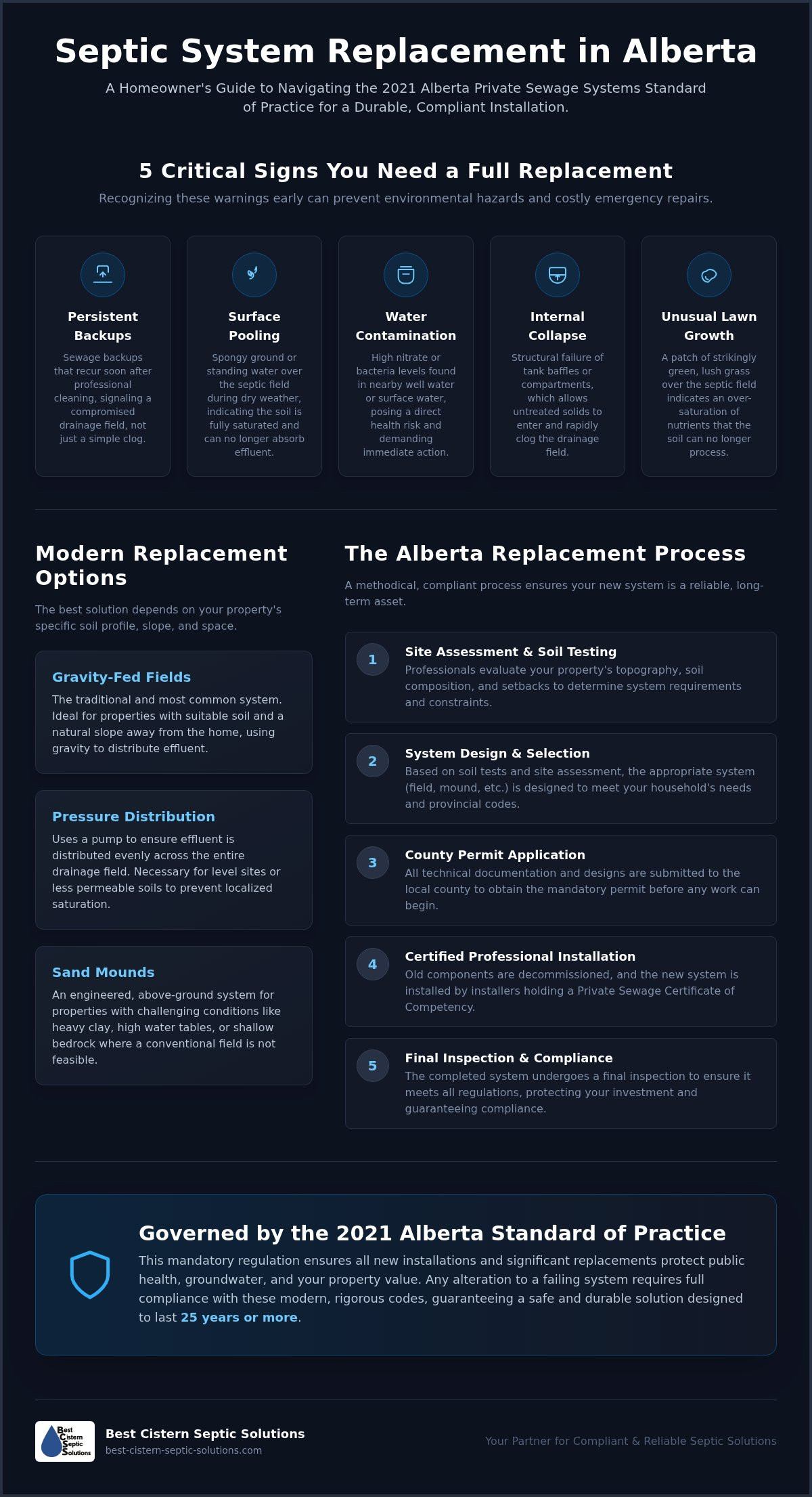
- Discover the differences between gravity-fed fields, pressure distribution, and sand mounds to determine which technical solution best suits your property's specific soil profile.
- Navigate the essential steps of site assessments and county permit applications to secure a system that functions as a reliable, long-term asset for your home.
- Gain peace of mind by learning how a methodical, compliant installation protects your household safety and prevents significant future yard disruption for decades.
Understanding Septic System Replacement in North Central Alberta
Septic replacement is more than a simple repair; it is a comprehensive overhaul of your property's essential utility infrastructure. In North Central Alberta, where soil conditions range from heavy clay to sandy loam, planning a septic system replacement alberta involves decommissioning old, failing components and installing modern tanks or drainage fields. Your property's value is deeply tied to its ability to manage waste safely and efficiently. A professionally installed system acts as a long term asset, removing the stress of future failures and ensuring your home remains a safe environment for decades.
Modern standards in 2026 are significantly more rigorous than the guidelines used for legacy systems in the Edmonton region thirty years ago. While older installations often relied on simpler designs, contemporary requirements focus on environmental preservation and system longevity. Best Cistern Septic Solutions bridges the gap between these old "grandfathered" systems and current safety codes, providing a methodical path to a fully compliant resolution.
When Replacement Becomes Unavoidable
Sometimes, maintenance is no longer enough to keep a system functional. Structural failure is a common driver for replacement, particularly when older concrete tanks begin to corrode or plastic tanks collapse under soil pressure. When a drainage field reaches total saturation, the surrounding soil loses its ability to process effluent effectively, leading to surface pooling or backups. These Onsite sewage facilities require precise engineering to handle modern domestic water use. If your household size has grown beyond the original system design capacity, the increased hydraulic load will eventually overwhelm the system, making a full upgrade the only reliable fix.
The Alberta Private Sewage Standard of Practice
The 2021 Alberta Private Sewage Systems Standard of Practice governs every septic system replacement alberta project. This regulation, which came into force on November 1, 2022, ensures that all new installations protect public health and the local groundwater. While existing systems are generally allowed to continue operating as they are, any significant replacement or alteration triggers the requirement to meet current codes. This means your new system might require larger setbacks or more advanced treatment components than your previous one.
Legal compliance is not just about following rules; it is about protecting your investment. Using certified installers who hold a Private Sewage Certificate of Competency is mandatory for obtaining the necessary county permits. We handle the difficult technical and regulatory work, from initial site assessments to final inspections, so you can feel confident that your new system is both legal and durable. This thorough approach ensures that once the work is finished, the invisible benefits of a high quality installation provide you with lasting peace of mind.
5 Signs You Need a Full Septic System Replacement
Identifying the moment maintenance is no longer sufficient requires a keen eye for specific environmental changes. While some issues are minor, others indicate a fundamental breakdown of your property's onsite utility. Recognising these signals early helps you avoid the high cost of emergency interventions and ensures the safety of your family. Planning for a septic system replacement alberta is a proactive step that transforms a potential liability into a long-term asset.
- Persistent backups: Sewage backups that recur shortly after a professional cleaning often point to a compromised drainage field rather than a simple clog.
- Surface pooling: Spongy, wet ground or pooling water over the septic field during dry weather is a clear indicator that the soil is fully saturated.
- Water contamination: Evidence of high nitrate or bacteria levels in nearby well water or surface water bodies demands immediate action.
- Internal collapse: The physical collapse of tank baffles or internal compartments allows untreated solids to enter your drainage field, causing rapid failure.
- Strikingly green grass over a field indicates the soil can no longer absorb effluent effectively.
The "Repair vs. Replace" Decision Framework
The logic of replacement often becomes clear when a system crosses the 20 to 25 year threshold. Most systems have a finite functional lifespan; once you reach this age, mechanical parts and soil absorption rates naturally decline. When evaluating the cost to replace a septic system against the mounting expense of repeated short-term repairs, replacement is frequently the more fiscally responsible choice. In Alberta's sub-zero winters, a failing system is also significantly more prone to freezing, which can lead to a total loss of household utility during the coldest months. A professional inspection remains the only definitive way to confirm if your system can be salvaged or if a full upgrade is necessary.
Environmental Risks of Delaying Replacement
Protecting your household safety is a proactive task that extends to the land surrounding your home. In Parkland and Leduc Counties, the risk of groundwater contamination is a significant concern for rural residents who rely on well water. Delaying a necessary septic system replacement alberta can lead to untreated wastewater leaching into local ecosystems, impacting both your property and the broader community. Homeowners are responsible for ensuring their installations align with the Alberta Private Sewage Systems Standard of Practice. Following these guidelines prevents legal liabilities and ensures your system operates with the high level of sophistication required for modern environmental preservation.
If you are noticing these warning signs on your property, scheduling a comprehensive septic system inspection is the first step toward a permanent resolution.
Comparing Replacement Options: Fields, Mounds, and Plants
Selecting the right technology for your septic system replacement alberta depends heavily on your property's topography and soil profile. While gravity-fed fields are the traditional choice due to their simplicity and lower mechanical needs, they require highly permeable soil to function. In contrast, pressure-distribution systems use a pump to ensure effluent is spread evenly across the entire field, which prevents localized saturation and extends the life of the installation. This methodical approach to distribution is often the key to achieving a system lifespan that exceeds 25 years.
Why Alberta Soil Dictates Your System Choice
The infamous "Edmonton Clay" presents a unique challenge for rural homeowners in Parkland and Leduc Counties. This heavy, dense soil has low percolation rates, meaning it absorbs water very slowly. A professional soil texture analysis is a mandatory step in the design process; it determines whether a standard field will suffice or if you require a sand mound. Mounds are elevated structures that use imported sand to treat effluent before it reaches the restrictive clay layer below. This approach is often the most reliable way to ensure a system remains a long-term asset in areas with poor natural drainage.
For properties with limited space or those near sensitive water bodies, advanced treatment units (ATUs) or "package plants" offer a high level of sophistication. These systems treat wastewater to a much higher standard before discharge, often allowing for a smaller field footprint. Understanding how to care for your septic system starts with choosing the right components for your land's specific limitations. We focus on providing a fix that respects the local environment while ensuring your household remains safe and compliant.
The Role of Septic Tanks in Replacement
A modern septic system replacement alberta also requires updating the tank to meet current dual-compartment codes. These compartments allow for better solids separation, which is vital for protecting your new drainage field from premature clogging. You will need to choose between concrete tanks, known for their weight and stability, or fiberglass tanks, which offer excellent resistance to chemical corrosion and are easier to transport to remote sites.
When planning a septic tank installation, we assess which material provides the best long-term security for your specific property. This thorough selection process ensures your utility remains a silent, reliable asset for your household. By addressing the tank and the field as a single, integrated unit, you remove future worries and secure the integrity of your property's essential services.
The Alberta Replacement Process: Permits and Soil Tests
Undertaking a septic system replacement alberta is a methodical journey that moves from technical assessment to physical installation. While the regulatory landscape is detailed, following a sequential path ensures your new system is a durable asset rather than a source of stress. The process is designed to protect your property and the surrounding environment, ensuring every component functions as intended for decades.
- Step 1: Site Assessment and Soil Profile. A certified professional must conduct a mandatory evaluation of your land. This includes digging test pits to determine soil texture and identifying the depth to the water table or restrictive layers.
- Step 2: System Design. Using the soil data, we design a system that meets the 2021 Alberta Private Sewage Systems Standard of Practice. This design specifies tank sizes, field dimensions, and treatment levels.
- Step 3: Permit Acquisition. We secure the necessary private sewage permits from Parkland, Leduc, or Sturgeon County. These permits are mandatory under the Safety Codes Act.
- Step 4: Installation. Certified professionals manage the physical excavation and placement of tanks and drainage components. This stage requires precision to maintain proper slopes and soil integrity.
- Step 5: Final Inspection. Before backfilling, a safety codes officer inspects the installation to verify it matches the approved design. Once cleared, we restore the site to preserve your yard's aesthetics.
Navigating Local County Requirements
Each municipality in North Central Alberta has specific nuances regarding permit applications. For example, Parkland County may have different administrative timelines than Strathcona County. Setback distances are strictly enforced; septic tanks must remain at least 3 metres from buildings, while drainage fields require a 5 metre buffer. Following your septic system replacement alberta, you will receive completion documentation. Keep these records safe; they are vital for real estate transactions to prove your property is fully compliant with modern provincial codes.
What to Expect During Installation
A typical rural residential replacement usually takes between three to seven days, depending on weather and system complexity. During the period when the system is offline, your household will need to minimize water use to prevent backups into the house. We work diligently to minimize disruption to your daily routine. After the final backfill, the soil will naturally settle over the next several months. We provide clear guidance on how to manage this transition and when it's safe to begin final landscaping or seeding.
If you're ready to begin the permitting process, we can handle the technical filings for your septic field installation to ensure a smooth, compliant project.
Why Choose Best Cistern Septic Solutions for Your Replacement
When you face a failing utility, you need more than just an excavator; you need a partner who understands the unique environmental stressors of our region. Best Cistern Septic Solutions specializes in septic system replacement alberta, bringing a high level of sophistication to every project. We don't just swap parts. We build systems that protect your property's value for the next quarter century. Our team takes pride in performing difficult tasks with a level of care that ensures your household remains safe and your yard remains functional.
Our team brings deep expertise in understanding septic systems in Parkland County and the surrounding areas. We have spent years working with the specific clay profiles and frost depths unique to North Central Alberta. This local knowledge allows us to design resilient systems that handle our province's extreme temperature swings without compromising integrity. We manage the entire process from the initial diagnostic inspection to the final backfill, including navigating the technicalities of the Alberta Private Sewage Standard of Practice and securing all necessary county permits.
Our Reassuring Approach to Utility Management
Our approach to utility management is rooted in the belief that your septic system is a vital long term asset. We treat your property with the same care we would our own, ensuring that every excavation is precise and every component is installed for maximum durability. Transparency is a core promise of our service journey. You will receive clear, declarative updates at every stage, removing the mystery and stress often associated with major property repairs. Our goal is to provide a professional fix that removes future worries, allowing you to focus on your home rather than your utilities.
Contact Us for a Professional Evaluation
If your system is showing signs of failure, the first step is a thorough diagnostic evaluation. We provide expert septic system replacement alberta services across a broad area, including Spruce Grove, Stony Plain, Parkland County, Leduc County, and Sherwood Park. Booking an inspection allows us to identify the underlying cause of your system's distress and offer a definitive fix. We guide you through the site assessment and provide a transparent quote for a system that secures your property's future. Reach out to our team today to begin the process of restoring your property's essential services with a solution built to last.
Securing Your Property's Essential Infrastructure
Transitioning from a failing utility to a modern, compliant system is a significant step toward long-term property security. You now understand how to spot critical failure signs and the importance of matching your technology to the specific soil conditions on your land. By following the 2021 Alberta Private Sewage Systems Standard of Practice, you ensure your investment remains legal and functional for decades.
A successful septic system replacement alberta depends on technical precision and thorough site assessments. As Certified Alberta Private Sewage Installers serving Parkland, Leduc, and Sturgeon Counties, we specialize in expert site assessments that take the guesswork out of your project. We handle the difficult regulatory work so you can enjoy the invisible benefits of a reliable system. Your home deserves a utility that works silently in the background, providing you with lasting peace of mind.
Get a Professional Septic Replacement Quote
Frequently Asked Questions
How much does it cost to replace a septic system in Alberta in 2026?
Industry estimates for a standard system replacement in 2026 typically range from $12,000 to $28,000. If your property requires a sand mound due to restrictive soil conditions, costs generally sit between $20,000 and $28,000. These figures include excavation, materials, and specialized labour. Site-specific factors like property accessibility and soil reports can influence the final investment required for a durable solution.
Do I need a permit to replace my septic field in Parkland County?
Yes, a private sewage permit is mandatory for any septic system replacement alberta project within Parkland County. These permits fall under the provincial Safety Codes Act and ensure your new installation meets the 2021 Standard of Practice. We manage the application process and coordinate with local safety codes officers to ensure your system is fully compliant and legally documented.
Can I replace my own septic tank, or do I need a certified installer?
Alberta provincial regulations require that all septic installations and replacements be performed by a contractor holding a Private Sewage Certificate of Competency. This certification ensures the installer understands the complex hydraulic and environmental requirements of the law. Attempting a DIY replacement can lead to legal liabilities, failed inspections, and potential safety risks for your household and the local groundwater.
How long does a full septic system replacement take from start to finish?
A typical rural residential replacement usually takes between three to seven days for the physical installation. This timeline begins once the site assessment is complete and permits are issued. While the excavation and tank placement happen quickly, we allow time for methodical testing and county inspections before final backfilling. We work to ensure your household utility is restored as efficiently as possible.
What is the difference between a septic field and a treatment mound?
A septic field is installed entirely below the natural ground surface and relies on permeable soil for effluent treatment. A treatment mound is an elevated structure built with specialized sand. We recommend mounds for properties with heavy "Edmonton clay" or high water tables where the natural soil cannot process wastewater effectively. Both systems provide reliable treatment when designed correctly for your land.
Will a new septic system increase my property value in rural Alberta?
A modern, compliant septic system replacement alberta acts as a significant long-term asset for your property. Prospective buyers in rural areas prioritize the integrity of essential utilities. Having a documented, professionally installed system that meets the 2021 Standard of Practice removes future worries for buyers and protects your home's marketability. It transforms a hidden utility into a verified point of security.
What happens if my replacement system doesn’t pass the final county inspection?
Final inspections are a standard part of the safety codes process to verify the installation matches the approved design. If an inspector identifies a deficiency, the installer must rectify the specific component before the project is signed off. Our methodical approach and adherence to provincial standards ensure that systems are built correctly the first time, preventing delays and ensuring your household safety.
How can I extend the life of my new replacement system?
Regular maintenance and mindful water use are the most effective ways to protect your new investment. Schedule professional inspections every three years to monitor tank levels and component health. Avoid flushing non-biodegradable items or harsh chemicals that can disrupt the natural bacterial balance. By treating your system with care, you can expect it to function reliably for 25 years or more.


