

The most expensive component of your Stony Plain property isn't always the one you can see; often, it's the one buried three feet underground. While many residents focus on interior finishes, the long-term health of your home depends on a professional septic field design in Stony Plain that can handle the region's notoriously dense clay. We understand that facing the 2023 Alberta Private Sewage Systems Standard of Practice feels overwhelming. You deserve a system that functions silently for 25 years, not a source of constant anxiety regarding permit delays or environmental compliance.
We agree that the technicalities of soil percolation and effluent distribution shouldn't be your burden to carry. Our goal is to provide the peace of mind that comes from a system built with integrity. This guide provides the clarity you need to ensure your investment is protected and your household remains safe. We'll walk through the specific soil testing required by Parkland County, compare the most reliable system types for our northern climate, and explain exactly how to secure a permit without the typical 30 day wait times caused by incomplete applications.
Key Takeaways
- Learn how to navigate the 2026 Alberta Private Sewage Systems Standard of Practice to ensure your property remains fully compliant and safe.
- Discover how to select the right system for Parkland County’s unique terrain by understanding the most effective septic field design Stony Plain options for rural residential lots.
- Understand why a comprehensive soil profile evaluation is superior to a basic "perc test" for ensuring the long-term integrity and drainage of your wastewater system.
- Follow a clear, step-by-step roadmap for site mapping and permitting that simplifies complex local requirements into a manageable, stress-free process.
- Identify how professional engineering protects your family’s health and safeguards your property investment for decades to come.
Navigating Stony Plain’s Septic Design Requirements
A professional septic field design Stony Plain homeowners can rely on starts with a deep understanding of the Alberta Private Sewage Systems Standard of Practice. This provincial framework isn't just a suggestion. It's a mandatory set of engineering rules that ensures your wastewater is treated safely before it returns to the water table. In Stony Plain, the local geography often features heavy clay or varied soil pockets that make a generic blueprint impossible to use. Every property requires a custom approach to ensure the soil can actually absorb and treat the effluent produced by your household.
Your Certified Private Sewage Systems Installer plays a vital role during the design phase. They perform a site evaluation, including a soil profile and percolation test, to determine the exact capabilities of your land. This technical data informs the size, depth, and type of system required. A well-engineered design is your primary defense against premature system failure. It protects your family's health and prevents environmental contamination by ensuring the biological processes within the soil happen exactly as intended. It's a proactive investment in your home's long-term infrastructure.
The Legal Framework: Alberta Standards and Parkland County Bylaws
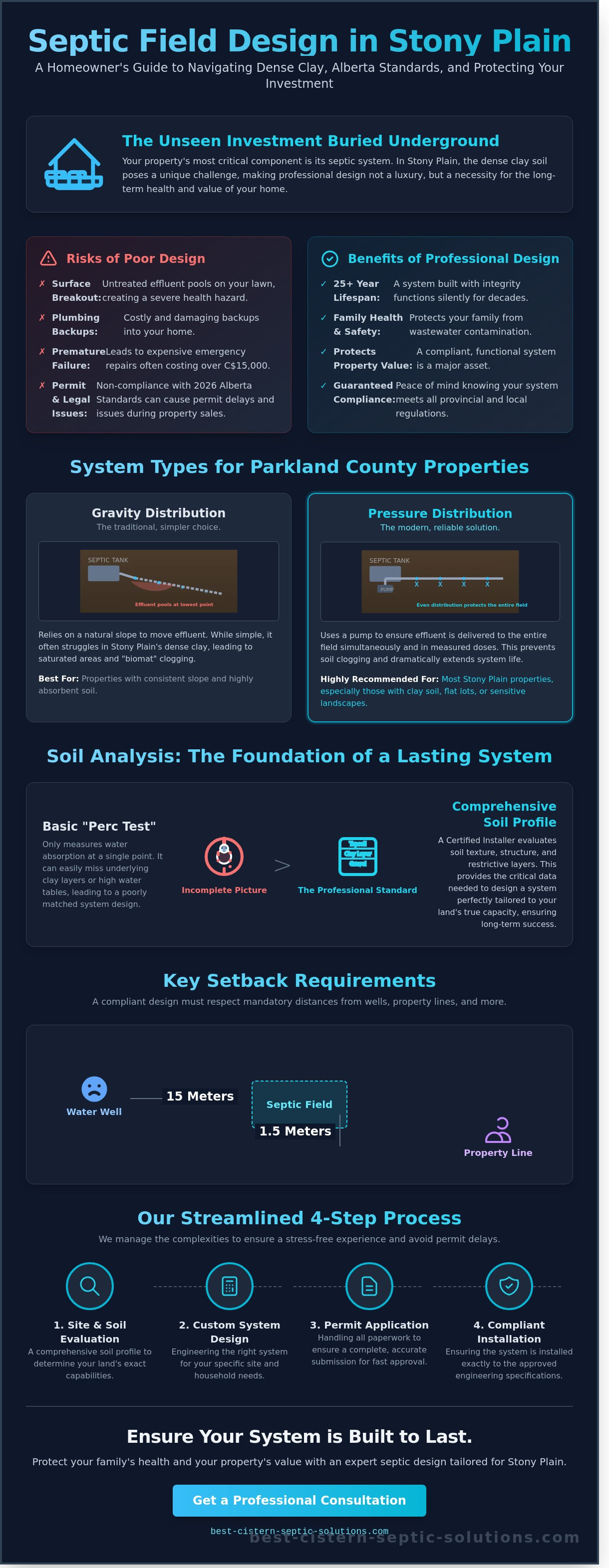
The 2026 Alberta Private Sewage Standards are introducing stricter requirements for new builds and system replacements. These updates focus on higher treatment levels to protect our regional groundwater. In Stony Plain and surrounding Parkland County, you must adhere to specific setback requirements. For instance, a septic field must be at least 15 meters away from a water well and 1.5 meters from property lines. If you're replacing an older system, you'll find that "grandfathered" layouts rarely meet modern criteria. We ensure your new design complies with current 2024 regulations to avoid permit delays or legal complications during future property sales.
The Consequences of Poor Design
When a system isn't tailored to the specific site, the risks are high. Improper sizing or poor soil assessment often leads to surface breakout, where untreated effluent pools on your lawn. This creates a significant health hazard and a foul odor that's difficult to ignore. Understanding how septic drain fields work helps clarify why design integrity is so important. If the field is too small or the soil is too compacted, the water has nowhere to go. This results in plumbing backups and expensive emergency repairs that can cost thousands of CAD. A robust design maintains your property value and provides the peace of mind that your home's waste management is silent, safe, and efficient.
Comparing Septic Field Types for Parkland County Properties
Choosing the right septic field design Stony Plain homeowners require depends heavily on soil composition and topography. North Central Alberta often presents heavy clay soils that resist drainage, making the selection process vital for long-term home health. While older properties often relied on simple layouts, modern installations must adhere to the 2015 Alberta Private Sewage Systems Standard of Practice to ensure environmental safety and system integrity. Transitioning from basic disposal to advanced treatment protects your property investment and the local groundwater.
Gravity vs. Pressure Distribution Fields
Gravity systems are the traditional choice for properties with a natural, consistent slope. They use the pull of the earth to move effluent from the tank to the drainage pipes. These systems are simple, but they often struggle in the thick clay found around Stony Plain. Because effluent trickles to the lowest point first, it can saturate specific areas, leading to "biomat" failure.
Pressure distribution systems solve this by using a pump to deliver effluent to the entire field simultaneously. This ensures every square centimetre of soil works equally. While the initial setup for pressure systems involves more mechanical components, they are often more cost-effective over a 20-year lifespan. By preventing localized soil clogging, a pressure system can delay a C$15,000 field replacement by a decade or more compared to a failing gravity setup. Professionals often recommend this septic field design Stony Plain wide to handle the region's unique soil challenges.
At-Grade and Raised Sand Mantle Systems
When your lot has beautiful mature trees or sensitive topsoil, an At-Grade system is a primary solution. These systems are installed directly on the natural forest floor or grass, covered by a layer of wood chips or mulch. This method avoids deep excavation, preserving the 100% natural soil structure that is essential for wastewater treatment. It's a low-impact choice that keeps your landscaping intact.
In areas with high water tables or very poor soil, a Raised Sand Mantle is the standard fix. This design involves building a mound of specialized sand above the natural grade to provide the necessary filtration.
- Visual Impact: Raised mantles create a visible hill in the yard, which can be integrated into your landscaping with specific grasses.
- Safety: These systems provide a critical buffer, ensuring effluent is treated before it ever reaches the water table.
- Maintenance: Both systems require annual inspections to ensure the distribution laterals remain clear of debris.
Every property in Parkland County has a unique footprint that dictates which mechanical solution will perform best. If you're planning a new build or managing an aging system, consulting with a local specialist can provide the clarity you need to make an informed decision for your home's infrastructure.
Soil Analysis: The Foundation of Every Stony Plain Septic Layout
Soil doesn't just support your home; it acts as a natural biological filter for your wastewater. For a successful septic field design Stony Plain homeowners can trust, we must first understand the ground's ability to absorb and treat effluent. Soil texture and structure are the primary drivers of system size. If your land contains 60 percent clay, the drainage area needs to be much larger than a site with sandy loam to prevent backups and surface pooling.
In the Stony Plain area, we frequently encounter heavy clay and silt deposits. These fine particles create a "tight" soil structure that slows down the infiltration of water. While a basic percolation test measures how fast water drops in a hole, it doesn't provide the full picture. We perform a comprehensive soil profile evaluation to look at the overall health and capacity of the land. This detailed approach ensures the system we design today still functions perfectly 25 years from now, protecting your property investment and the local environment.
The Soil Profile Test: What to Expect
Our team begins the process by digging test pits, typically 2.5 to 3 meters deep, to examine the soil horizons. We look for the limiting layer, which is the depth where the soil becomes too dense, rocky, or saturated to provide adequate treatment. Identifying these restrictive horizons is vital because they dictate the maximum depth of your drainage trenches. In our Alberta climate, winter testing requires specialized machinery to penetrate frost lines that can reach 1.5 meters. Hiring certified septic professionals in Alberta ensures that these inspections are accurate regardless of the season, maintaining the integrity of your home's infrastructure.
Interpreting Percolation and Loading Rates
Understanding how quickly your soil can safely absorb treated effluent prevents the system from becoming overwhelmed. We use the data from our soil samples to calculate the exact square footage required for your specific lot. The hydraulic loading rate is the volume of effluent applied per square foot. This number is the most critical factor in your septic field design Stony Plain project. When loading rates are calculated incorrectly, it leads to the "greener grass" syndrome, where the soil becomes oversaturated and forces untreated water to the surface. By using precise data, we provide a solution that safeguards your family's health and ensures your yard remains dry and sanitary.
The Step-by-Step Septic Design and Permit Process
A successful septic field design Stony Plain project relies on a methodical sequence of events that prioritizes long-term soil health and system integrity. We begin with an initial site consultation to identify property boundaries and establish critical setbacks from your home, water wells, and neighboring property lines. This phase ensures your system meets all Alberta Private Sewage Systems Standard of Practice requirements from the very start. We focus on finding the most efficient placement that protects your landscape while maximizing the longevity of the drainage area.
Next, our team conducts a mandatory soil profile and site topography mapping. This isn't a surface-level look; it involves excavating test pits to evaluate soil texture and structure at various depths. Understanding how the specific soil on your Stony Plain property absorbs water allows us to calculate the exact size of the drainage field. We also map the landscape's slope to prevent effluent from surfacing or contaminating groundwater, ensuring your family's safety and the environment's protection. Once we gather this data, we draft the technical site plan and system specifications, selecting the right components for your household's specific water usage patterns.
Drafting the Site Plan: Beyond the Tank
Your technical site plan serves as a blueprint for the entire installation. We don't just plan for today; we map out both the "primary" field and a designated "replacement" area to future-proof your property. This proactive approach ensures that if the original field ever reaches the end of its life cycle, a secondary location is already vetted and protected from development. Our designs also account for heavy equipment access and preserve your existing landscaping to minimize property disruption. For a deeper look at the physical setup, read about Septic Field Installation in North Central Alberta.
Securing Your Parkland County Septic Permit
Obtaining a permit from Parkland County or Alberta Safety Codes requires precise technical data. Many permit delays happen because of incomplete site plans or incorrect soil classifications. A professional design avoids these hurdles, ensuring a smoother approval process. In 2026, permit processing timelines typically range from 14 to 30 days, depending on seasonal demand. Once the installation is finished, a final inspection leads to the issuance of a Certificate of Compliance. This document is vital for future real estate transactions, as it proves your system meets current safety standards and adds measurable value to your home investment.
Professional Septic Solutions for Stony Plain Homeowners
Choosing the right septic field design Stony Plain requires more than just digging a hole. It demands a technical balance between the Alberta Private Sewage Systems Standard of Practice and the specific layout of your property. Best Cistern Septic Solutions views every project as a long-term investment in your home's health. We focus on "Solutions" because a failing system isn't just a mechanical issue; it's a threat to your family's safety and your property value. Our engineering approach ensures that your wastewater treatment is invisible, odorless, and efficient.
We understand that Stony Plain residents value both technical expertise and a neighborly touch. Our designs account for the unique topography of the region, ensuring that effluent is treated properly before it ever reaches the water table. This proactive planning prevents the stress of future backups or environmental contamination. We take pride in performing these difficult tasks with a high level of sophistication and care, giving you total peace of mind.
The Best Cistern Septic Solutions Advantage
Our process begins with a detailed diagnostic approach. We don't rely on guesswork. Whether you need a brand-new installation or specialized septic system repairs, we provide grounded advice based on soil morphology and site-specific data. Stony Plain features diverse soil types, ranging from heavy clay to sandy pockets. Local expertise ensures your system won't fail when the spring thaw arrives or during heavy rainfall events.
Transparency and professional integrity are the pillars of our service. We explain the "why" behind every design choice, from tank sizing to lateral line placement. Our goal is to support the overall health of your home with integrated care. This includes:
- Soil Analysis: Evaluating the percolation rate to determine the best septic field design Stony Plain can offer for your specific lot.
- System Integration: Ensuring your cistern and septic components work in harmony to maintain water pressure and sanitary waste removal.
- Longevity Focus: Using high-quality baffles and filters to protect the integrity of your drain field for decades.
Next Steps: Booking Your Site Evaluation
Preparing for your initial consultation is a straightforward process. To help us provide the most accurate assessment, please have your property plot plan and any existing records of previous soil tests or system layouts ready. This information allows us to hit the ground running and identify potential challenges early in the design phase.
Permit applications and regulatory coordination are part of the heavy lifting we handle for you. We manage the paperwork required by Parkland County and provincial authorities to ensure every component meets safety codes. This coordination prevents costly delays and ensures your system is fully compliant from day one. Your home deserves a wastewater solution that operates silently and reliably. We are ready to transition your project from a technical design to a long-term protection plan for your property.
Request a Professional Septic Design Consultation in Stony Plain today to secure your property's future and protect your family's health.
Secure Your Property’s Health with a Reliable Septic Layout
A successful project starts with a precise understanding of your land's unique characteristics. In Parkland County, the 2026 standards require a rigorous soil analysis to ensure your system handles effluent safely while protecting your property's long term integrity. By securing a professional septic field design Stony Plain residents can rely on, you transition from the stress of permit applications to the confidence of a sound infrastructure investment. Our team operates as Certified Alberta Private Sewage Systems Installers with decades of experience navigating the specific clay and silt conditions found throughout North Central Alberta. We manage every technical detail of the Parkland County regulatory process so you don't have to worry about the complexities of wastewater management. Choosing a scientifically backed layout today prevents environmental risks and safeguards your family's household health for the future. You deserve the peace of mind that comes from a system built to last. Get a professional septic field design for your Stony Plain property and start your project with expert guidance.
Frequently Asked Questions
Do I really need a professional design for a simple septic field replacement in Stony Plain?
Yes, every septic field replacement in Alberta requires a professional design to comply with the 2015 Private Sewage Systems Standard of Practice. Even a simple replacement must account for current soil conditions and modern setback requirements. Professional septic field design Stony Plain ensures your new system protects your property value and remains sanitary for decades. This process prevents premature failure and ensures your installation meets all Parkland County safety codes.
How much does a septic permit cost in Parkland County for 2026?
While 2026 specific rates aren't published yet, Parkland County's 2024 fee schedule listed private sewage permits starting at C$200 for basic installations. Complex systems often incur higher fees based on the total project valuation. You should budget for potential inflationary increases of 3% to 5% annually. Obtaining this permit is a mandatory step that validates your system's integrity and ensures it meets provincial health standards.
Can I build a deck or driveway over my septic field if it is designed properly?
You cannot build permanent structures like decks or driveways over any part of your septic field. Covering the area prevents essential oxygen from reaching the soil; this stops the natural treatment of effluent. Heavy vehicles on a driveway will also crush the distribution pipes and compact the soil. To protect your investment, keep the area clear of everything except grass to ensure long term performance and easy maintenance access.
What is the minimum distance a septic field must be from my water well in Alberta?
The Alberta Private Sewage Systems Standard of Practice requires a minimum distance of 15 metres between a septic field and a water well. This 15 metre setback protects your potable water from potential contamination and ensures your family's safety. If your property has a high water table or specific slope conditions, a professional designer might recommend increasing this distance to further safeguard your well's water quality.
How long does the septic design and permit process typically take in Stony Plain?
The entire process from initial site evaluation to receiving your permit typically takes between 14 and 28 days. This timeline includes the mandatory soil profile analysis, the technical design phase, and the county's review period. Parkland County officials generally process complete applications within 5 to 10 business days. Planning your septic field design Stony Plain at least one month before your intended start date ensures a smooth, stress free construction schedule.
What happens if my soil test fails? Are there alternative septic designs available?
Soil doesn't actually fail; it simply dictates which type of system you need. If your soil has poor percolation rates or high clay content, a traditional gravity field won't work. In these cases, we design alternative solutions like a treatment mound or an At-Grade system. These advanced designs use specific sand layers to treat effluent safely even when the native soil isn't ideal for standard absorption.
Does a pressure distribution system require more maintenance than a gravity system?
Pressure distribution systems require slightly more regular attention because they include a mechanical pump and electrical components. You'll need to check the pump chamber and clean the internal filters at least once every 12 months. While a gravity system is simpler, pressure distribution provides more even effluent loading. This often extends the life of your field by 10 to 15 years, making the proactive maintenance a small trade off for better system longevity.
Is a site evaluation required if I am just repairing a small part of my septic field?
Yes, a site evaluation is required for repairs that involve moving or replacing soil components. Alberta regulations treat significant repairs with the same scrutiny as new installations to ensure the environmental impact is managed. A professional evaluation identifies why the original section failed, which prevents you from wasting money on a temporary fix. This thorough approach ensures your repaired system maintains its integrity and continues to protect your household's health.


