Imagine waking up during the first warm week of April in North Central Alberta only to find your yard saturated and your drains gurgling. For many rural homeowners, the spring thaw is a season of anxiety rather than renewal because of a high groundwater level. Understanding the nuances of high water table septic system design is the difference between a yard that stays dry and a system that fails when you need it most.
You likely want a utility system that works silently in the background, regardless of how much rain falls or how quickly the snow melts. It's natural to feel concerned about your septic tank shifting or even popping out of the ground due to intense hydrostatic pressure during wet seasons. We understand that interpreting the Alberta Private Sewage Systems Standard of Practice 2021 can feel overwhelming when you simply want a safe, functional home.
This guide provides the technical clarity you need to design a reliable, compliant septic system for properties with challenging groundwater conditions. We'll walk through the specific engineering choices, from soil profile investigations to advanced treatment options, that keep your system grounded and functional. This methodical approach ensures you secure county approval and protect your property as a long-term asset for years to come.
Key Takeaways
- Identify how spring thaws and seasonal groundwater shifts in North Central Alberta impact the stability of your wastewater infrastructure.
- Navigate the Alberta Private Sewage Systems Standard of Practice 2021 to ensure your system meets the mandatory 1.5-metre vertical separation requirement.
- Evaluate the technical advantages of mounds versus Advanced Treatment Units (ATUs) as part of a robust high water table septic system design.
- Protect your investment by understanding the physics of tank buoyancy and how to mitigate hydrostatic pressure during wet conditions.
- Learn how professional site evaluations and precise installations transform a high-risk utility into a durable, long-term property asset.
Understanding High Water Tables in North Central Alberta
A high water table refers to the upper surface of the zone of saturation, where every gap between soil particles is filled with water. In the context of rural property development, this means groundwater sits uncomfortably close to the surface. For homeowners in Parkland County and across North Central Alberta, this isn't just a geological curiosity. It's a technical challenge that dictates how you manage household wastewater. When the groundwater level is high, the soil loses its ability to absorb and treat effluent through traditional methods.
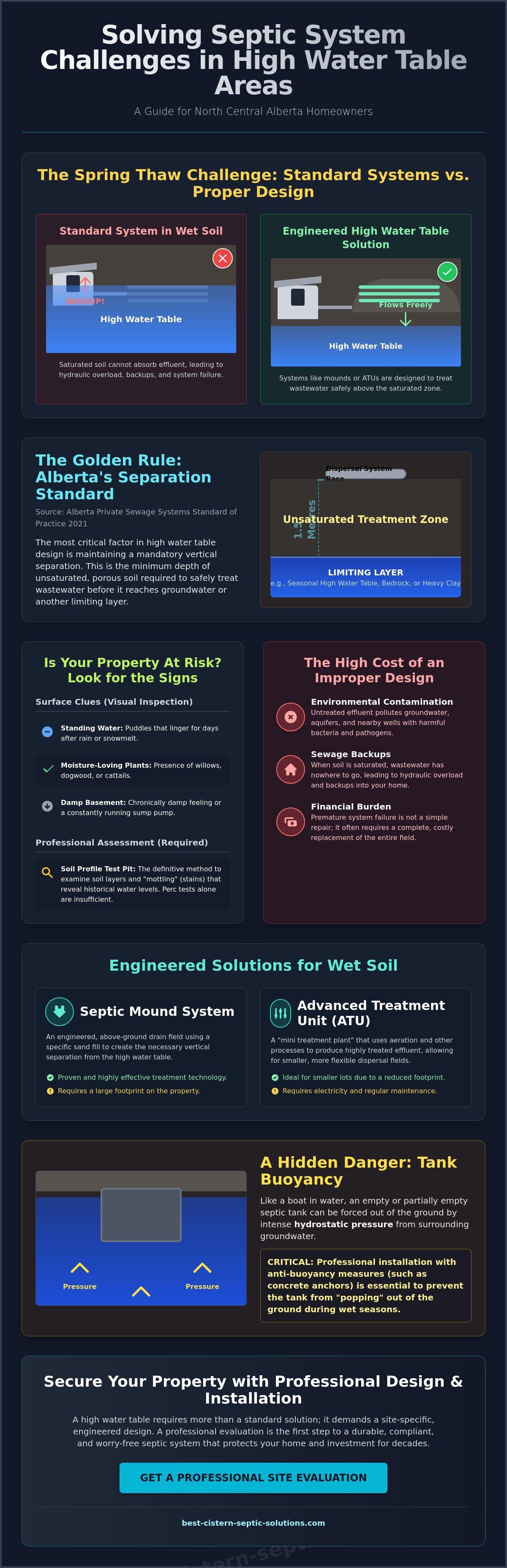
Seasonal shifts play a massive role in our local environment. During the spring thaw, the water table often surges as massive volumes of snowmelt saturate the upper soil layers. This creates a seasonal high water table that may be much higher than what you observe in the dry heat of August. A permanent high water table remains consistently near the surface year-round, regardless of the weather. Both scenarios make standard gravity-fed systems physically impossible. These traditional systems require a deep, dry treatment zone beneath the septic drain field to filter out pathogens. If that zone is already full of water, the sewage cannot move downward, leading to a total system standstill. This is why a specialized high water table septic system design is a necessity for property safety.
Identifying High Groundwater on Your Property
You don't always need a drill to spot potential issues. Look for visual cues like standing water that lingers days after a rain or the presence of moisture-loving vegetation such as willows, dogwood, or cattails. If your basement feels chronically damp or your sump pump runs constantly, your water table is likely high. However, surface observations are only the start. We rely on a professional soil profile, which involves digging a deep test pit to examine soil color and "mottling." These stains in the soil reveal where water has sat historically, even if the ground is dry today. Relying on "perc tests" alone is insufficient. A percolation test only tells us how fast water moves; it doesn't tell us where the groundwater sits, which is the most critical data point for high water table septic system design.
The Risks of Improper Design in Wet Soil
Cutting corners in wet conditions creates a ripple effect of property damage. When a system is submerged in groundwater, it can't provide aerobic treatment. This leads to the environmental contamination of local aquifers and nearby wells, potentially spreading bacteria into the water supply. Beyond the environmental impact, you face the immediate threat of hydraulic overload. When the soil is saturated, there's no room for your daily wastewater, which often results in sewage backups into your tubs and sinks. Without a design that accounts for these pressures, you risk the premature failure of your septic field installation. A failed field is not just a mess; it's a significant financial burden that could have been avoided with a methodical, site-specific approach.
Alberta Regulations for Vertical Separation Distances
Every septic installation in our province must adhere to the Alberta Private Sewage Systems Standard of Practice 2021. This document isn't just a set of suggestions; it's a strict regulatory framework designed to protect our shared water resources. When we talk about high water table septic system design, the most critical factor is vertical separation. This is the depth of unsaturated, porous soil available to treat wastewater before it reaches a limiting layer, such as bedrock, tight clay, or the water table itself. Without this buffer, pathogens and nutrients enter the groundwater untreated, which is one of the primary reasons for septic system failure and environmental contamination.
In regions like Leduc and Sturgeon County, local inspectors often apply even closer scrutiny to permit applications for wet lots. These areas frequently deal with heavy clay soils that act as a secondary limiting layer. When you have both a high water table and poorly draining soil, your system's footprint must expand significantly to compensate. We've seen many homeowners surprised to find that a standard trench system is prohibited on their property because the groundwater is simply too high to meet provincial safety margins. If you are planning a new build or a renovation, a professional septic system inspection can determine exactly where your water table sits before you commit to a specific design.
The 1.5-Metre Rule Explained
Alberta law requires a minimum of 1.5 metres (approximately 5 feet) of vertical separation between the bottom of your disposal field and the high-water mark of the groundwater. This distance is calculated from the point where the effluent leaves the distribution pipe, not from the ground surface. If your soil profile investigation reveals groundwater at only 1 metre deep, you cannot install a traditional buried system. In these cases, we must look at "above-grade" solutions that use imported sand and soil to artificially create that mandatory 1.5-metre treatment zone. It's a precise calculation that ensures the safety of your household and the surrounding environment.
Regulatory Compliance and Permitting
Securing a permit for a high-water site requires a certified designer who understands how to document and mitigate these risks. While some homeowners hope for a "variance" or exception from the county, these are rarely granted for vertical separation because the health risks are too high. Instead, the focus shifts to advanced engineering. For a deeper look at the local requirements, you might find our guide on understanding septic systems helpful for navigating the specific expectations of North Central Alberta counties. Professional design ensures your application moves through the approval process without costly delays, providing you with a system that is both legal and durable.
Advanced Design Solutions: Mounds vs. ATUs
When the soil on your property cannot provide the necessary 1.5-metre vertical separation naturally, we must engineer a solution that works around the environment. High water table septic system design typically moves in one of two directions: building upward with a raised mound or enhancing the treatment process with an Advanced Treatment Unit (ATU). Both methods are proven, reliable ways to ensure your household wastewater is safely processed before it ever touches the groundwater. The right choice for your acreage depends on your lot size, your long-term maintenance preferences, and the specific topography of your yard.
Selecting between these systems is a methodical process. While a mound uses volume and imported soil to treat effluent, an ATU uses mechanical components to "pre-treat" the water to a much higher standard. This means the water leaving an ATU is significantly cleaner than the water leaving a standard septic tank. Because the water is already partially purified, the final disposal field can often be smaller and shallower, which is a vital advantage for properties with limited space or particularly sensitive environments.
Raised Mound Systems: The Alberta Standard
A raised mound is essentially a precision-engineered sand filter built on top of your existing grade. By importing specific types of sand and soil, we create the mandatory 1.5-metre treatment zone above the natural water table. These systems are incredibly durable and remain the go-to solution for many rural Alberta properties because they rely on well-understood biological processes. The primary trade-off is the visual "hump" in the backyard, which can be landscaped but remains a permanent feature of the property. Mounds require a pressure-distribution system, meaning an effluent pump is used to spread water evenly across the sand, ensuring no single area becomes saturated.
Advanced Treatment Units (ATUs) and Biofilters
For homeowners who prefer to maintain a flat yard or have a smaller lot, ATUs and biofilters offer a sophisticated alternative. These units act like a miniature municipal wastewater plant on your property. Technologies like MicroFAST or Advantex use oxygen and specialized media to break down waste more efficiently than a standard tank. This produces "Level B" effluent, which is clear and odorless. Because this water is so much cleaner, it requires less soil for final treatment. This makes ATUs ideal for shoreline properties or small acreages where a massive sand mound would be impractical. While these systems involve more mechanical parts, they provide a compact, high-performance solution for challenging sites.
Preventing Tank Buoyancy and Hydrostatic Pressure
In North Central Alberta, the physical weight of your septic tank is its best defense against the earth itself. When soil becomes saturated, it exerts immense hydrostatic pressure against the walls and base of any buried structure. If your plan does not account for these physical forces, the results can be catastrophic for your property's infrastructure. High water table septic system design is not just about how the water leaves the tank; it's about making sure the vessel stays securely in place for decades. We treat every installation as a precision engineering project to ensure your utility system remains a silent, reliable asset.
Material selection is your first line of defense. While fiberglass and polyethylene tanks are excellent for many applications, they are lightweight by nature. In a high-water zone, these tanks require significantly more anchoring to prevent shifting. Concrete tanks provide a massive amount of natural ballast, making them a preferred choice for many sites in Parkland County. Choosing the right material depends on your specific soil profile and the peak groundwater levels we expect during the spring thaw.
Why Septic Tanks 'Float'
A septic tank is a hollow vessel. According to the principles of buoyancy, any object submerged in a fluid is buoyed up by a force equal to the weight of the fluid it displaces. When the groundwater rises, an empty or partially empty tank effectively becomes a boat. This creates a high-risk scenario during the wet spring months. If a tank is pumped out for maintenance when the surrounding soil is fully saturated, the upward lift can exceed the weight of the tank and the soil covering it. As soil becomes fully saturated with water, the resulting hydrostatic force creates significant upward pressure on any empty vessel buried within it. This force is strong enough to snap inlet pipes and heave a multi-ton tank out of the ground.
Anchoring and Ballast Solutions
To prevent shifting, we use specific engineering techniques during the septic tank installation process. We often utilize "deadmen" anchors, which are heavy concrete blocks buried alongside the tank and connected by heavy-duty, non-corrosive straps. This creates a physical lock that holds the vessel down against upward pressure. We also employ an over-excavation technique, where we provide a thick bedding of clean gravel to improve drainage around the tank base. This helps dissipate localized hydrostatic pressure before it can build up. These methodical steps ensure your system remains stable and functional, providing the long-term peace of mind you expect from a professional installation.
Professional Installation and Long-Term Peace of Mind
A successful high water table septic system design requires more than just following a diagram. It demands a deep understanding of how Alberta's unique climate interacts with local soil structures. While many home improvement projects are suitable for a DIY approach, engineering a wastewater system in saturated soil is not one of them. The margin for error in high-water zones is non-existent. A single miscalculation in pump sizing or tank anchoring can lead to environmental contamination or physical damage to your home's foundation. We view these systems as vital infrastructure, and our methodical approach ensures that every component functions as a long-term asset for your property.
By investing in a professional installation, you are essentially buying insurance against future headaches. Properly executed plans significantly reduce the likelihood of needing a septic system repair shortly after installation. We focus on creating a system that doesn't just meet the minimum code but exceeds it to handle the unpredictable spring thaws of North Central Alberta. This foresight transforms a potential liability into a reliable utility that works silently in the background, providing you with true peace of mind.
Choosing the Right Installation Partner
When you evaluate potential contractors, verify their certification with the Alberta Onsite Wastewater Management Association (AOWMA). This certification confirms the designer stays current with the Alberta Private Sewage Systems Standard of Practice 2021. Local experience in counties like Parkland, Leduc, and Sturgeon is equally important. A contractor who knows the local "limiting layers" of clay and silt will design a more resilient system than someone unfamiliar with our regional geology. Furthermore, a professionally documented system is a major advantage during property resale. Potential buyers and home inspectors look for the assurance that a high-water site has been handled by a specialized expert, protecting your home's market value.
Maintenance for High-Water Systems
Even the best-engineered system needs consistent upkeep to maintain its integrity over a 25 to 40-year lifespan. For high water table properties, maintenance focuses heavily on the mechanical components that fight gravity and water pressure. We recommend annual inspections to ensure your effluent pumps and septic alarms are in peak condition. These electrical components are the heartbeat of a mound or ATU system. Additionally, managing surface water is a simple but effective way to protect your investment. Ensure your yard is graded to move rainwater and snowmelt away from the treatment field. This prevents the soil from becoming unnecessarily saturated from above while it's already fighting groundwater from below.
Ready to secure your property's future? Book a site assessment for your high water table property today. Our team provides the professional fix you need to ensure your utility systems remain safe, compliant, and durable for decades to come.
Securing Your Property’s Future with Precision Engineering
Managing high groundwater doesn't have to be a source of seasonal stress for your household. By prioritizing the mandatory 1.5-metre vertical separation and choosing between mounds or ATUs based on your lot's unique topography, you create a system that protects both the environment and your home's foundation. A successful high water table septic system design relies on a methodical approach that accounts for soil saturation and prevents the physical risks of tank buoyancy. These engineered solutions transform a challenging site into a stable, long-term asset.
We bring specialized expertise in the Alberta Private Sewage Standard of Practice and have spent years navigating the specific soil conditions of Parkland and Leduc County. Our team utilizes professional anchoring systems to ensure your infrastructure remains grounded even during the most intense spring thaws. We focus on providing a permanent resolution to complex drainage challenges so you can enjoy your property without worry.
Get a Professional Septic Design Quote for Your Property
Your rural lifestyle depends on the integrity of your utility systems. We are here to ensure your property remains a safe, dry, and valuable investment for decades to come.
Frequently Asked Questions
Can I install a standard septic field if I have a high water table?
You cannot install a standard gravity-fed septic field if your groundwater level prevents the mandatory 1.5-metre vertical separation required by Alberta law. Standard systems rely on a deep layer of dry soil to filter effluent. When groundwater is high, these systems fail to treat waste and often lead to surface ponding or backups. Instead, you will need a specialized design such as a mound or an advanced treatment unit.
What is a mound septic system and why is it used in Alberta?
A mound septic system is an elevated drainage field constructed above the natural ground surface using specific sand and soil. It's a common choice across Alberta because it artificially creates the necessary vertical treatment zone in areas with high water tables or heavy clay. This design ensures that wastewater is fully purified before it reaches the groundwater level, protecting your local environment and property value.
How much more does a high water table septic system cost?
Systems designed for high groundwater typically require a higher investment than standard gravity systems. This is due to the need for imported sand, specialized effluent pumps, and detailed engineering plans. While costs vary based on your specific lot conditions in North Central Alberta, investing in a robust design prevents the much higher expense of premature system failure or environmental remediation in the future.
Will my septic tank float if the ground gets too wet?
A septic tank can float or shift if it isn't properly secured in saturated soil. This phenomenon, known as buoyancy, occurs when upward hydrostatic pressure exceeds the weight of the tank and the soil covering it. We prevent this by using heavy concrete tanks or professional anchoring systems. It's especially important to avoid pumping your tank during a wet spring when groundwater levels are at their peak.
What is vertical separation in septic design?
Vertical separation is the depth of unsaturated soil located between the bottom of your septic field and a limiting layer, such as the water table or bedrock. In Alberta, the standard is 1.5 metres of separation to ensure pathogens are filtered out. Maintaining this distance is the core objective of any high water table septic system design, as it provides the space needed for biological treatment to occur.
Do I need a special permit for a septic system in a floodplain?
You do need a specific permit, and the application process is often more rigorous for properties within a floodplain. Local counties, such as Sturgeon or Parkland, may have additional bylaws that restrict certain system types in these sensitive areas. A certified designer must demonstrate how the system will remain protected from floodwaters and how it will prevent contamination during high-water events.
How do I know if my property has a high water table before building?
The most reliable method is a professional soil profile investigation. We dig test pits to look for soil mottling, which indicates where water has historically sat. Surface signs like lingering puddles or the presence of specific plants like willows can also suggest high groundwater. Getting this assessment done early in your planning process ensures your high water table septic system design is accurate and compliant from the start.
How often should a high water table system be inspected?
We recommend an annual inspection for systems in high-water areas. These systems often rely on mechanical components like effluent pumps and alarms that require regular testing to ensure reliability. A yearly check allows us to monitor the health of the treatment field and confirm that surface water is still moving away from the site. This proactive maintenance schedule is the best way to ensure long-term system durability.


