
What if your restaurant's most critical infrastructure isn't the high-end stove in the kitchen, but the invisible system buried beneath your parking lot? For many owners, the reality of wastewater management only becomes clear when a grease clog threatens a total shutdown. You understand that maintaining a clean, compliant kitchen is non-negotiable, yet the technical side of restaurant septic system installation in Sherwood Park often feels like a hurdle of red tape and engineering jargon. It's a high-stakes investment where the safety of your property and the continuity of your service are always on the line.
This guide simplifies the complex process of commercial utility design, offering you the peace of mind that comes with a system built for durability. You'll learn how to align your project with the Alberta Private Sewage Systems Standard of Practice and navigate Strathcona County’s 2026 ePermit portal without the usual stress. We will walk through the essential integration of grease interceptors and advanced treatment technologies to provide the definitive septic solutions your business needs to remain a reliable, long-term asset for years to come.
Key Takeaways
- Identify the technical differences between residential and high-strength restaurant wastewater to ensure your system is built for commercial demands.
- Learn why professional restaurant septic system installation in Sherwood Park must include specific grease interceptor technology to protect your drainage field.
- Understand the site assessment process, including soil testing and hydraulic loading, to prepare for future business growth and dining expansions.
- Navigate the 2026 Strathcona County ePermit portal and Alberta Health Services requirements with a clear, step-by-step roadmap.
- See how investing in a precision-engineered system creates a durable property asset that prevents costly health inspector shutdowns.
Why Restaurant Septic Systems in Sherwood Park Demand Specialized Design
A common misconception among new business owners is that a commercial septic system is simply a larger version of a residential one. In reality, the wastewater produced by a professional kitchen is fundamentally different in composition and volume. When you plan a restaurant septic system installation in Sherwood Park, you aren't just installing a tank; you're building a specialized utility asset designed to process high-strength effluent that would quickly destroy a standard home system. Failing to account for these differences often leads to premature field failure, which can result in immediate health code violations or business closure.
The Challenge of High-Strength Effluent
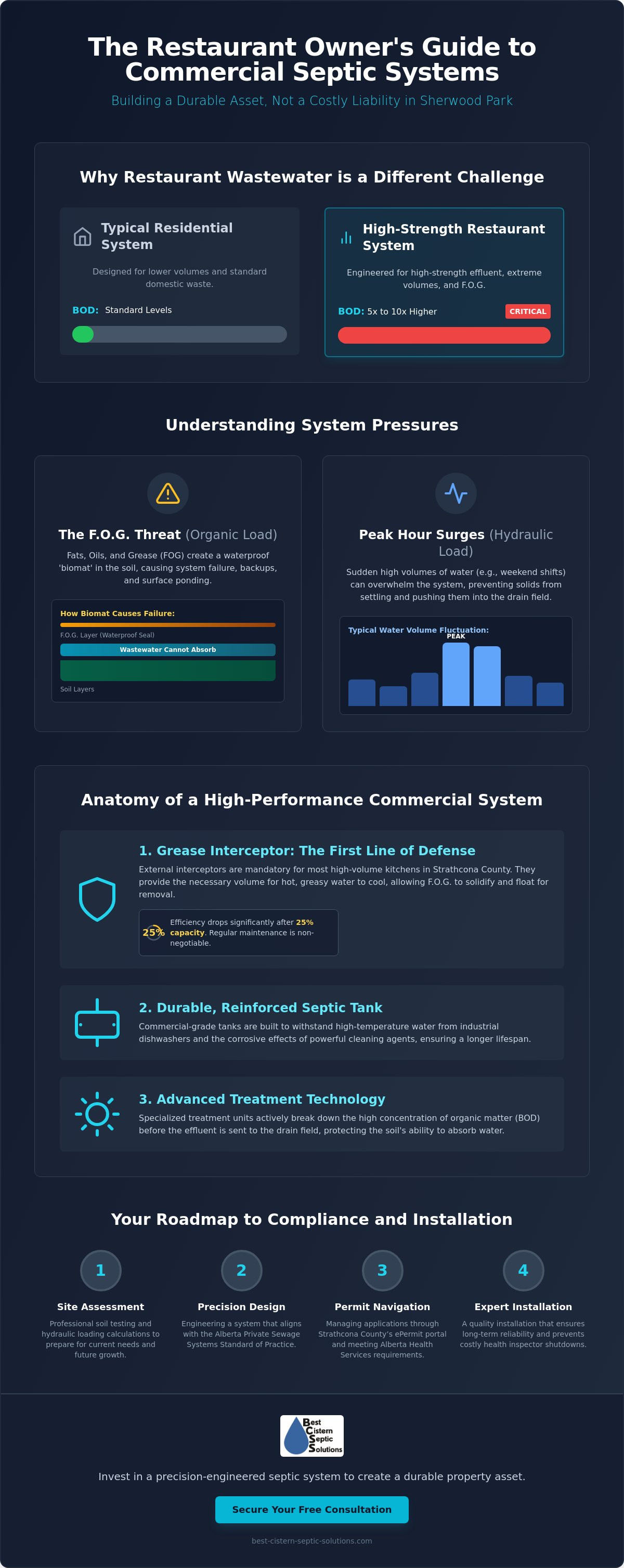
The primary factor that sets commercial food service apart is the concentration of organic matter in the wastewater. This is measured by Biochemical Oxygen Demand (BOD), which represents the amount of dissolved oxygen needed by aerobic biological organisms to break down organic material. While most people have a general idea of what a septic system is, the commercial version must process BOD levels that are often five to ten times higher than those found in a typical household.
Fats, oils, and grease (FOG) present an even greater threat. If these substances escape the kitchen and enter the drainage field, they create a waterproof seal in the soil known as a biomat. This seal prevents the soil from absorbing liquid, leading to surface ponding and backups. Professional design includes specialized pre-treatment and grease management to ensure these contaminants are captured before they can compromise the integrity of your property's soil.
Hydraulic Loading vs. Organic Loading
Successful restaurant septic system installation in Sherwood Park requires balancing two distinct types of pressure on the system: hydraulic loading and organic loading. Hydraulic loading refers to the total volume of water moving through the pipes. In a busy restaurant, this volume peaks during weekend shifts when dishwashers, prep sinks, and restrooms are all in constant use. If the system cannot handle this surge, the wastewater moves through the tank too quickly, not allowing enough time for solids to settle.
Organic loading, on the other hand, is the actual amount of "waste" within that water. Simply installing a massive tank doesn't solve an organic loading problem; it requires a design that facilitates active treatment. Because Sherwood Park soils often contain heavy clay, they have specific limits on how much liquid they can absorb. We focus on creating a balanced design that manages these peak flow periods while ensuring the organic matter is thoroughly treated, providing a reliable fix that protects your business for the long term.
Essential Components of a Commercial Food Service Septic System
A successful restaurant septic system installation in Sherwood Park relies on a chain of specialized components working in unison. Unlike residential setups, commercial systems must be rugged enough to handle high-temperature water from industrial dishwashers and the corrosive nature of commercial cleaning agents. The durability of your septic tank installation is the first step in creating a system that functions as a long-term property asset rather than a recurring headache. These tanks are often reinforced to withstand the unique chemical loads and higher temperatures found in a professional kitchen environment. If you are researching high-capacity utility infrastructure for sites in other metropolitan areas, you can learn more about Sewer Services Sydney and their expertise in specialized sewer works.
Grease Interceptors: Your First Line of Defence
Grease management is the single most important factor in commercial septic health. You must decide between internal grease traps, which sit under your sinks, or larger external interceptors buried outside. Most high-volume establishments in our region require external interceptors to meet Strathcona County Source Control regulations. These units are sized based on Drainage Fixture Units (DFU), ensuring the tank has enough volume to allow fats and oils to cool, solidify, and float to the top before the wastewater exits. Without this cooling period, grease stays liquid and travels straight into your drainage field, causing immediate clogs. Regular maintenance schedules are vital; once an interceptor reaches 25% capacity, its efficiency drops, and you risk a system bypass.
Advanced Distribution and Monitoring
Because restaurant output is often inconsistent, with massive surges during dinner rushes followed by quiet hours, a simple gravity-fed system is rarely sufficient. When planning a restaurant septic system installation in Sherwood Park, we typically recommend pressure distribution systems. These use an effluent pump to distribute wastewater evenly across the entire drainage field at timed intervals. This prevents saturated spots in the soil and ensures the field has time to rest and breathe between surges.
To protect your investment, a professional septic alarm installation is non-negotiable. These integrated systems monitor water levels in real-time. They alert managers to potential issues, such as a pump failure or a high-water surge, long before effluent reaches the surface or backs up into the kitchen. This proactive monitoring provides the peace of mind you need to focus on your guests. Advanced effluent filters also play a role by acting as a final physical barrier, catching any remaining fine solids before they can enter the soil. Choosing high-quality components ensures your system remains a reliable, invisible part of your business operations.
Sizing and Site Assessment for Your Sherwood Park Establishment
Selecting the right location for your utility infrastructure is a decision that impacts your business for decades. When we manage a restaurant septic system installation in Sherwood Park, we prioritize a thorough soil assessment over guesswork. This process begins with a deep dive into soil morphology. We perform percolation tests to determine exactly how much treated wastewater your specific site can absorb. It's a technical step that ensures your system won't become overwhelmed during your busiest shifts.
Strathcona County Soil Considerations
A successful restaurant septic system installation in Sherwood Park requires a design that respects the local geography. The soil profiles in North Central Alberta are notoriously diverse, often featuring heavy clay that offers limited absorption. If your site has high clay content, a traditional trench system might struggle with the high-volume output of a commercial kitchen. In these scenarios, we look toward advanced solutions like mound systems or At-Grade installations. These designs utilize the most permeable upper layers of the soil or imported sand media to ensure effluent is treated safely. We also consider your future business goals. If you plan a dining room expansion or a kitchen upgrade, your current design must account for that increased hydraulic load today.
Site Layout and Infrastructure Protection
The physical layout of a restaurant site presents unique challenges that residential properties simply don't face. Unlike a quiet backyard, a commercial property sees heavy traffic from delivery trucks and customer vehicles. We ensure your drainage field is situated far from these high-pressure areas. Soil compaction is a silent killer of septic systems. Once the soil is packed down by heavy tires, it loses its ability to filter wastewater. We also plan for the realities of Alberta winters. Your field must be protected from commercial snow removal equipment that can scrape away essential insulation layers or crush distribution pipes.
Strategic placement also ensures that future Septic System Inspections are straightforward and non-disruptive to your guests. We often integrate the septic layout with existing water storage solutions, such as cisterns, to create a cohesive utility footprint. By maintaining strict setbacks from property lines and commercial wells, we build a system that meets all regulatory codes. This methodical approach transforms your septic system into a reliable, invisible asset for your establishment.
Navigating Permits and Compliance in Strathcona County
Securing the necessary approvals for your utility systems shouldn't be a source of anxiety. In Strathcona County, the regulatory framework exists to ensure that every restaurant septic system installation in Sherwood Park protects both the public health and the local environment. Since June 1, 2026, the county has streamlined this process through an online ePermits portal, making it easier for certified professionals to manage your application. However, the documentation required remains rigorous. You'll need a comprehensive package that includes professional system designs, detailed site plans, and soil morphology reports. Because your establishment involves food service, Alberta Health Services (AHS) also plays a critical role in reviewing your wastewater plan to ensure it meets strict hygiene standards.
Alberta Private Sewage Systems Standard of Practice
The foundation of every compliant project is the Alberta Private Sewage Systems Standard of Practice (ABSOP) 2021. This code dictates everything from tank placement to the technical specifications of your drainage field. Working with a certified private sewage installer isn't just a recommendation; it's a legal requirement for applying for permits under Bylaw 43-2025. Non-compliant installations carry heavy risks, often leading to the denial of business insurance or forced closures if a failure occurs. We treat these regulations as a blueprint for quality, ensuring your system is a durable asset that stands up to provincial scrutiny. This methodical adherence to the code removes future worries about legal or environmental liabilities.
The Inspection Roadmap
Timing is everything when you're managing a restaurant construction schedule. We coordinate the final inspection to align with your build, ensuring that the county inspector can verify the installation before any components are backfilled. Common red flags that delay approval include unapproved grease interceptors or minor deviations from the original site plan. Once the inspector gives the green light, we provide you with complete post-installation documentation. These records are vital for your permanent business files, serving as proof of compliance for future health inspections or property assessments. If you're ready to begin your project with a team that understands these local requirements, our septic solutions provide the professional oversight you need to open your doors with confidence. We take pride in performing these difficult tasks with a high level of sophistication, ensuring your project moves from a potential risk to a definitive, professional fix.
Long-Term Reliability: Why Professional Installation is a Business Asset
A professional restaurant septic system installation in Sherwood Park is more than just a construction milestone. It represents a deep commitment to the long-term viability and safety of your business. When you invest in a precision-engineered septic field installation, you're directly increasing the market value of your commercial property. Prospective buyers or investors see a modern, compliant utility system as a sign of a well-managed establishment. It removes the fear of inherited liabilities and environmental concerns. This invisible asset works for you every day, ensuring your kitchen stays open and your guests remain comfortable.
Establishing a relationship with a local partner for septic service edmonton and the surrounding Strathcona County area ensures that your system remains in peak condition. Preventative care is always more cost-effective than reactive repairs. We view our role as a proactive partner in your property care, not just an emergency contact. By conducting regular, methodical checks, we identify minor wear or filter clogs before they turn into a service disruption. This steady rhythm of maintenance provides the peace of mind you need to focus on your culinary craft.
Avoiding the Cost of Failure
The true cost of a system failure isn't found in the repair bill alone. It's found in the lost revenue of a busy weekend, the wasted labour costs, and the lasting damage to your restaurant's reputation. Professional design significantly extends the lifespan of commercial septic systems by ensuring they can handle the unique organic and hydraulic loads of a professional kitchen. Choosing a "cheap" or undersized installation often leads to a cycle of expensive septic system repair within the first five years of operation. We help you avoid these financial surprises by getting the engineering right from the start.
The Best Cistern Septic Solutions Advantage
Securing Your Restaurant's Future with Specialized Infrastructure
Building a successful food service establishment requires attention to detail at every level, especially beneath the surface. You've seen how specialized design for high-strength wastewater and strict adherence to Strathcona County permits protect your business from the risks of downtime and health code violations. A precision-engineered restaurant septic system installation in Sherwood Park isn't just a utility; it's a foundational asset that preserves your property's value and ensures your operations run smoothly for decades. It's about removing future worries so you can focus entirely on your guests.
As Certified Alberta Private Sewage Installers with specialized commercial design expertise, we take pride in performing these essential tasks with diligence and care. We serve Strathcona County and the Greater Edmonton Region, providing the technical leadership needed to turn complex utility requirements into a definitive, professional fix. If you're ready to invest in the long-term reliability of your property, Request a Commercial Septic Installation Consultation today. You can move forward with confidence knowing your infrastructure is built to last and your business is fully protected.
Frequently Asked Questions
Do restaurants in Sherwood Park need a different septic permit than houses?
Yes, restaurants require a commercial sewage permit through Strathcona County's online ePermits portal. While residential permits focus on standard household usage, commercial applications require specialized engineering designs that account for high-strength wastewater and grease management. A certified private sewage installer must submit these applications on your behalf to ensure the design meets the current Alberta Private Sewage Systems Standard of Practice. This ensures your restaurant septic system installation in Sherwood Park is fully compliant with local bylaws.
How often does a restaurant grease trap need to be cleaned?
Most restaurant grease traps require professional cleaning every one to three months, depending on your kitchen's volume and menu type. We recommend following the "25% rule," which means the trap should be pumped out once solids and grease reach 25% of the tank's capacity. Regular maintenance prevents grease from bypassing the trap and entering your drainage field, which is the most common cause of expensive commercial system failures.
Can I expand my restaurant seating if I have an existing septic system?
Expanding your seating capacity often requires a technical re-evaluation of your existing septic infrastructure. Your system was originally sized based on specific peak hydraulic and organic loads, and adding more tables increases the daily volume of wastewater the soil must absorb. Before you begin renovations, it's wise to perform a site assessment to determine if your current drainage field can handle the additional demand without risking a backup.
What happens if my restaurant septic alarm goes off during a busy shift?
If your septic alarm sounds, it typically indicates a high-water level in the pump chamber or a mechanical failure. You should immediately reduce water usage and contact a professional for a diagnostic check to prevent a backup. Having a professional septic alarm installation in place gives you an essential early warning, allowing you to address the issue calmly before it disrupts your kitchen operations or guest experience.
How long does a commercial septic installation take in Strathcona County?
A typical restaurant septic system installation in Sherwood Park takes between one and three weeks for the physical construction, depending on weather and site complexity. However, the entire process, including soil morphology testing and the Strathcona County permit approval period, can take several weeks longer. We coordinate our work to align with your overall construction timeline, ensuring your utilities are ready well before your scheduled opening date.
Are there specific setbacks for septic fields near commercial kitchens?
Yes, commercial septic fields must adhere to strict setbacks defined by the Alberta Private Sewage Systems Standard of Practice. These include minimum distances from property lines, water wells, and the restaurant building itself to prevent contamination and structural issues. During the initial site assessment, we map out these requirements to ensure your system is placed in the safest, most efficient location on your property for long-term reliability.
What is the best type of septic field for a high-volume restaurant?
Pressure distribution systems are generally the best choice for high-volume restaurants because they distribute effluent evenly across the entire field. This prevents soil saturation during peak dining surges, which is critical for system longevity. For the clay-heavy soils often found in Sherwood Park, an At-Grade or mound system provides the superior filtration needed to ensure your wastewater is treated safely and effectively.
Who is responsible for inspecting the septic system before a restaurant opens?
A safety codes officer from Strathcona County must perform a final inspection before your system is backfilled and put into service. This inspection verifies that the installation matches the approved professional design and meets all Alberta safety codes. Your certified installer will coordinate this visit, ensuring all technical requirements are met so you can receive the green light to open your establishment with complete peace of mind.


