
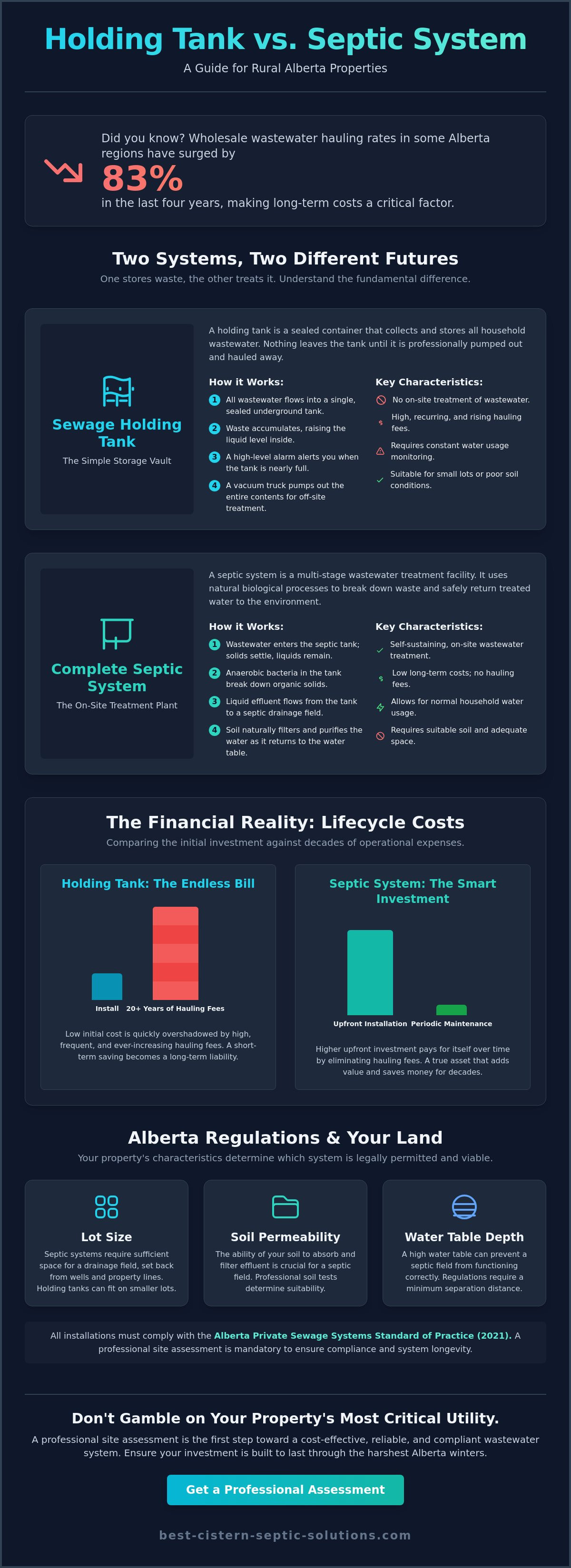
Did you know that wholesale wastewater treatment rates in some Alberta regions have surged by 83% over the last four years? If you're managing a rural property, you already know that what happens underground can quickly become your biggest monthly headache. Between rising hauling fees and the unpredictable Alberta frost, choosing between a holding tank vs septic system for acreages isn't just a technical plumbing decision; it's a long-term financial commitment. You want a system that works silently in the background without draining your bank account every time the pump truck arrives.
We understand the stress that comes with navigating the 2021 Alberta Private Sewage Systems Standard of Practice. This guide will help you discover the critical differences between simple wastewater storage and advanced on-site treatment so you can choose the most cost-effective and reliable system for your land. We'll examine the true lifecycle costs of each option, explain how local soil regulations affect your installation, and show you how to ensure your property remains environmentally safe through the harshest winters. By the end, you'll have a clear path toward lower maintenance costs and the security of a compliant, durable utility system.
Key Takeaways
- Learn the fundamental functional differences between a storage-only holding tank and a biological treatment septic system.
- Evaluate the long-term financial impact of holding tank vs septic system for acreages by comparing initial installation costs against recurring hauling fees.
- Understand the specific Alberta Private Sewage Codes and soil requirements that determine which system is legally permitted on your property.
- Discover why a professionally designed septic field acts as a long-term property asset that preserves your land's environmental health.
- Gain clarity on how professional site assessments prevent system failure and ensure reliable operation during harsh Alberta winters.
Choosing Between a Holding Tank and a Septic System for Your Acreage
Living on an acreage near Edmonton or Parkland County brings a sense of freedom, but it also places the full responsibility of wastewater management on your shoulders. When you're building a new home or upgrading an aging property, the choice between a holding tank vs septic system for acreages is one of the most consequential decisions you'll make. It isn't just about what sits under the grass; it's about how you intend to live on your land for the next twenty years. While both systems collect what goes down your drains, they handle that waste in fundamentally different ways. One acts as a simple vault, while the other functions as a miniature treatment plant. Carefully weighing a holding tank vs septic system for acreages ensures your home remains a safe, functional sanctuary for decades.
What is a Sewage Holding Tank?
A sewage holding tank is a heavy duty, watertight vessel designed for one purpose: storage. Think of it as a closed-loop system. Every drop of water that enters the tank stays there until a vacuum truck arrives to haul it away. Because there is no outlet for liquid to escape, these tanks fill up quickly based on your household's daily water usage. To prevent messy backups or environmental contamination, Alberta regulations require these tanks to have high-level alarms. These sensors provide peace of mind by alerting you well before the tank reaches capacity. We typically see these installed on smaller lots where there isn't enough space for a drainage field, or in areas with high water tables where soil treatment isn't a viable option.
What is a Complete Septic System?
A complete septic system is a sophisticated, two-part infrastructure designed to treat wastewater on-site. The process begins in the septic tank, where solids settle to the bottom and lighter materials float to the top. This initial stage provides primary treatment before the remaining liquid, or effluent, moves to the septic field. You can read more about How a Septic System Treats Wastewater through natural biological processes. Once the effluent reaches the drainage field, it undergoes secondary treatment as it filters through layers of soil and gravel. This natural filtration removes harmful pathogens and returns clean water back to the water table. For many rural homeowners, this self-sustaining cycle represents a long-term property asset that eliminates the constant need for external hauling services. Choosing the right setup requires a professional site assessment to ensure your soil can handle the filtration process effectively.
Treatment vs. Storage: How These Systems Manage Your Wastewater
While Section 1 defined the basic components of these systems, understanding the daily operational reality of a holding tank vs septic system for acreages helps you plan for the future. A septic system relies on a complex biological ecosystem. Inside the primary tank, billions of anaerobic bacteria work tirelessly to break down organic matter. This isn't just storage; it's active treatment. In contrast, a holding tank is a passive container. It has no biological engine and no way to reduce the volume of waste. Every time you flush a toilet or run the dishwasher, the liquid level rises until the tank is full.
This physical limitation often forces holding tank owners to become water-stingy. You might find yourself timing showers or delaying laundry to avoid an extra trip from the vacuum truck. This lifestyle shift is a significant factor when deciding between a holding tank vs septic system for acreages. While a septic system allows for a more traditional residential experience, a holding tank requires constant vigilance. The environmental impact also differs; a septic system returns treated water to the local water table, whereas a holding tank simply holds raw sewage for eventual transport and treatment elsewhere.
The Mechanics of a Septic Drainage Field
The true magic of on-site treatment happens beyond the tank. Once the primary treatment is complete, effluent flows into the drainage field. This is typically achieved through a network of perforated pipes or specialized chambers. A key component of this process is the "biomat" layer, a thin film of microorganisms that develops in the soil. This layer acts as a final filter, scrubbing the water of remaining pathogens before it returns to the earth. Because this process is so effective and sustainable, septic field installation remains the gold standard for rural properties with suitable soil conditions.
The Logistics of Holding Tank Management
Choosing a holding tank means entering a lifelong partnership with a sewage hauling contractor. Your household size directly dictates the rhythm of your life; a family of four might require pumping every one to two weeks, while a single occupant might stretch it to a month. If you miss a scheduled pump-out, the risks are immediate. High-level alarms are vital, but they don't solve the problem of an overfilled tank. Backups can lead to unpleasant odours and expensive emergency pumping fees that can strain a household budget.
To ensure your property meets all legal standards, it's helpful to review Alberta's Private Sewage Disposal Systems Regulation. These rules govern how both storage and treatment systems must be managed to protect public health and the environment. If you're unsure which path is right for your land, our team provides expert Septic Solutions tailored to the unique conditions of North Central Alberta, giving you the peace of mind that your home's utilities are built to last.
The Financial Reality: Installation Costs vs. Long-Term Hauling Fees
When you evaluate the financial impact of a holding tank vs septic system for acreages, it is easy to focus solely on the initial sticker price. A holding tank generally requires a smaller upfront investment because it involves less equipment and no drainage field construction. However, focusing only on the installation day can lead to the "hauling trap." In North Central Alberta, wholesale wastewater treatment rates have seen a cumulative increase of 83% over the four years leading up to 2026. These rising municipal fees directly impact how much you pay every time a vacuum truck visits your property. What seems like a bargain during construction can quickly evolve into a permanent, rising monthly utility bill that never ends.
A professionally installed septic system functions as a long-term property asset rather than a liability. While the initial capital requirement is higher due to the complexity of the drainage field, the system pays for itself by eliminating the need for perpetual hauling. Beyond the monthly savings, there is a significant impact on resale appeal. Savvy acreage buyers often view a holding tank as a red flag for high operating costs, whereas a certified septic field provides peace of mind and increases the overall market value of your home. Investing in treatment rather than just storage ensures your property remains competitive and financially sustainable in an era of rising utility costs.
Initial Installation Factors
Several variables drive the cost of your wastewater infrastructure. Every project begins with detailed soil testing and permit applications to ensure compliance with Alberta's Private Sewage Systems Standard of Practice. A septic field requires more heavy equipment operation and specialized materials like washed rock or treatment chambers. If you are dealing with an older property, a professional septic system repair can often restore a struggling field for much less than the cost of a full replacement. This approach preserves your existing infrastructure while avoiding the high operational costs of switching to a holding tank.
Ongoing Maintenance and Operational Costs
Maintaining a septic system is predictable and manageable. Most households only need to schedule tank pumping every 3 to 5 years to remove accumulated solids. You should also budget for periodic inspections and the eventual replacement of an effluent pump, which is a vital component for moving liquid to the field. Holding tanks, by contrast, operate on a "pay-as-you-flush" model. When you consider that Parkland County’s wastewater disposal rates at transfer stations are set at $10.00 per cubic meter for 2026, the cost of frequent pumping becomes a major household expense. Reliable Septic Solutions focus on durability and prevention, ensuring that your mechanical components like alarms and pumps remain in peak condition to avoid emergency service calls.
Alberta Regulations and Site Suitability for Rural Properties
Compliance with provincial law is the most critical step in securing the long-term safety of your home. In Alberta, all private wastewater projects must follow the Alberta Private Sewage Systems Standard of Practice 2021, which officially came into force on November 1, 2022. These regulations don't just exist for environmental protection; they ensure your system functions reliably during our extreme -40°C winters. When deciding between a holding tank vs septic system for acreages, the law often makes the choice for you based on the physical characteristics of your land. Before you can break ground, a certified professional must evaluate your property to ensure every component meets strict safety codes.
Setback requirements are another non-negotiable factor in your site plan. To protect your family's health and the integrity of your property, the Standard of Practice dictates specific distances between your wastewater system and other structures. For example, a septic field or holding tank must maintain a safe distance from water wells, property lines, and your home’s foundation. These rules prevent cross-contamination and protect your basement from moisture issues. Whether you live in Parkland County, Leduc County, or Sturgeon County, these provincial standards provide a consistent framework for safe rural living.
Why Soil Quality Dictates Your System Type
The texture of your soil is the primary factor that determines if you can install a treatment field or if you must rely on a holding tank. Sandy soils are ideal because they allow effluent to filter slowly and safely. However, much of North Central Alberta is characterized by heavy clay. Clay particles are so tightly packed that water cannot move through them effectively, often leading to the "holding tank default" if a traditional field can't drain. In these cases, we might look at advanced treatment options like mounds or specialized filters to avoid the high costs of a holding tank. We also pay close attention to frost depth; a system that isn't buried at the correct depth or properly insulated will fail when the ground freezes solid in January.
Navigating Local County Permits
Each municipality in the Edmonton Capital Region has its own specific permit application process. While the provincial standards are the same, the way Parkland County or Leduc County handles inspections can vary. Only a contractor with a Private Sewage Certificate of Competency can pull these permits and sign off on the installation. We find that understanding septic systems and their legal requirements helps homeowners feel more empowered during the construction phase. Working closely with local inspectors ensures that your system is documented correctly, which is vital when you eventually decide to sell your acreage. If you are unsure about the current state of your land, scheduling professional Septic System Inspections is the best way to determine which system is legally and physically viable for your property.
Professional Septic Solutions in Parkland County and Greater Edmonton
Choosing the right wastewater management strategy requires more than just a permit and a shovel. At Best Cistern Septic Solutions, we treat every installation as a long-term investment in your property's future. Our process begins with a comprehensive site assessment, which is the only way to truly understand the relationship between your specific soil conditions and your household needs. When we perform this evaluation, we look beyond the surface to help you decide between a holding tank vs septic system for acreages based on tangible data. This localized expertise is essential in North Central Alberta, where frost depth and soil saturation can vary significantly from one lot to the next.
The relationship between your water source and your waste management is inseparable. For many rural homeowners, managing the flow of water into the home is just as vital as managing the effluent leaving it. We often help clients integrate their wastewater systems with cisterns for rural properties to create a balanced, reliable utility network. By understanding how much water your household consumes, we can design a septic field or storage tank that operates without the constant stress of potential failure or overflow. Choosing between a holding tank vs septic system for acreages becomes much simpler when you have a partner who understands how these systems interact under the unique pressures of the Edmonton Capital Region.
Comprehensive Installation and Maintenance
Our project-based approach ensures that every step, from the initial design to the final backfill, is handled with meticulous care. We don't believe in "quick fixes" that lead to future headaches. Instead, we focus on durability. This includes the professional placement of high-level alarms through our Septic Alarm Installation service, which provides an essential layer of security for your home. If you are dealing with a system that has begun to struggle, we specialize in Septic Field Repair. Restoring an existing field can often save you from the high recurring costs of a holding tank while preserving the environmental integrity of your land.
Ensuring Your Acreage Utility Integrity
The health of your septic system is directly linked to the safety and comfort of your household. We see our work as a way to remove future worries, allowing you to enjoy the rural lifestyle without the looming fear of utility failure. Whether you are in Spruce Grove, Stony Plain, or the surrounding rural areas, our team is ready to provide a professional evaluation of your current setup. We take pride in being a hardworking, transparent partner for our neighbors. Our ultimate goal is to provide a professional fix that stands the test of time, ensuring your property remains a valuable and safe asset for years to come. When you are ready to secure your home's future, our specialized Septic Solutions are only a phone call away.
Securing Your Rural Property's Future
Deciding between a holding tank vs septic system for acreages is ultimately about balancing upfront costs with long-term financial freedom. While a holding tank might offer a simpler entry point, a professionally designed septic field eliminates the rising burden of monthly hauling fees and adds measurable value to your property. We've seen how Alberta's specific soil conditions and the strict 2021 standards require a methodical approach to ensure your utilities survive the deep freeze of winter. A system that's built correctly the first time becomes a silent, reliable partner in your daily life.
As Certified Private Sewage Installers, we specialize in rural Alberta wastewater solutions across Parkland, Leduc, and Sturgeon Counties. We take pride in helping our neighbors build systems that function as durable, invisible assets for their homes. Don't leave your property's integrity to chance. You can Contact Best Cistern Septic Solutions for a Professional Site Assessment to gain total clarity on the best path forward for your land. With the right design and professional oversight, you can enjoy your acreage with the peace of mind that your essential systems are built to last.
Frequently Asked Questions
Can I convert a holding tank into a septic system later?
You can often convert a holding tank into a full septic system by adding a drainage field, provided the existing tank is structurally sound and meets current provincial codes. This upgrade transforms your property from a storage-only model to an on-site treatment facility. It requires a new permit and a professional soil assessment to ensure the land can safely handle the effluent filtration process.
How often do I need to pump a holding tank vs. a septic tank?
Holding tanks require pumping every one to four weeks depending on your household water use, while septic tanks typically only need pumping every three to five years. This drastic difference in frequency is a major factor when comparing a holding tank vs septic system for acreages. While the septic tank only needs solids removed periodically, the holding tank must be emptied of every single gallon of wastewater your household produces.
What are the signs that my septic field is failing and I might need a tank?
Signs of a failing septic field include persistent sewage odors, slow-clearing drains, or patches of unusually lush, soggy grass over the drainage area. You don't always need to switch to a holding tank if these signs appear. A professional inspection can often identify if a repair or a localized component replacement can restore the field’s function and save you from the high costs of a storage-only system.
Do holding tanks freeze in Alberta winters?
Holding tanks can freeze during extreme Alberta winters if they aren't buried below the frost line or properly insulated. We prevent this by ensuring the tank and its connecting pipes are installed at the correct depth according to provincial standards. Adding specialized insulation during the installation process provides an extra layer of security against the deep cold, ensuring your system remains functional even in January.
How much space do I need for a septic field on my acreage?
The space required for a septic field depends on your household's daily water volume and the soil’s ability to absorb liquid. A typical acreage might need between 500 and 1,500 square feet of dedicated land for the field itself. You must also account for mandatory setback distances from your home, property lines, and water wells as dictated by the Alberta Private Sewage Standard of Practice.
Is a holding tank the only option if I have a high water table?
A holding tank isn't your only choice if you have a high water table or poor soil drainage. Advanced treatment systems, such as raised mounds or sand filters, are designed to treat wastewater safely even when ground conditions are difficult. These systems allow you to enjoy the benefits of on-site treatment without the high operational costs and hauling fees associated with a storage tank.
Are there specific permits required for holding tanks in Parkland County?
Yes, Parkland County has specific requirements for holding tank permits, including a minimum capacity of 4,500 liters for single-family dwellings. The system must also include a high-level alarm to prevent overflows and potential environmental contamination. Working with a certified installer ensures your application meets these local bylaws and the overarching provincial Safety Codes correctly.
Can I install my own septic system or holding tank in Alberta?
No, you cannot legally install your own wastewater system in Alberta. Provincial law requires that all private sewage installations be performed by a contractor who holds a Private Sewage Certificate of Competency. This regulation protects the environment and ensures your system is safe, durable, and fully compliant with the 2021 Standard of Practice, providing long-term security for your property.


