
What if the most expensive repair your property needs this year didn't have to come entirely out of your own pocket? We know that facing a full system overhaul is a major source of stress for rural homeowners. The high upfront cost of a professional septic field installation often feels like a barrier to maintaining a safe and functional home. Finding reliable information on government grants for septic replacement Alberta 2026 can be frustrating because many programs are specialized or localized.
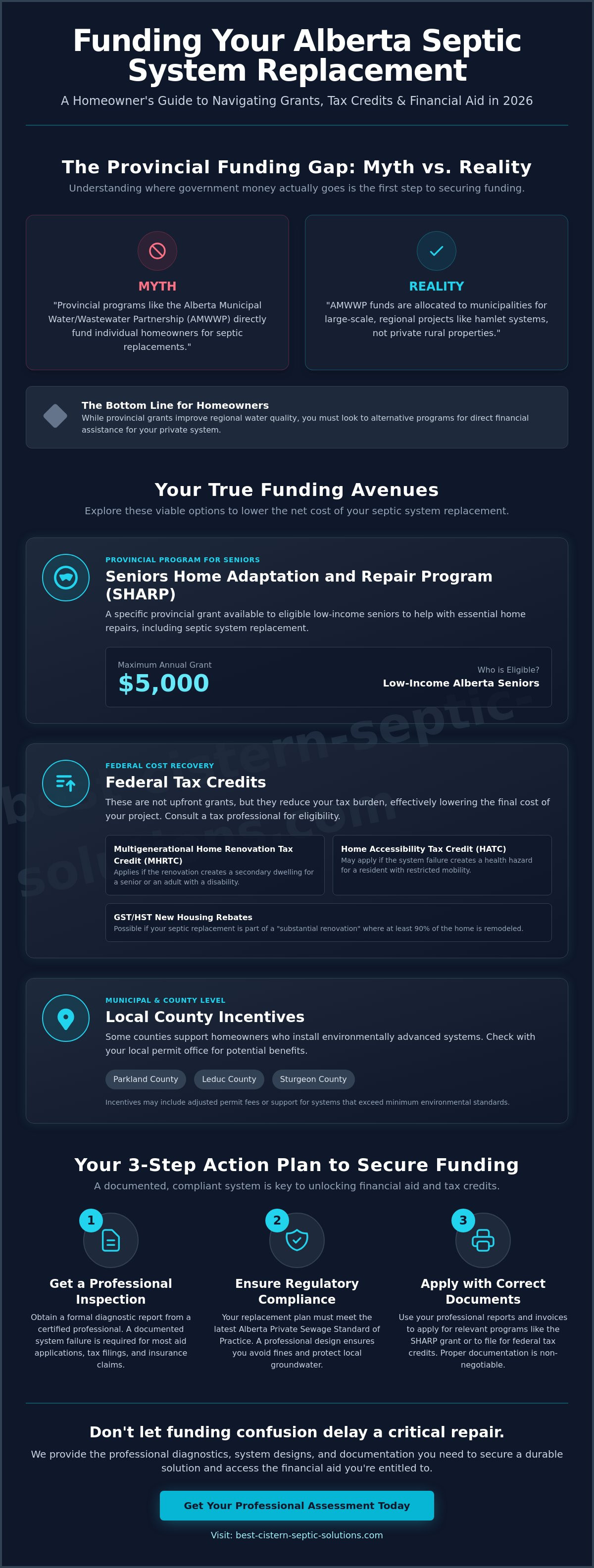
We agree that your property's long-term health shouldn't be a financial mystery. This guide simplifies the funding landscape by highlighting the Seniors Home Adaptation and Repair Program (SHARP) grant, which offers up to $5,000 annually for eligible low-income seniors. You'll also learn the difference between municipal incentives and provincial support, ensuring you don't miss out on available tax credits or low-interest financing options like HELOCs. We'll walk you through the current environmental regulations and provide a clear path to lowering your net costs while securing a durable, professional fix for your utility system.
Key Takeaways
- Learn how to navigate the current landscape of government grants for septic replacement Alberta 2026, including specific eligibility for the SHARP grant available to low-income seniors.
- Understand the distinction between provincial funding for municipalities and the financial aid options actually available to private homeowners.
- Identify federal tax credits, such as the Multigenerational Home Renovation Tax Credit, that can help offset the cost of essential system upgrades.
- Discover local incentives and permit fee structures in Parkland, Leduc, and Sturgeon Counties that support environmentally advanced septic solutions.
- Follow a step-by-step action plan to secure professional diagnostics and documentation required for successful insurance claims or tax filings.
Understanding Alberta Septic Grants: What is Available in 2026?
Many Alberta homeowners start their search for financial relief by looking into provincial programs. It's a logical first step when facing the costs of a major utility upgrade. However, the reality of the 2026 provincial budget is that most funding is diverted toward large-scale regional infrastructure rather than private property upgrades. Understanding this distinction early can save you hours of paperwork and redirected phone calls.
The Alberta Municipal Water/Wastewater Partnership (AMWWP) is the most cited program in government literature. It's designed to assist municipalities with the capital costs of building water supply and treatment facilities. While this sounds promising, there's a significant "funding gap" for the individual rural resident. The province prioritizes collective systems that serve entire communities. This is a common structure for Water supply and sanitation in Canada, where the focus remains on public health at a municipal level. Most government grants for septic replacement Alberta 2026 searches lead back to the AMWWP, but this money stays with the county or the town, not the homeowner.
In 2026, Alberta Environment and Protected Areas continues to tighten standards for groundwater safety. Their role is to set the benchmarks that every private system must meet. If your system fails to meet these criteria, you may receive an environmental protection order. These orders mandate a fix to protect the local ecosystem, but they rarely come with a provincial check to cover the work. It's a challenging position for any property owner to be in, which is why identifying legitimate secondary funding is so important.
The AMWWP and Rural Utilities
If you live in Parkland or Leduc counties, you might see local projects funded by the AMWWP. These grants are vital for improving the regional water table, but they usually support "hamlet" systems. These are concentrated clusters of homes that share a common wastewater facility. For those on isolated rural acreages, these funds aren't accessible. You should check if your property is part of a Local Improvement District (LID). In some rare cases, an LID might coordinate a group replacement project, but this is the exception for most rural residents.
Private Sewage Disposal Systems (PSDS) Regulations
Compliance is the cornerstone of any potential aid. The 2026 Alberta Private Sewage Standard outlines strict requirements for how effluent is treated before it reaches the soil. Failing systems are viewed as environmental risks. While the province doesn't offer a direct repair grant to most, having a professional Septic System Inspection is your first step. A documented failure is often required if you intend to apply for any secondary aid, such as the SHARP program for seniors or specific tax credits. We provide the technical reports needed to prove your system requires professional Septic Solutions to meet these safety codes and protect your property's long-term value.
Federal Tax Credits and Financial Aid for Septic Replacement
While we've established that the Alberta Municipal Water/Wastewater Partnership (AMWWP) focuses primarily on municipal infrastructure, federal tax credits provide a different route for private homeowners to recover costs. These are not traditional upfront checks, but they effectively lower the net investment in your property. If you're searching for government grants for septic replacement Alberta 2026, looking toward your annual income tax return is a strategic move that provides legitimate financial relief.
The federal government also offers GST/HST New Housing Rebates that might apply if your septic replacement is part of a "substantial renovation." This typically requires that at least 90% of the existing home is remodeled. Additionally, if a failing system creates a specific health hazard for a resident with restricted mobility, certain components of the replacement may qualify under the Home Accessibility Tax Credit. These programs ensure that essential utility work is treated as a priority for household safety and property preservation.
The Multigenerational Home Renovation Tax Credit
The Multigenerational Home Renovation Tax Credit (MHRTC) is a valuable tool for rural Albertans. If you're building a secondary suite to house a senior or an adult with a disability, your existing septic system likely won't handle the increased effluent load. The CRA allows you to claim 15% of eligible expenses, up to $50,000, for these types of projects. Because a functional system is essential to making that secondary suite habitable, the costs often fall under the "eligible dwelling" upgrade category. You'll need comprehensive documentation and detailed invoices from your septic field installation provider to prove the work was a direct requirement for the expansion.
Federal Financing vs. Direct Grants
Loans are increasingly becoming the primary way the federal government supports private property resilience. The Canada Greener Homes Loan, for instance, offers up to $40,000 interest-free with a 10-year term. While septic systems are not always the primary focus of energy-related grants, they can often be bundled into larger property resilience projects that protect the local environment. Comparing these 0% or low-interest federal options to a standard bank loan can save you thousands in interest over the life of the system. We recommend keeping every receipt, as professional diagnostic fees are often the first expense you'll incur. These reports are vital for proving the necessity of the work for tax purposes. If you need a clear breakdown of costs for your records, our team provides transparent septic solutions that make the financial filing process much simpler.
Local Incentives in Parkland, Leduc, and Sturgeon Counties
While provincial and federal programs provide a broad framework, the most immediate financial relief often comes from county-level initiatives. Each county operates with its own set of bylaws and environmental priorities. While the Edmonton Capital Region shares common environmental goals, the specific permit requirements in Sturgeon County can differ significantly from those in Leduc. If you're looking for government grants for septic replacement Alberta 2026, your local municipal office is often the most practical place to start your inquiry.
Some Alberta municipalities are expanding the Clean Energy Improvement Program (CEIP). This program allows homeowners to finance major property upgrades through their property taxes, spreading the cost over several years. While CEIP has traditionally focused on solar panels or insulation, several regions are exploring wastewater management as part of this resilience model. This approach turns a daunting upfront cost into a manageable, long-term investment in your property's infrastructure.
Navigating Parkland and Leduc County Requirements
In Parkland and Leduc counties, the proximity to sensitive watersheds like Wabamun Lake or Pigeon Lake means higher installation standards. Local authorities often prioritize Advanced Treatment Plants (ATPs) in these areas. While these systems require a higher initial investment, some counties offer permit fee rebates or waivers for homeowners who choose these environmentally superior options. If you're managing a septic system repair in Parkland County, it's worth asking the planning department about municipal tax installment payment plans. These plans can help distribute the financial weight of essential utility repairs over a more comfortable timeframe.
Collaborating with Local Safety Codes Officers
A compliant design is your best defense against future fines and environmental liabilities. This process begins with a site-specific soil test, also known as a perc test, which is required for local approvals. Safety Codes Officers in Sturgeon and Parkland counties use these tests to ensure your new system won't contaminate the local water table. Beyond technical compliance, municipal social service departments often manage "Hardship Grants." These are targeted at low-income seniors or residents in crisis. If a failing septic system threatens to make a home uninhabitable, these local funds can sometimes bridge the gap where larger provincial programs fall short. We work closely with local officers to ensure every Septic Solution we provide meets these rigorous standards, giving you peace of mind that the job is done right the first time.
Action Plan: How to Fund Your Septic System Without a Direct Grant
Securing funding for a major utility project requires a methodical approach. While direct government grants for septic replacement Alberta 2026 are limited to specific demographics like low-income seniors, a combination of insurance, tax credits, and strategic financing creates a manageable path forward. We recommend following a logical sequence to ensure you don't leave any potential savings on the table. This proactive strategy turns a stressful replacement into a structured property improvement project.
Your action plan should begin with these five essential steps:
- Step 1: Secure a professional diagnostic. You need written proof of system failure to trigger any insurance claims, tax credits, or municipal aid.
- Step 2: Review your property insurance policy. Specifically, check for "service line" or "sewer backup" riders that may cover a portion of the excavation or pipe replacement.
- Step 3: Consult a tax professional. Ask about the federal rural improvement credits and the MHRTC mentioned earlier in this guide.
- Step 4: Contact your municipal office. Inquire about Clean Energy Improvement Programs (CEIP) or local tax installment plans that can spread out the cost.
- Step 5: Select a contractor who provides detailed, transparent documentation. This paperwork is vital for successful financial applications.
Insurance and Warranty Claims
Insurance coverage for septic systems often depends on the nature of the failure. Most standard policies distinguish between sudden, accidental damage and gradual wear and tear. A collapsed line caused by shifting soil might be covered, whereas a field that has reached the end of its natural life usually is not. Service line coverage is a specific endorsement you can add to your policy to protect the underground pipes connecting your home to the tank. Maintaining a record of proper septic maintenance is your best tool during a claim. It proves you have been a diligent steward of the system, which makes insurers more likely to honor your request for assistance.
Cost-Saving Through Strategic Design
Strategic design is a powerful way to manage the net cost of your system. While a gravity-fed field is often the least expensive to install, a pressure-distribution system might offer better longevity in the heavy clay soils common in North Central Alberta. Choosing a system that matches your specific soil profile prevents premature failure and protects your investment for decades. If your property also requires a reliable water source, a high-quality cistern installation can often be bundled into the same project. This bundling can sometimes qualify you for larger financing packages or reduced permit fees. Avoid the "cheap fix" that only addresses a symptom. A professional, code-compliant replacement is a long-term asset that removes future worries.
If you need a professional assessment to begin your funding journey, we are here to help. Our team provides the detailed Septic System Inspections required for insurance and tax documentation. Contact Best Cistern Septic Solutions today to schedule a diagnostic visit and secure your property's future.
Professional Septic Solutions in North Central Alberta
Securing the necessary funding for a major property upgrade requires more than just filling out forms. It demands accurate, technical data that stands up to the scrutiny of tax auditors and insurance adjusters. While the search for government grants for septic replacement Alberta 2026 often leads to complex regulatory hurdles, we specialize in turning that complexity into a clear, actionable plan. Best Cistern Septic Solutions provides the professional partnership needed to navigate the intersection of environmental standards and financial aid requirements. Our team understands that a failing utility system is a significant stressor. We focus on providing the peace of mind that comes with a definitive, professional fix.
We don't just perform the physical work of a septic field installation. We act as your technical advocate throughout the entire process. This includes providing the detailed Septic System Inspections and diagnostic reports required to prove eligibility for programs like the SHARP grant or federal tax credits. By choosing a partner who understands the specific documentation needs of rural Albertans, you ensure that no potential savings are lost due to incomplete paperwork or vague descriptions. We treat your property's infrastructure as a long-term asset, ensuring every repair or replacement adds measurable value and security to your home.
Why Local Expertise Matters for Funding
Every county in the Edmonton Capital Region has unique geological and regulatory nuances. The heavy clay soils in parts of Sturgeon County require different Septic Solutions than the more varied terrain found in Parkland or Leduc. We understand these local conditions intimately. Our diagnostic reports are recognized and respected by local Safety Codes officers, which often streamlines the permit approval process. When you work with experts who know the local bylaws, you avoid the costly delays and fines that come from non-compliance. We help you choose the most durable system for your specific site, maximizing the lifespan of your investment and ensuring it meets the 2026 Alberta Private Sewage Standard.
Peace of Mind for Rural Homeowners
Moving from the stress of an emergency failure to a managed resolution is our core promise to you. We maintain transparent communication from the first site visit to the final inspection. You will always know the timelines, the permit status, and the long-term maintenance requirements of your new system. Our grounded approach removes the guesswork from rural property care, allowing you to focus on your family while we handle the technical complexities. We take pride in performing difficult, essential tasks with a high level of sophistication and care. Once the job is done, the future worries about your wastewater management simply disappear. Contact Best Cistern Septic Solutions for a professional evaluation and let us help you secure the funding and the functional system your property deserves.
Securing Your Property’s Future with a Clear Financial Path
Finding the right way to fund a system overhaul doesn't have to be an overwhelming task. While the landscape for government grants for septic replacement Alberta 2026 is specialized, focusing on programs like the SHARP grant for seniors or federal tax credits provides a manageable resolution. You now have the tools to navigate these financial aids by combining professional diagnostics with municipal financing options to lower your net costs. Protecting your property’s environment is a long-term asset that starts with understanding your specific eligibility and local requirements.
Our team serves Parkland, Leduc, and Sturgeon Counties with deep expertise in the 2026 Alberta Private Sewage Standards. We provide the comprehensive diagnostic reports you need for successful insurance claims and tax filings. By addressing your system needs proactively, you remove future worries and ensure the continued safety of your household. We're ready to help you move from uncertainty to a professional, durable fix that preserves your property value for years to come. Book a Professional Septic Inspection in North Central Alberta today and take the first step toward a secure, worry-free property.
Frequently Asked Questions
Does the Alberta government provide direct cash grants for septic tank replacement?
Direct cash grants for the general public aren't currently available from the provincial government. The primary exception is the Seniors Home Adaptation and Repair Program (SHARP), which provides up to $5,000 for low-income seniors. For most residents, government grants for septic replacement Alberta 2026 searches will show that funding is instead directed toward municipal infrastructure or tax-based incentives rather than immediate cash payments to private property owners.
Can I claim my septic system replacement on my 2026 income tax?
You can claim a portion of the costs if the work qualifies under specific federal programs. The Multigenerational Home Renovation Tax Credit allows for a 15% claim on eligible expenses if you're adding a secondary suite. If the replacement is part of a substantial home renovation, you might also be eligible for a GST/HST New Housing Rebate. Always keep your detailed invoices to support these claims during the tax season.
What is the Alberta Municipal Water/Wastewater Partnership (AMWWP)?
The Alberta Municipal Water/Wastewater Partnership is a provincial program that funds water and wastewater infrastructure for municipalities and hamlets. It helps local governments build treatment plants and distribution lines. While this program improves the regional water table, it doesn't provide direct financial assistance to individual rural homeowners for private septic system upgrades. It's a public-sector tool designed for community-wide environmental protection rather than private utility maintenance.
Are there low-interest loans available for rural septic repairs in Alberta?
Low-interest options are available through various government-backed initiatives. Low-income seniors can access the SHARP loan program, while other homeowners might find success through the Clean Energy Improvement Program (CEIP) if their municipality has expanded it to include water conservation. Many rural residents also utilize Home Equity Lines of Credit (HELOC), which often offer lower interest rates than personal loans for high-priority property repairs and essential system installations.
Does home insurance cover the cost of a new septic field in Parkland County?
Standard home insurance typically covers sudden and accidental damage, such as a collapsed line caused by shifting soil. It rarely covers gradual wear or the natural end of a system's life cycle. You should review your policy for "service line coverage" or "sewer backup" riders. These specific add-ons provide the best protection for the underground components of your utility system and can significantly lower your out-of-pocket replacement costs.
What federal credits apply to rural homeowners in Canada for 2026?
Federal support for 2026 includes the Multigenerational Home Renovation Tax Credit and the Canada Greener Homes Loan. While the loan primarily targets energy efficiency, it can sometimes be bundled with property resilience projects. These programs help offset the high cost of maintaining rural infrastructure. Understanding the nuances of government grants for septic replacement Alberta 2026 involves looking at these federal tax-back schemes as a primary method of financial recovery.
How much does a septic permit cost in Leduc County?
Permit fees in Leduc County depend on the complexity and the type of the system you're installing. These costs are set by the municipal planning department and cover the administrative review and the required site inspections. Because these fees can change, we recommend contacting the Leduc County Safety Codes department directly for the most current schedule. We handle the technical application process to ensure your permit is processed without unnecessary delays.
How do I prove my septic system needs replacement for a tax credit?
To prove the necessity of a replacement, you need a comprehensive diagnostic report from a certified professional. This report should detail the current state of the system and explain why it no longer meets the Alberta Private Sewage Standard. We provide these detailed inspections, which serve as vital evidence for tax professionals or insurance adjusters. Having clear, technical documentation is the most important step in securing any available financial aid for your property.


