
A single piece of plastic, often no larger than a household flashlight, is the only thing standing between your home's comfort and a $30,000 septic field failure. Most homeowners in Alberta rarely think about their septic system until a backup occurs, and it's completely natural to feel a sense of hesitation or even physical disgust when considering the maintenance of your tank's inner components. However, staying consistent with effluent filter cleaning and replacement is the most effective way to protect your property's long-term value and your family's peace of mind.
We understand that navigating technical utility systems can feel overwhelming, but every problem has a manageable resolution. This guide will provide you with a clear maintenance schedule and the confidence to identify when a filter is nearing the end of its functional life. You'll learn how this simple "firewall" prevents solids from clogging your drainage field, ensuring your system remains a durable asset for decades to come. By the end of this article, you'll have a professional's perspective on how to maintain your system's integrity without the stress of the unknown.
Key Takeaways
- Understand the technical role of the effluent filter as a fine-mesh barrier that prevents solid carryover from damaging your drainage pipes.
- Follow a safe, step-by-step process for effluent filter cleaning and replacement using basic household tools while avoiding hazardous sewer gas exposure.
- Learn to identify physical warning signs, such as warped mesh or failing seals, that indicate your filter requires a professional replacement rather than a simple rinse.
- Prepare for Alberta’s climate by performing maintenance every October to avoid the "winter lockout" caused by deep frost lines in regions like Leduc and Sturgeon County.
- Discover when to transition from DIY upkeep to a professional diagnostic to ensure your septic system remains a durable, long-term asset for your home.
The Role of the Effluent Filter in Your Septic System
The effluent filter is a critical mechanical component designed to act as a final barrier before liquid waste leaves your tank. Physically, it's a fine-mesh cylindrical insert located at the outlet tee of your septic tank. While it may seem like a minor detail, this device serves as a "firewall" for your property. It prevents the carryover of suspended solids, grease, and hair into your drainage pipes. In Alberta, the 2021 Private Sewage Systems Standard of Practice (SOP) emphasizes the importance of these components. While not mandatory for every historical build, modern installations and alterations must comply with these rigorous standards to ensure environmental safety and system longevity. Regular effluent filter cleaning and replacement ensures that only filtered liquid reaches your soil, which is vital for maintaining the permeability of your drainage area.
How the Filter Protects Your Drainage Field
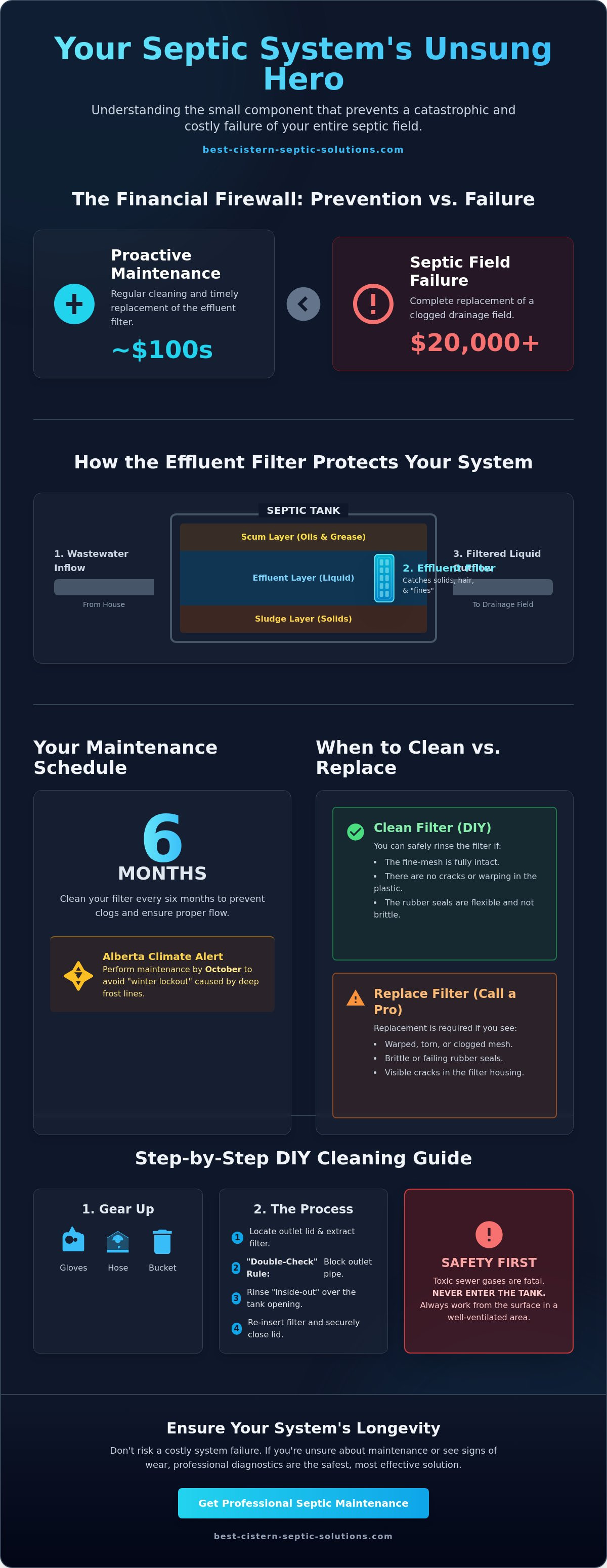
To understand the value of this component, it helps to visualize how septic systems work on a daily basis. Wastewater enters the tank, where solids settle and oils float. The liquid in the middle, known as effluent, flows toward the outlet. Without a filter, small particles called "fines" can escape into the drainage field. These particles eventually clog the soil pores, leading to a total system failure. The financial contrast is stark. A quality filter represents a small investment in the low hundreds of dollars. In comparison, a full septic field installation in North Central Alberta can exceed $20,000. Protecting your field with consistent maintenance is the most logical way to preserve your property's utility.
Common Types of Effluent Filters Found in Parkland County
Homeowners in Parkland County typically encounter a few specific filter designs based on their system's age and complexity. Standard mesh filters are common in gravity-flow systems. They rely on simple surface area to catch debris. High-capacity commercial-grade filters are often installed in larger households or systems with higher water usage. These offer more surface area to prevent premature clogging. If your home uses a pressure-dosing system, you likely have a specialized filter designed to handle the surge of a pump. The size of your family directly dictates your filter's requirements. A larger household generates more "fines," meaning a larger filter surface area is necessary to keep the system running smoothly. Staying proactive with effluent filter cleaning and replacement prevents these varied systems from becoming a source of household stress.
Maintaining your septic system doesn't have to be a source of anxiety. While the idea of handling wastewater components is rarely appealing, a proactive approach to effluent filter cleaning and replacement prevents messy backups and preserves your property value. For families in Stony Plain and Spruce Grove, we recommend a six-month cleaning cycle. This frequency accounts for typical household water usage and ensures the filter never becomes so clogged that it restricts flow or forces solids into your drainage field. Consistent effluent filter cleaning and replacement remains the most effective way to avoid the stress of a failing system.
Before you begin, gather a few essential tools: heavy-duty rubber gloves, a garden hose with a spray nozzle, and a 5-gallon bucket. Safety is the absolute priority. Never enter a septic tank under any circumstances. Sewer gases like methane and hydrogen sulfide are toxic and can be fatal in enclosed spaces. Always work from the surface and keep the area well-ventilated while the lid is open. If you're unsure about the process, professional Septic Maintenance provides the definitive resolution your home requires.
Step-by-Step Cleaning Process
Start by locating the secondary lid on the outlet side of your tank. Once open, you'll see the filter handle. Carefully extract the filter using a hook or a gloved hand. One of the most important steps is the "Double-Check" rule: verify that the outlet pipe remains blocked by the filter housing or a temporary plug while the filter is removed. This prevents raw solids from escaping directly into your drainage field during the maintenance window.
When rinsing, use the "inside-out" method. Spray the water through the center of the filter so that debris falls back into the septic tank rather than onto your lawn. For a visual reference on these technical steps, you can review this guide on how to clean your effluent filter. This process ensures that all captured "fines" remain in the primary treatment zone where they belong.
Essential Safety Gear and Hygiene
Hygiene is just as vital as mechanical accuracy. Wear eye protection and long sleeves to guard against splashes. After the filter is reinstalled and the lid is secured, thoroughly disinfect your tools and the surrounding ground. If you notice a thick "grease cap" or a solid crust forming around the filter handle, it may indicate that your tank is overdue for a professional assessment. This buildup suggests that the biological balance in the tank might be struggling to break down fats and oils, which can eventually lead to a more complex repair if left unaddressed.
Knowing When to Clean vs. When to Replace Your Filter
While routine maintenance is the standard for most households, there comes a point where a simple rinse is no longer sufficient for your system's health. Identifying the exact moment to transition from effluent filter cleaning and replacement is a skill that saves homeowners both time and significant expense. A reliable rule of thumb is the "Cleaning Frequency" test. If your household water usage hasn't changed, yet you find yourself cleaning the filter every eight weeks to prevent slow drains, the component has likely lost its effectiveness. This persistent clogging suggests that the mesh pores are no longer clearing fully, or the internal structure has shifted.
Visual cues provide the most definitive evidence of a failing part. During your semi-annual check, look closely at the mesh for signs of warping or a bypass seal that no longer sits flush against the outlet tee. If the seal is loose, unfiltered wastewater can "leak" around the edges, sending solids directly into your drainage field. This bypass negates the filter's entire purpose and quickly escalates into a need for septic system repair. We often see that a stubborn layer of bio-mat, which is a thick biological film, can become so deeply embedded that even high-pressure water won't remove it. At this stage, replacement is the only way to restore proper flow and protection.
Signs Your Filter is Beyond Saving
Structural integrity is the first thing to fail as a filter ages. Long-term exposure to hydrogen sulfide gases within the tank makes plastic components brittle. If the plastic feels "chalky" or cracks under light pressure, it's time for a new unit. Pay special attention to missing mesh sections or holes larger than 1/8th of an inch. These gaps allow larger debris to pass through, which is the primary cause of field clogging. Finally, if the extraction handle has snapped off, you should replace the filter immediately. A missing handle makes future maintenance nearly impossible and often leads to the filter being dropped into the tank.
Upgrading to a High-Performance Filter
When you decide a replacement is necessary, consider moving beyond a basic model. High-performance filters offer a much larger surface area, which naturally extends the time between required cleanings. For homeowners in the Edmonton region, we often recommend "smart" filters equipped with built-in alarms. These sensors notify you the moment the filter reaches 75% capacity, removing the guesswork from your maintenance schedule. Always ensure your new filter is compatible with your existing outlet tee and tank depth to maintain a secure, airtight seal that protects your property for the long term.
Alberta Challenges: Septic Maintenance in Cold Climates
Alberta's climate demands a specific rhythm for utility upkeep that differs from warmer regions. The "Winter Lockout" is a primary concern for homeowners in Leduc and Sturgeon County. Once the ground freezes, accessing your tank lids becomes significantly harder and more physically demanding. We recommend completing your effluent filter cleaning and replacement every October. This proactive step ensures the system is clear before the deep frost sets in. If a filter clogs in January, the frozen earth makes emergency access a complex ordeal that can often be avoided with simple seasonal planning.
Spring brings its own set of technical challenges, specifically a phenomenon known as "sludge bulking." As the ground warms during the spring thaw, rapid temperature shifts in the tank can cause solids to rise and stay suspended in the effluent. These solids rush toward your filter, increasing the risk of a sudden blockage just as the ground is at its wettest. Staying consistent with effluent filter cleaning and replacement during the shoulder seasons prevents these seasonal surges from turning into household emergencies. If you encounter a frozen lid during a cold snap, don't use a sledgehammer, as this can crack the concrete or plastic. Instead, use gentle heat or warm water to break the ice seal safely.
Seasonal Timing for the Edmonton Capital Region
The best practice for the Edmonton region is a semi-annual rhythm. Aim for a cleaning in late April after the snow has vanished and again in mid-October. It's best to avoid maintenance during periods of heavy rain or rapid snowmelt. Excess water in the soil can put pressure on the tank and make the process unnecessarily difficult. A simple pro-tip is to mark your tank lids with tall stakes before the first snowfall. This small action saves you from digging multiple test holes when the yard is covered in a meter of snow.
Insulating Your Septic Lids
Frost heaving can shift your septic lids or even damage the riser if the ground moves significantly during a freeze-thaw cycle. Many local experts suggest using specialized foam covers or even simple hay bales to provide a layer of insulation over the access point. This extra warmth prevents the filter area from freezing solid. A frozen filter leads to an immediate backup into the home because the wastewater has nowhere to go. Always verify local bylaws in your county regarding riser heights, as proper elevation helps keep the lid above the most aggressive frost zones. For a professional assessment of your system’s winter readiness, contact Best Cistern Septic Solutions to ensure your property is fully protected.
Professional Maintenance for Long-Term Peace of Mind
Professional oversight transforms a messy chore into a strategic investment for your home. While many homeowners manage basic rinsing, professional effluent filter cleaning and replacement provides a level of technical certainty that DIY efforts can't match. Our experts ensure that the bypass seal is seated perfectly against the outlet tee. A small gap here might seem insignificant, but it allows solids to bypass the "firewall" and migrate into your drainage field. By trusting a specialist, you eliminate the risk of a minor maintenance error turning into a major financial liability.
There is a significant difference between a quick filter rinse and a comprehensive septic inspection. During a professional visit, we don't just look at the filter; we evaluate the entire ecosystem of your tank. We check the integrity of the baffles and assess the sludge layers to ensure your system isn't under undue stress. This proactive approach integrates filter care into a broader strategy for property preservation, ensuring your utility systems remain invisible and reliable.
Why DIY Isn't Always the Best Choice
One common risk homeowners face is accidentally dropping the filter into the tank during extraction. If this happens, retrieving it requires specialized tools and expertise to avoid damaging the outlet piping. Beyond mechanical accidents, professionals identify "upstream" problems that are easy to miss. For instance, high sludge levels or excessive grease buildup can signal that your household habits need adjustment before they cause a field failure. Our team ensures your system remains compliant with Parkland and Strathcona County environmental standards, giving you total confidence in your home's infrastructure.
Booking Your Professional Septic Service
A maintenance visit from Best Cistern Septic Solutions includes a thorough cleaning of the effluent filter, a visual inspection of the tank’s interior, and a summary of the system’s current performance. We provide detailed documentation of these visits, which serves as a valuable asset during future real estate transactions. Showing a consistent history of professional care builds trust with potential buyers and proves your commitment to property upkeep. Contact us today for professional septic maintenance in Spruce Grove to secure the long-term health of your septic field and enjoy the peace of mind that comes with a professional fix. Consistent effluent filter cleaning and replacement is the core promise of a healthy, worry-free home.
Securing Your Home’s Infrastructure for the Long Term
A well-maintained septic system is one of your property's most valuable invisible assets. By treating the effluent filter as a vital firewall, you protect your drainage field from premature failure and avoid the significant expense of a full replacement. It's a small investment in the long-term health of your home. Alberta's unique climate requires a disciplined schedule, and cleaning your filter in the shoulder seasons ensures your system is ready for the challenges of deep frost and spring thaws. Regular effluent filter cleaning and replacement remains the most reliable method to maintain household safety and system longevity.
We take pride in performing these essential tasks with a high level of sophistication and care. Our team understands the specific environmental needs of rural residents in Parkland, Leduc, and Sturgeon Counties. This grounded, professional approach focuses on removing future worries so you can enjoy your home without the stress of utility failures. Protect your septic field with professional filter maintenance from Best Cistern Septic Solutions. Taking this small step today ensures a professional fix is always available to preserve your property for decades to come.
Frequently Asked Questions
How often should I clean my effluent filter in Alberta?
Most households in Alberta should clean their filter every six months. This schedule aligns with our seasonal shifts, allowing you to perform maintenance in April after the thaw and again in October before the ground freezes. Homes with more residents or high water usage might require more frequent checks to ensure the "firewall" remains clear and functional.
Can I run my septic system without a filter?
While a system can physically operate without one, running without a filter removes your primary defense against field failure. Without this barrier, small solids and grease flow directly into your drainage pipes, which eventually leads to soil clogging. Modern Alberta standards strongly encourage these components because they significantly extend the life of your property's infrastructure.
What happens if I forget to clean the filter?
Neglecting this task leads to a gradual buildup of debris that eventually chokes the flow of wastewater. You will likely notice slow-draining sinks or gurgling pipes first. If left unaddressed, a completely clogged filter will cause sewage to back up into your home. Regular effluent filter cleaning and replacement prevents these stressful and messy situations from occurring.
My filter is stuck; how do I get it out without breaking it?
If a filter feels seized, it's often due to a "grease cap" or hardened solids locking the housing in place. Gently wiggle the handle back and forth while applying steady, upward pressure. Avoid using a pry bar or excessive force, as brittle plastic can snap easily. If the filter remains stuck, a professional can safely extract it without damaging the outlet tee.
Does a filter eliminate the need for septic tank pumping?
A filter does not replace the need for professional pumping. While the filter catches small particles, the primary tank still accumulates heavy solids and scum that must be removed every three to five years. The filter acts as a final screen to protect the field, but it cannot process the bulk waste that settles at the bottom of your tank.
Is there an alarm that tells me when the filter is clogged?
Many modern septic systems are equipped with high-water alarms that trigger when a filter is blocked. When wastewater cannot exit through the filter, the liquid level in the tank rises and activates a float switch. This early warning system provides excellent peace of mind, allowing you to resolve the blockage before it impacts your household plumbing.
What is the average cost to replace an effluent filter?
The cost for effluent filter cleaning and replacement in Alberta is a manageable investment in your home's health. According to industry data, replacing an existing filter typically costs between $230 and $280. If you're installing a new filter on an older system for the first time, the cost can range from $275 to $850 depending on the tank's configuration.
Can cleaning the filter fix slow-draining toilets?
Cleaning a clogged filter often provides an immediate resolution for slow-draining toilets. When the filter mesh is blocked, wastewater cannot exit the tank, which creates a bottleneck for the entire house. Restoring the flow through the filter allows your plumbing to breathe again and often eliminates gurgling sounds in your pipes without the need for more complex repairs.


