

What if the most critical investment in your Parkland County property is the one you'll never actually see? For many local homeowners, the cost to put in a septic tank feels like a moving target, especially when faced with the technical complexities of the Alberta Private Sewage Systems Standard of Practice. It's common to feel a sense of unease regarding hidden excavation fees or the long-term integrity of your wastewater system. We understand that you want a solution that protects your family and your land without any budgetary surprises during the 2026 construction season.
This guide provides a clear, methodical breakdown of the variables that determine your total investment. We'll help you navigate the specific regulatory requirements in North Central Alberta so you can proceed with confidence. You'll gain a thorough understanding of how proper design and professional installation ensure your system remains sanitary and functional for over 25 years. We outline everything from soil morphology tests to final permit approvals to give you complete peace of mind.
Key Takeaways
- Learn why the total cost to put in a septic tank involves more than just the vessel, encompassing the entire drainage network and site preparation required for North Central Alberta’s landscape.
- Understand the current 2026 pricing for essential components, including the breakdown of material costs for concrete versus polyethylene and the mobilization of heavy equipment.
- Evaluate the investment difference between gravity and pressure systems to find a sustainable solution that balances initial capital outlay with long-term maintenance needs.
- Navigate the hidden variables of local installations, from mandatory Alberta SOP permits to how site access and landscaping impact the complexity of your project.
- Discover how professional end-to-end project management provides peace of mind by prioritizing the longevity and sanitary integrity of your home’s infrastructure.
Understanding Septic System Costs in Parkland County: A 2026 Overview
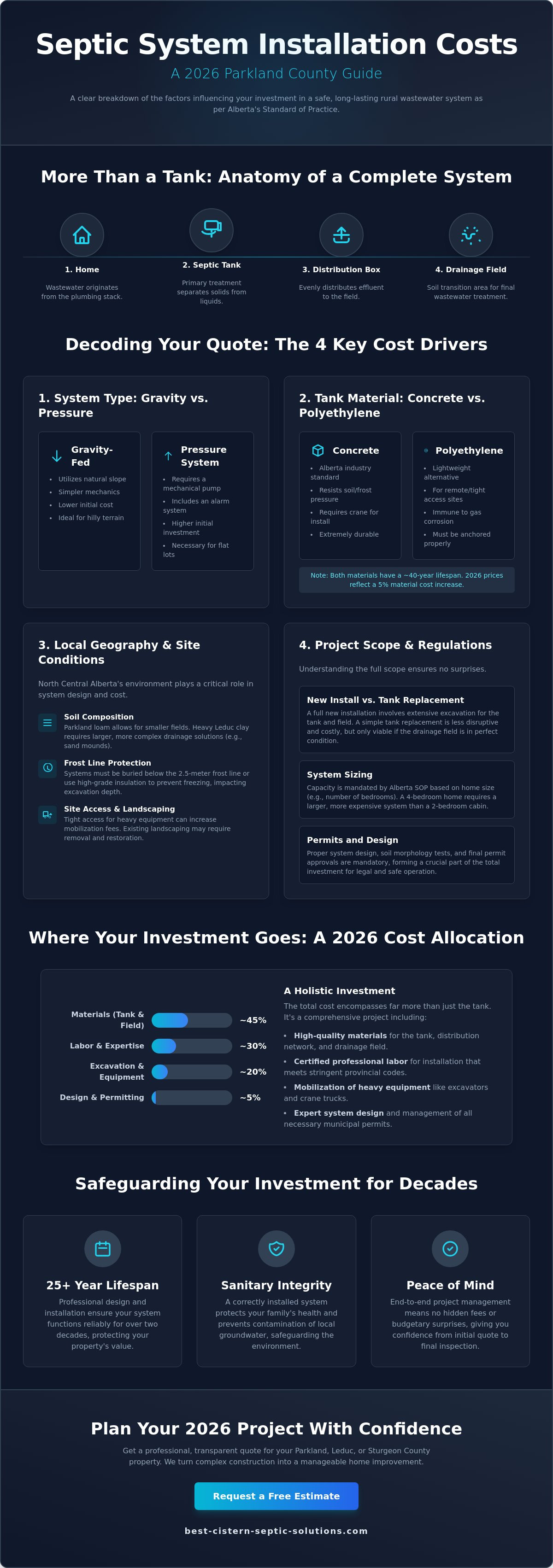
Investing in rural infrastructure requires a clear roadmap and a professional perspective. When homeowners search for the cost to put in a septic tank, they're typically looking for a complete wastewater solution rather than just a buried container. In the 2026 Alberta market, pricing reflects a 5% increase in raw material costs for reinforced concrete and high-density polyethylene compared to two years ago. A successful installation ensures your home remains a safe, sanitary environment for decades.
Understanding what a septic system is helps clarify why the budget involves an entire network of components. The system includes the primary treatment tank, the distribution box, and the soil transition area, commonly called the drainage field. Alberta's Private Sewage Systems Standard of Practice mandates that system capacity must match the home's potential occupancy. For example, a standard four-bedroom residence in Parkland County requires a larger daily design flow than a two-bedroom seasonal cabin, directly impacting the size and price of the installation.
The Difference Between Tank Replacement and New Installation
A simple tank swap is often possible if your existing drainage field remains in peak condition. This surgical procedure involves disconnecting the old unit and dropping a new, resilient tank into the same footprint. It's a localized task that minimizes yard disruption. However, if you notice soggy patches in the grass or slow-moving drains, the field is likely the true source of your concerns. A full installation requires more extensive excavation and complex integration with your home’s main plumbing stack, which increases the labor hours required to secure the system's integrity.
Why Local Geography Matters in North Central Alberta
The cost to put in a septic tank fluctuates based on what's beneath your feet. Parkland County loam offers better natural filtration than the heavy, stubborn clay often found in neighboring Leduc County. Clay stays saturated longer, which frequently necessitates a larger drainage footprint or an above-ground sand mound to meet provincial safety codes.
- Frost Line Protection: Alberta winters are unforgiving. We install systems deep enough to sit below the 2.5-metre frost line or use high-grade R-value insulation to prevent seasonal freeze-ups.
- Topography: If your property has a natural slope, we can often utilize a gravity-fed system. Flat lots usually require a mechanical pump and an alarm system to move effluent, adding to the initial mechanical budget.
- Soil Composition: Sandy soil allows for smaller, more affordable fields, while dense clay demands specialized engineering to protect your groundwater.
By addressing these environmental factors early, we turn a complex construction project into a manageable home improvement. Every site presents unique variables, but a methodical approach ensures your family’s health and your property’s value remain protected for the long haul.
Breaking Down the Components: Where Your Investment Goes
Understanding the cost to put in a septic tank requires a look at the physical assets buried on your property. Your investment isn't just for a container; it's for a complex wastewater treatment plant. In Parkland County, the 2026 market reflects shifts in raw material costs and fuel surcharges for heavy equipment mobilization. A standard installation involves three primary financial pillars: the tank itself, the lateral field materials, and the technical labour required to calibrate the system for long-term safety.
Septic Tank Materials: Concrete vs. Plastic
Concrete tanks remain the industry standard in Alberta due to their sheer mass and structural integrity. They resist the shifting pressures of freezing soil during our long winters. Installing a 4,500-litre concrete tank requires a 20-tonne crane truck for delivery. This adds to the mobilization fee if your site has restricted access. Polyethylene (plastic) tanks offer a lighter alternative for remote acreages where heavy trucks cannot reach. While plastic is immune to the corrosion caused by hydrogen sulfide gas, it requires precise anchoring to prevent "floating" in high water tables. Both options typically provide a 40-year service life when maintained with regular inspections from a trusted specialist.
The Drainage Field: The Most Variable Cost Factor
The disposal field often represents 50% to 60% of the total project budget. Costs fluctuate based on whether you utilize traditional gravel trenches or modern chamber systems. Because Parkland County soil often contains high clay content, many sites require "imported" sandy loam or washed rock to meet provincial safety codes. This aggregate must meet specific filtration standards to ensure the effluent is purified before reaching the groundwater. The size of this field scales directly with the number of bedrooms in your home, as Alberta Private Sewage Systems Standards of Practice dictate field capacity based on peak daily flow. You can learn more about the different types of septic systems to see which configuration might suit your land's topography.
Beyond the excavation, your budget must account for the mechanical and electrical components that keep the system sanitary. These include:
- Effluent Pumps: Essential for pressure distribution systems to ensure even field loading and prevent soil clogging.
- High-Water Alarms: A critical safety feature that alerts you to system backups before they reach your home's interior.
- Specialized Sand: Often sourced from local pits in the Acheson or Spruce Grove area to minimize hauling fees.
- Electrical Wiring: Professional connection of the control panel to your home's main breaker, ensuring the protection of the pump motor.
Focusing on high-quality components during the initial cost to put in a septic tank prevents the need for invasive repairs later. This methodical approach ensures your mechanical system maintains its integrity for decades, providing the peace of mind that your household waste is handled with professional care.
System Types and Their Price Points: Gravity vs. Pressure
The total cost to put in a septic tank depends largely on the mechanical requirements of your property's soil and topography. While a basic tank might seem like a simple purchase, the delivery system that moves effluent to your disposal field represents the true engineering challenge. You must balance the initial capital outlay against the 20 to 25 year lifespan of the system. In Parkland County, the Alberta Private Sewage Systems Standard of Practice dictates which system types are permissible based on your site's specific soil profile. Choosing the wrong system to save money upfront often leads to premature field failure and expensive emergency excavations later.
Conventional Gravity Systems
Gravity systems remain the most budget friendly option for homeowners with sloped properties and excellent soil drainage. These setups rely on natural physics to move liquid from the tank to the drainage trenches. They don't require pumps or complex electrical components, which reduces the initial cost to put in a septic tank. However, they're highly sensitive to soil depth. If your land has high groundwater levels or restrictive layers within the first 90 to 120 centimetres, gravity won't be an option. You'll need to commit to a strict effluent filter cleaning schedule every six months to prevent solids from reaching and clogging the soil pores.
Pressure Distribution and LPP Systems
Pressure distribution is the standard for modern Alberta homes built on heavy clay or flat terrain. These systems use an effluent pump to "dose" the entire drainage field at once, ensuring every square foot of soil works equally. This prevents the "saturated front" that often kills gravity fields in Parkland County. You'll need to budget for a pump chamber, high-level floats, and a reliable septic alarm installation to monitor the mechanical health of the system. While the electrical components add to the price, they provide a level of control and longevity that simple gravity cannot match.
Advanced Treatment Plants (ATUs)
Advanced Treatment Plants act like miniature municipal sewage facilities for your backyard. They're often mandatory for smaller lots near lakes or environmentally sensitive areas where traditional fields won't fit. These units use oxygen to break down waste more aggressively, resulting in high quality effluent that requires a much smaller footprint for the final discharge area. You can expect higher upfront costs and a requirement for ongoing service contracts. Most manufacturers require professional inspections every 12 months to maintain the mechanical components. This investment protects the local ecosystem and allows for residential development on lots that were previously considered unbuildable.
Analyzing the total cost of ownership is vital for your 2026 budget. A cheaper gravity system might cost less today, but a pressure system's ability to distribute waste evenly can extend the life of your drain field by a decade. When you view your septic system as a long-term utility rather than a one-time expense, the value of robust mechanical components becomes clear. We focus on providing solutions that safeguard your property value and ensure your home remains a healthy environment for your family.
The Hidden Variables: Why Quotes Differ in Leduc and Sturgeon Counties
Property owners often wonder why two identical homes in Leduc and Sturgeon Counties receive vastly different estimates for wastewater systems. The total cost to put in a septic tank depends on more than just the size of the vessel. Every project begins with the non-negotiable Alberta Private Sewage Systems Standard of Practice (SOP) permits and site inspections. These regulatory steps ensure your system protects the local water table and meets provincial safety codes. Beyond paperwork, the physical layout of your land dictates the labor hours required for excavation. Site access issues, such as narrow gates or overhead power lines, can force contractors to use smaller, slower machinery. This increases the time spent on-site and shifts the final invoice.
Landscaping and existing infrastructure also play a significant role in your budget. If a contractor must navigate around mature prize-winning spruce trees or cross a paved driveway, the restoration costs will climb. Utility locates are mandatory before any shovel hits the ground to prevent catastrophic damage to gas or fiber optic lines. These variables transform a standard installation into a custom engineering project tailored to your specific lot.
Soil Testing and Engineering Design
A professional soil percolation test is the most critical document in your project file. This "perc test" measures how quickly water moves through your specific soil profile. It dictates whether you can install a traditional gravity-fed system or if you require a more complex septic field installation involving pressure distribution. In Alberta, professional design services are a legal prerequisite for obtaining permits. These designs ensure the effluent is treated effectively, safeguarding your family's health and the integrity of your property for decades. Skipping this step isn't an option; it's the foundation of a functional system.
Permits and Regulatory Compliance
Navigating the permit application fees in Parkland County or Leduc County requires precision. While these fees are a small percentage of the overall cost to put in a septic tank, they provide the essential "Certificate of Compliance" upon completion. This document is vital for future real estate sales, as most modern buyers and lenders demand proof of a permitted, inspected system. Working without a permit is the most expensive mistake a homeowner can make. Unpermitted systems can lead to mandatory dig-ups, heavy municipal fines, and potential environmental liability that far exceeds the initial savings.
- Tree Removal: Clearing a 15-meter radius for a drain field can add several days to the timeline.
- Driveway Restoration: Heavy equipment can crack standard residential asphalt or thin concrete pads.
- Utility Locates: Identifying buried lines is a safety requirement that prevents service interruptions.
We believe every homeowner deserves a system that provides total peace of mind. If you're ready to secure your property's future, contact Best Cistern & Septic Solutions for a professional consultation today.
Safeguarding Your Investment: The Best Cistern Septic Solutions Advantage
Choosing a contractor involves more than comparing quotes. It's about securing the health of your land and the safety of your family. At Best Cistern & Septic Solutions, we maintain a grounded approach to technical excellence. We believe professional integrity means doing the job right the first time, even when the components are buried deep underground. Our team manages every phase of the project, from initial permits to final testing. This end-to-end management removes the stress often associated with rural infrastructure. We don't use a one-size-fits-all model. Every property in Parkland County has specific soil types and drainage needs. Our solution-first mindset ensures we design a system tailored to your unique site. We prioritize pristine installation to safeguard your household safety. Every connection is tested to ensure a sanitary, leak-free environment for your family.
Long-Term Value Over Bottom-Dollar Pricing
When calculating the cost to put in a septic tank, looking only at the lowest bid can be a mistake. Lower prices often hide missing permit fees or subpar materials that fail within five years. Our detailed site inspections prevent these costly mid-project surprises. We identify soil saturation issues early; this can save you C$2,500 or more in emergency redesigns during the construction phase. We also emphasize high-quality effluent pumps. These components are the heart of your system. A premium pump extends the longevity of your drain field by ensuring consistent, measured wastewater distribution. You can learn more about how these parts work together by understanding septic systems in depth.
Next Steps for Your Rural Property
Ready to move forward? Your first step is a professional site diagnostic. We'll assess your property's topography and soil composition to determine the most efficient system for your needs. Before our specialists arrive, gather any existing land surveys or utility maps you have on file. This information helps us refine the cost to put in a septic tank for your specific lot. We'll walk you through the entire process so you feel empowered rather than overwhelmed. Our goal is to provide a permanent resolution to your wastewater needs. Contact us for a professional septic consultation to secure your home's future and gain true peace of mind.
Plan Your 2026 Septic Installation with Confidence
Investing in your property's infrastructure is one of the most significant decisions you'll make as a homeowner in Parkland County. As we look toward 2026, the cost to put in a septic tank remains dependent on your specific soil profile and whether your site requires a gravity or pressure distribution system. Adhering to the Alberta Private Sewage Systems Standard of Practice (SOP) ensures your system operates safely for decades while protecting the local environment. Best Cistern Septic Solutions provides a methodical approach to every project. We manage the entire journey from your initial soil testing to the final certificate of compliance. Our team has served Parkland and Leduc Counties for years, treating every installation as a vital safeguard for your family's health. You don't have to navigate these technical regulations alone. We're here to turn a complex requirement into a manageable, long-term asset for your home. Your peace of mind starts with a system built to last.
Request a Professional Septic Installation Quote
Frequently Asked Questions
How much does a typical septic permit cost in Parkland County?
In Parkland County, a Private Sewage Disposal System (PSDS) permit typically costs between C$225 and C$350 as of 2024. This fee covers the administrative review and the mandatory inspections required to ensure your system meets the Alberta Private Sewage Systems Standard of Practice. Securing this permit is the first essential step to ensure your installation is legal and your property remains protected.
Does the type of soil on my property really change the installation price?
Soil composition is the primary factor that dictates the final cost to put in a septic tank. Heavy clay soils, which are common in many Alberta regions, require much larger drainage fields or specialized treatment mounds to process effluent safely. While sandy soil allows for a more compact and affordable gravity system, poor-draining clay can increase material and labor costs by 40% to 60% compared to ideal conditions.
Can I install my own septic tank to save on labor costs in Alberta?
Alberta law allows homeowners to apply for a Homeowner Permit to install their own system if they reside in the home, but strict adherence to the 2015 Standard of Practice is mandatory. However, 85% of self-installed systems fail initial inspections due to technical errors in slope or tank leveling. Hiring a certified professional ensures the long-term integrity of your home’s waste management and prevents the stress of costly remedial excavations.
How much extra does a pressure-distributed system cost compared to gravity?
A pressure-distributed system typically adds C$6,000 to C$12,000 to the total project budget when compared to a standard gravity-fed system. This investment covers the cost of a high-head effluent pump, electrical controls, and specialized small-diameter piping. These systems provide superior protection for your property by ensuring even distribution of wastewater, which significantly extends the lifespan of your disposal field.
What is the most expensive part of a septic system installation?
The soil treatment area, specifically the drain field or treatment mound, represents the largest portion of your budget. For a standard three-bedroom home, the specialized washed rock and ASTM C33 sand required for a mound can account for 50% of the total material costs. These high-quality materials are essential for maintaining a pristine environment by filtering out pathogens before they reach the groundwater.
How long does it take to install a new septic tank and field?
A professional installation typically takes between 3 and 5 business days to complete from the initial excavation to final backfilling. This timeline assumes that the site is prepared and the weather remains stable. Our team coordinates the delivery of the concrete or plastic tank and the arrival of the safety inspectors to ensure the project moves forward without unnecessary delays, giving you back your peace of mind quickly.
Are there grants or subsidies for septic replacement in North Central Alberta?
Direct provincial grants for residential septic systems are currently limited, but some residents in the North Saskatchewan River watershed may qualify for local environmental conservation programs. You should check with Parkland County regarding the Clean Energy Improvement Program (CEIP), as some municipalities are expanding these to include water conservation and sanitary upgrades. Investing in a modern, efficient system serves as a long-term safeguard for your property's health.
What happens if my soil fails the percolation test?
If a percolation test or soil morphology report indicates poor drainage, you'll likely need an above-grade solution like a Wisconsin Mound or an Advanced Treatment Plant. These systems use mechanical aeration or specialized sand layers to treat effluent when the natural soil cannot. While these solutions require a higher initial cost to put in a septic tank, they provide a reliable, professional fix for even the most challenging Alberta terrain.


