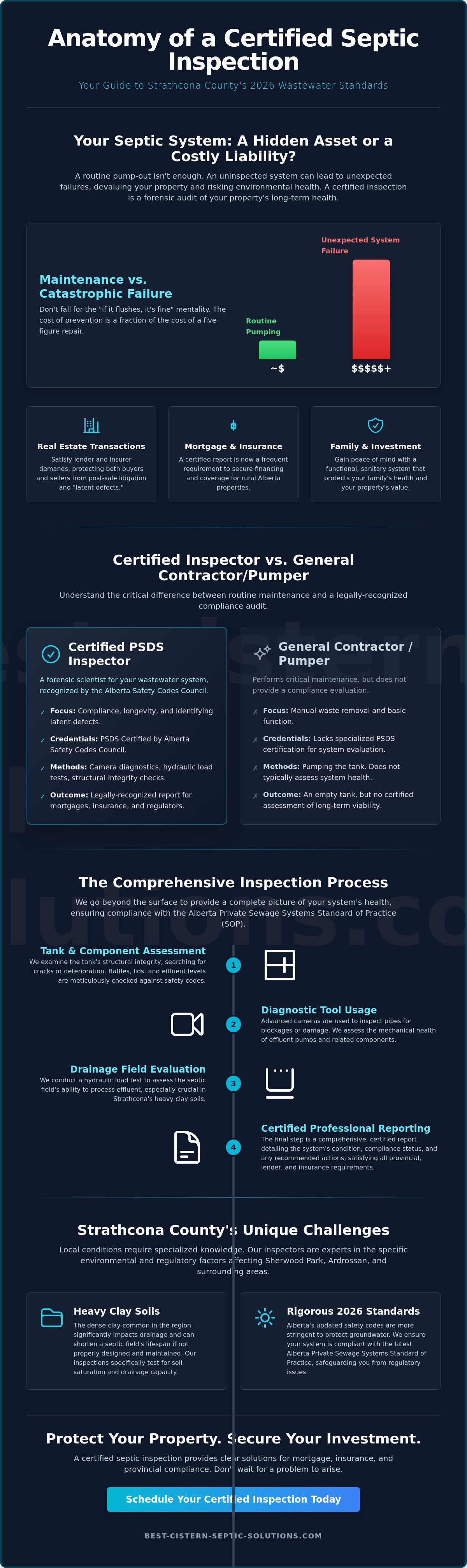
A septic inspection isn't just a look inside the tank; it's a forensic audit of your property's long term health. Many homeowners mistakenly believe that a routine pump out covers their legal requirements, only to face five figure repair costs when a system fails unexpectedly. Working with a certified septic inspector Strathcona County residents trust ensures that your system doesn't just work today, but remains compliant with the Alberta Private Sewage Systems Standard of Practice (SOP) for years to come.
It's understandable to feel anxious about the hidden state of your wastewater system, especially when a real estate deal or insurance policy is on the line. You want the peace of mind that comes from a functional, sanitary system that protects your family and your investment. This guide explains exactly what a professional inspection entails under the 2026 safety standards. We'll break down the technical differences between maintenance and compliance, detail the specific components we examine, and show you how to secure a certified report that satisfies both lenders and provincial regulators.
Key Takeaways
- Learn why real estate transactions in Strathcona County require a formal evaluation from a Private Sewage Disposal Systems (PSDS) professional rather than a general contractor.
- Understand how a certified septic inspector Strathcona County uses diagnostic tools like cameras and hydraulic load tests to assess your system’s integrity.
- Discover how the heavy clay soils of Sherwood Park and Ardrossan impact your septic field's drainage and long-term longevity.
- Identify the specific Alberta Safety Codes Council standards that ensure your inspector is qualified to evaluate critical wastewater infrastructure.
- Find out how professional reporting acts as a safeguard for your property's value, providing clear solutions for mortgage and insurance compliance.
Why You Need a Certified Septic Inspector in Strathcona County
Your home's septic system is likely its most expensive hidden asset. Because it operates out of sight, it's easy to overlook until a problem arises. In 2026, the standards for rural wastewater management in North Central Alberta have become more rigorous to protect local groundwater and property values. Hiring a certified septic inspector Strathcona County residents can trust is the first step toward ensuring your home remains a safe, sanitary environment. While a general contractor might be excellent at home renovations, they lack the specialized training required to evaluate complex onsite sewage facilities. A certified Private Sewage Disposal Systems (PSDS) professional holds specific credentials recognized by the Alberta Safety Codes Council, allowing them to provide the technical accuracy you need.
Real Estate and Mortgage Requirements
Buying or selling a rural property in Strathcona County involves unique challenges that city homes don't face. Alberta lenders and insurers now frequently demand a certified inspection report before they will approve a mortgage or provide coverage. This requirement exists because a failed system can decrease a property's value by tens of thousands of dollars instantly. A professional inspector identifies "latent defects," which are deep-seated issues that a standard pump-out service would miss. By providing a clear, documented state of the system, a certified septic inspector Strathcona County professional protects both buyers and sellers from the stress of post-sale litigation. It ensures that everyone involved in the transaction has a transparent understanding of the system's integrity.
Maintenance vs. Compliance
Many homeowners operate under the "if it flushes, it’s fine" mentality. Unfortunately, a system that flushes today might be on the verge of a total breakdown tomorrow. Maintenance is about keeping the water moving, but compliance is about meeting the Alberta Private Sewage Disposal Systems Standard of Practice. A technical inspection goes beyond the surface to identify system aging before it leads to a catastrophic septic field failure. We view these evaluations as an investment in your home’s health. By verifying that your tank, baffles, and effluent levels meet current safety codes, we help you avoid emergency repairs and extend the longevity of your infrastructure. This proactive approach turns a potentially overwhelming technical problem into a predictable, manageable solution for your household.
What Does "Certified" Mean? Alberta Standards and the Safety Codes Council
A certified septic inspector is a professional recognized by the Alberta Safety Codes Council to evaluate Private Sewage Disposal Systems (PSDS). This designation represents a deep commitment to technical excellence and public safety. In Alberta, the PSDS certification is the only credential that grants an individual the legal authority to declare a system compliant with provincial law. This training covers everything from soil morphology to the hydraulic principles of effluent distribution. Without this specific recognition, an evaluation lacks the regulatory weight required by banks, insurers, and the county itself.
It's vital to distinguish between a septic pumper and a certified septic inspector Strathcona County residents rely on for technical audits. A pumper performs the necessary manual labor of hauling waste, which is a critical part of maintenance. However, they don't usually evaluate the mechanical health of the effluent pump or the structural integrity of the tank walls. An inspector acts as a forensic scientist for your wastewater system. They look for signs of stress, such as hairline fractures or deteriorating baffles, that could lead to environmental contamination. If you need a definitive answer on your system's longevity, a technical inspection is the only way to get it.
The Alberta Safety Codes Council Framework
The Safety Codes Council sets the benchmark for all private sewage training in 2026. This framework requires inspectors to stay current with the Alberta Private Sewage Systems Standard of Practice. A certified report carries significant weight in provincial matters, acting as a verified document that your system complies with the Safety Codes Act. If you're unsure about a provider's status, you can always ask for their certification number or verify their credentials through the council's registry. This transparency ensures that the professional you hire is qualified to protect your home's most critical infrastructure.
Why Local Strathcona Expertise Matters
Every municipality has its quirks. Strathcona County’s Land Use Bylaw contains specific provisions for environmental zones and setback distances that an out-of-town inspector might miss. Local expertise is vital when navigating the permitting process for a new septic field installation. We maintain professional relationships with local health and safety officers, which helps streamline the approval process and ensures all paperwork is filed correctly. If you have questions about your specific lot, our team can provide professional septic advice tailored to the county's unique landscape and regulatory environment.
The Comprehensive Inspection Process: What to Expect
A professional audit is far more than a visual check of your lawn. When you hire a certified septic inspector Strathcona County homeowners trust, you are commissioning a forensic review of your home's wastewater infrastructure. This process follows the rigorous standards established by the Alberta Onsite Wastewater Management Association to ensure every component of your system is evaluated for safety and longevity. We use specialized tools like high-resolution cameras, soil probes, and electronic locators to map out the invisible parts of your property. The goal is to provide a complete picture of the system's health, moving beyond surface-level symptoms to find the root cause of any potential issues.
Step 1: Tank Integrity and Baffle Assessment
Evaluating the tank involves a deep dive into its structural integrity. We look for cracks, corrosion, or leaks in the tank walls that could compromise the sanitary seal. Our team specifically checks the inlet and outlet baffles to verify they are properly directing flow and keeping solids where they belong. This step is vital because a missing baffle can allow solids to enter your drainage field, leading to premature failure. We also measure the depth of the sludge and scum layers to determine if your current septic tank maintenance schedule is adequate for your household's actual usage.
Step 2: The Septic Field Diagnostic
The dispersal field is the most expensive part of your system. We use soil probes to look for signs of anaerobic "black layer" conditions that indicate poor oxygen flow and potential saturation. A hydraulic load test is an essential part of our diagnostic toolkit. By simulating heavy household usage, we can observe how quickly the field recovers and processes effluent. This test ensures your distribution boxes and header lines are providing even distribution across the entire soil surface. If the field is struggling to keep up, we can identify specific septic system repair options before a complete replacement becomes necessary.
Step 3: Mechanical and Electrical Components
Mechanical failure is a frequent cause of sudden backups. We test the effluent pump and float switches to confirm they engage exactly when needed. Our inspectors also verify that the septic alarm system is functional and properly wired to alert you of high water levels before a spill occurs. If your property uses a combined water and waste system, we verify the integrity of the cistern to ensure your potable water remains pristine. At the end of this process, you receive a detailed Certified Inspection Report. This document provides the peace of mind you need for insurance providers or real estate transactions, clearly outlining the state of your home's most vital infrastructure.
Strathcona County Challenges: Clay Soils and Cold Climates
Strathcona County presents a unique set of geological and climatic hurdles for rural homeowners. The heavy clay soils common in Sherwood Park and Ardrossan don't drain as easily as sandy loams found elsewhere in Alberta. When you work with a certified septic inspector Strathcona County expert, they evaluate your system through the lens of these local conditions. This specialized knowledge is vital because a system designed for a different environment will likely fail prematurely here. We look for specific indicators of stress caused by our region’s high water tables and intense freeze-thaw cycles.
Soil Composition and Drainage Rates
Heavy clay is notoriously difficult for effluent dispersal. Because clay particles are small and packed tightly, drainage rates are naturally slow. This is why "perc tests" or comprehensive soil profiles are critical during an inspection. A certified inspector evaluates the soil's ability to accept wastewater without becoming saturated. On many Strathcona County acreages, soil compaction from heavy machinery or even livestock can further reduce this capacity. We use soil probes to check for anaerobic conditions, ensuring your field isn't becoming a "sealed" environment that prevents proper treatment.
Winter Operations and Frost Protection
Our North Central Alberta winters are a significant stress test for any onsite system. Shallow-buried lines are particularly vulnerable to freezing if they aren't properly insulated or if snow cover is stripped away. Hiring a certified septic inspector Strathcona County specialist allows you to identify these vulnerabilities before they turn into mid-winter emergencies. A professional inspection identifies signs of past frost damage, such as heaved pipes or cracked tank lids. We also check the venting system. Proper airflow is essential to prevent sewer gases from freezing and creating ice blockages in the stack. If your system was installed decades ago, it might lack the modern frost protection required by the 2026 safety codes.
The "Greener Grass" phenomenon is a common trap for homeowners. While a lush, bright green patch over your septic field might look healthy, it often indicates that effluent is rising to the surface rather than soaking into the ground. This "surfacing" is a clear sign of field failure. Similarly, the spring thaw brings high water tables that can put immense pressure on your tank. If your system isn't watertight, groundwater can leak in, overwhelming your effluent pump and leading to a backup. These seasonal shifts require a proactive approach to prevent long term damage.
Don't wait for the spring thaw to discover a problem. You can book a professional septic evaluation today to ensure your system is prepared for the next Alberta winter.
Choosing Best Cistern Septic Solutions for Your Inspection
Selecting a certified septic inspector Strathcona County property owners can rely on is about more than checking a box for a permit. It's about finding a partner who understands the intricate mechanics of rural infrastructure. At Best Cistern & Septic Solutions, we take a "Trusted Specialist" approach. We don't just point out flaws; we provide a clear path forward. Our experience spans the unique landscapes of North Central Alberta, including Leduc and Parkland Counties, giving us a deep understanding of how local soil and weather patterns affect your system's integrity.
We believe an inspection should be the start of a solution, not the end of a conversation. If our diagnostic reveals an issue, we offer comprehensive septic solutions to restore your system's health. Whether it's a minor mechanical adjustment or a major restoration, our goal is to protect your family and safeguard your property value. We focus on the invisible benefits of our work, ensuring you don't have to worry about what's happening beneath your lawn. Every problem has a manageable resolution when you have the right technical expert on your side.
Transparent, Professional Reporting
Our reports are a staple for realtors and lenders across the Edmonton Capital Region because they are thorough and easy to read. We break down technical findings into clear, declarative insights. You won't find confusing jargon here. Instead, you'll get a detailed look at your system's current state and proactive steps for prevention. This transparency builds trust with mortgage providers and gives you the peace of mind that your home is in compliance with all 2026 standards. We prioritize the health of your home's most expensive infrastructure so you can focus on enjoying your rural lifestyle.
A Partner in Rural Home Health
We view your property as a complete water cycle. This is why we often integrate cistern maintenance with our septic inspections. By auditing both your water storage and wastewater dispersal, we ensure your entire household remains sanitary and safe. Our reputation for diligence in Strathcona County is built on this detail-oriented service. We treat every home as if it were our own, emphasizing longevity and protection above all else. We are a hardworking entity that takes pride in performing these essential tasks with a high level of sophistication. If you're ready to invest in your home’s health, contact Best Cistern Septic Solutions for a professional evaluation today. Our team is ready to provide the definitive, professional resolution you deserve.
Protect Your Property Value with Professional Oversight
Securing your rural home’s future means looking far beyond the surface of your lawn. We've explored how a forensic diagnostic protects your investment from the specific challenges of Strathcona County’s heavy clay soils and extreme winter frost. By partnering with a certified septic inspector Strathcona County families can rely on, you ensure your wastewater system meets Alberta’s 2026 safety standards while avoiding the stress of unexpected failures. Our team focus on proactive maintenance and technical accuracy to provide you with total peace of mind.
Best Cistern & Septic Solutions serves Strathcona County and the Greater Edmonton Area as a Safety Codes Council Certified PSDS Inspector. We provide the comprehensive real estate and maintenance reports required by modern lenders and insurance providers. Whether you're buying a new acreage or protecting your current one, we're here to turn complex technical issues into manageable, long term results. Every infrastructure problem has a professional fix, and we're ready to help you find it.
Book Your Certified Septic Inspection in Strathcona County and invest in the health of your home today.
Frequently Asked Questions
Is a septic inspection the same as having my tank pumped?
No, a septic inspection is not the same as a pump out. Pumping is a maintenance task that involves removing accumulated waste, while an inspection is a technical audit of the system's mechanical and structural health. A certified septic inspector Strathcona County residents hire will evaluate the tank walls, baffles, and the dispersal field's ability to process effluent. This process identifies potential failures that a simple cleaning would miss entirely.
How long does a certified septic inspection take in Strathcona County?
A standard inspection usually takes between two and four hours to complete. The exact timeframe depends on the size of your property and how easily we can access your tank lids and dispersal field. We take the time to perform a methodical review, including hydraulic load tests and camera diagnostics. This ensures you receive a thorough report that correctly reflects the state of your infrastructure.
What happens if my septic system fails the inspection?
If a system fails, it means specific components don't meet current Alberta safety codes or are reaching the end of their lifespan. We provide a detailed list of manageable solutions to bring the system back into compliance. Whether it's an effluent pump replacement or a septic field repair, every problem has a professional resolution. We focus on restoring the safety and integrity of your home's wastewater management.
Can I perform my own septic inspection for a real estate sale?
No, you cannot perform your own inspection for a real estate transaction. Lenders, insurers, and the county require a report from a professional recognized by the Alberta Safety Codes Council. A certified septic inspector Strathcona County specialist has the technical training to identify latent defects. This official documentation protects both buyers and sellers from future liability and ensures the property meets provincial standards.
How much does a certified septic inspection cost in Alberta?
The cost of an inspection depends on the complexity of the system and the level of diagnostic testing required. While we don't provide a flat rate without seeing the property, we view the fee as an investment in your home's health. It's a small price to pay to avoid the five figure costs associated with a total system failure. We provide transparent pricing based on the specific needs of your rural property.
How often should I have my septic system professionally inspected?
You should have your system professionally inspected every 12 to 36 months. This frequency aligns with recommendations from Strathcona County and provincial guidelines. If your system includes electrical components like alarms or pumps, you might consider more frequent checkups. Regular oversight helps identify minor issues before they become emergency repairs, extending the longevity of your septic field and tank.
Do I need to be home during the inspection?
You don't have to be home, but it's often helpful if you are. Being present allows us to access indoor plumbing for flow tests and explain our findings to you in person. If you can't be there, we can still perform the exterior audit as long as we have clear access to the tank and field. We'll provide a digital copy of the certified report once the evaluation is complete.
Will the inspector need to dig up my yard?
We aim for minimal disturbance to your landscaping. We use soil probes and cameras to look underground without the need for heavy machinery. You will need to ensure your tank access lids are exposed before we arrive. If a component is buried deep without a riser, we might need to uncover it, but we never perform large scale excavation as part of a standard diagnostic inspection.


