
Could the "tried and true" advice from your neighbor actually be the reason your drainage field fails a decade early? In the quiet stretches of North Central Alberta, rural homeowners often rely on passed-down wisdom to manage their essential utilities. While these stories are shared with good intentions, following common septic system myths can lead to catastrophic failures and the heavy burden of a full system replacement. We understand the anxiety that comes with a potential winter backup or a failing field. You deserve to feel certain about your property’s long-term safety and functional integrity.
It's natural to feel overwhelmed by conflicting information regarding additives, pumping schedules, and winter maintenance. This guide separates fact from fiction to help you protect your property and avoid thousands in unnecessary repair costs. We provide a clear, professional look at the biological realities of your system. You'll learn how to maintain the health of your utility through eight debunked myths, all grounded in the 2021 Alberta Standard of Practice. By the end, you’ll have the confidence to ensure your system remains a durable, high-performing asset for your household.
Key Takeaways
- Understand why chemical "quick fixes" and yeast often do more harm than good by disrupting the natural bacterial balance of your tank.
- Learn to identify the warning signs of a failing drainage field, including why common septic system myths about lush green grass usually indicate surfacing effluent.
- Discover the critical distinction between routine tank maintenance and professional restoration, ensuring you don't waste money on pumping when a mechanical repair is required.
- Protect your system during harsh Alberta winters by leveraging natural snow insulation rather than clearing it and risking frozen components.
- Gain a proactive 3-step checklist to transition from reactive troubleshooting to long-term property preservation and system health.
The 'Magic Bullet' Myth: Do Septic Additives Actually Work?
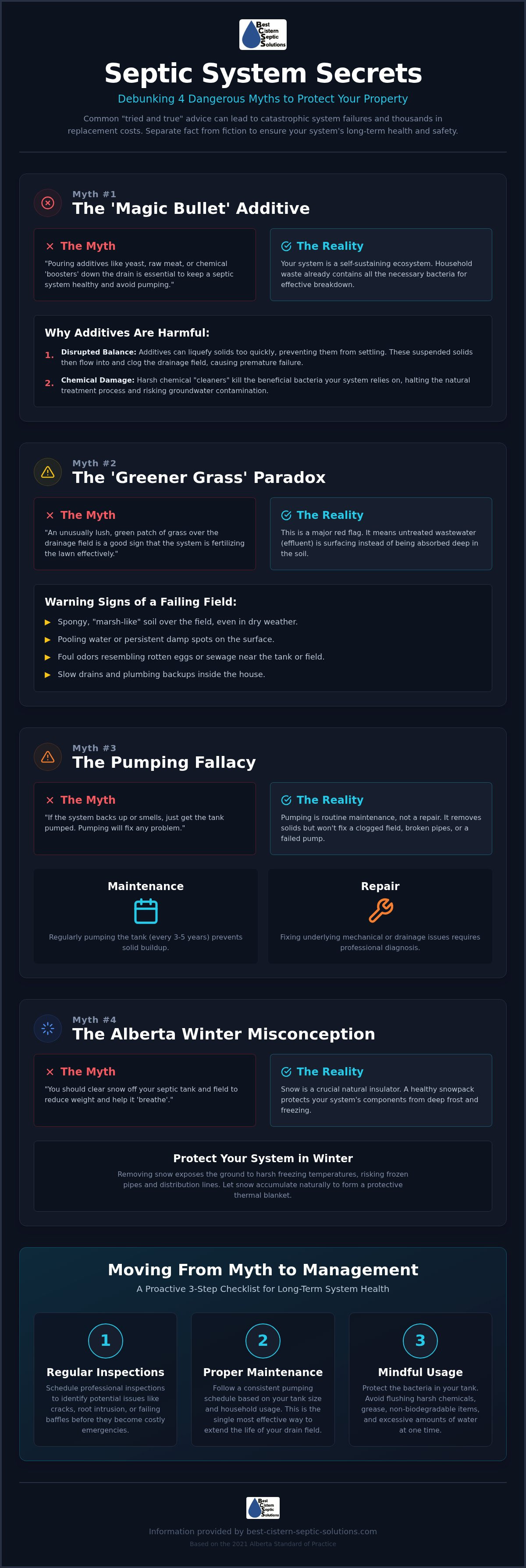
Many homeowners in North Central Alberta search for a shortcut to avoid the stress of a failing utility. This search often leads to one of the most persistent septic system myths: the idea that you can simply pour a "magic bullet" down the drain to keep everything running smoothly. Septic additives are frequently marketed as essential boosters or "starters," but in reality, they often disrupt the delicate natural bacterial flora that makes your system work. These products suggest a level of simplicity that ignores the complex biological processes occurring beneath your lawn.
The belief that baking yeast or even raw meat can act as a necessary "starter" for a system is common but misguided. A healthy septic system doesn't need external biological triggers to begin its work. Household waste already contains the exact enzymes and bacteria required for effective digestion. In fact, Alberta environmental experts and the EPA generally advise against using these products. Adding foreign substances can cause solids to liquefy too quickly or stay suspended in the water, allowing them to flow into your drainage field and cause a premature, expensive failure. Relying on these home remedies is no substitute for professional diagnostic inspections.
The Science of Natural Bacterial Breakdown
Your septic tank functions as a living, self-sustaining ecosystem. It relies on a complex balance of anaerobic and aerobic bacteria to break down organic matter into manageable layers. Understanding how septic systems work reveals that the waste entering the tank provides all the necessary nutrients for these microbes to thrive. Problems arise when homeowners try to accelerate this process. If solids are broken down into fine particles too rapidly, they don't settle as sludge. Instead, they travel out with the effluent, eventually clogging the soil pores in your drainage field and leading to total system collapse.
Chemical Additives vs. Biological Balance
While biological additives are often redundant, chemical "cleaners" are actively harmful. Harsh solvents and synthetic miracle treatments can kill the beneficial bacteria your system depends on for safety and cleanliness. The biomat is a thin layer of specialized bacteria and organic material that forms at the soil interface to provide the final stage of effluent treatment. When synthetic chemicals bypass the tank and reach this layer, they can damage the soil's ability to filter water. This increases the risk of groundwater contamination and threatens the long-term durability of your property's infrastructure. Relying on science rather than septic system myths ensures your utility remains a reliable asset for decades.
The 'Greener Grass' Myth: Is a Lush Lawn a Good Sign?
It's a common sight across Parkland County: a backyard with one specific patch of grass that looks significantly more vibrant than the rest. While a healthy lawn is usually a source of pride, this particular phenomenon is one of the most misunderstood septic system myths. Homeowners often assume that the extra growth is a sign of a thriving ecosystem. In reality, exceptionally green, spongy grass over your drainage field is a red flag that requires professional attention. It indicates that your system is no longer functioning as an invisible utility but is instead making its presence known on the surface.
This is the 'Greener Grass' Paradox. A properly functioning field should distribute effluent deep into the soil for natural filtration. When the soil becomes clogged or saturated, the wastewater is forced upward toward the surface. This provides an unnatural amount of moisture and nutrients to the grass roots, creating a lush appearance that masks a developing failure. If you notice pooling water or persistent odors near the tank, the system is likely in a state of hydraulic overload. Addressing these signs early can prevent the high costs associated with a full field replacement.
Symptoms of a Failing Septic Field
Spongy soil is often the first physical indicator of a struggle. You might feel a distinct "marsh" effect when walking over the area, even during dry spells. It's easy to mistake this for seasonal runoff, especially during an Alberta spring; however, consistent dampness is a clear sign of a leak or field exhaustion. Professional septic system inspections are vital in these moments. They help differentiate between temporary environmental factors and a genuine mechanical failure before the problem reaches your basement.
Why 'Out of Sight' Doesn't Mean 'Functional'
A system that isn't backing up into the house isn't necessarily healthy. The transition from a sluggish field to a total backup is often slow and invisible. As soil becomes saturated, it loses its ability to "breathe," which is essential for the aerobic bacteria to treat the effluent effectively. A properly functioning septic system should have no visible impact on the surface of your yard. If your lawn looks like a golf course only over the pipes, it's time to seek professional Septic Solutions to preserve your property's long-term value and ensure your household's safety.
The Pumping Fallacy: Why Pumping Isn't the Same as Repair
One of the most frequent septic system myths we encounter is the belief that a "honey wagon" visit can solve a failing drainage field. When drains slow down or toilets gurgle, the immediate reaction for many homeowners is to call for a pump-out. While regular pumping is essential for removing accumulated sludge, it is a maintenance task, not a mechanical fix. If your field has reached its capacity or suffered structural damage, emptying the tank is merely a temporary "band-aid" that addresses the symptom rather than the cause. You might find relief for a few days, but the tank will inevitably fill back up because the effluent has nowhere to go.
A professional diagnostic inspection is the only way to identify the root cause of slow performance. Without seeing what's happening inside the pipes, you're essentially guessing. This is where many property owners lose money; they pay for repeated pumping services while the underlying issue continues to degrade the field's integrity. Understanding the distinction between these two services is the first step toward a permanent, manageable resolution.
Understanding the Tank vs. The Field
It's helpful to view your system as two distinct stages. The tank's primary job is settling solids and allowing grease to float, while the drainage field handles the complex biological treatment of the water. A clean tank cannot compensate for a clogged or crushed drainage pipe. If the field is saturated or the biomat has become impermeable, the water remains trapped regardless of how empty the tank is. During regular service, it's also critical to check effluent filters, as a simple blockage here can mimic a total system failure. Addressing these specific components is the core of effective septic system repair.
Diagnostic Inspections: Finding the Real Problem
At Best Cistern Septic Solutions, we use advanced cameras and flow tests to evaluate field health in Leduc County and across North Central Alberta. These tools allow us to see what pumping misses, such as root intrusion, pipe offsets, or soil compaction. Because we don't offer pumping services, our diagnostic reports remain completely unbiased and focused solely on the health of your infrastructure. Consider the long-term value: a professional inspection typically costs between C$300 and C$500. This is a minor investment compared to the C$15,000 to C$30,000 required for a complete system replacement. Finding the real problem early protects your property's integrity and ensures your peace of mind.
Alberta Winter Myths: Snow, Frost, and Frozen Pipes
Winters in North Central Alberta present a unique set of challenges for rural property owners. When the temperature drops below -30°C, a common instinct is to clear the yard, leading to one of the most damaging septic system myths: the belief that you should shovel snow off your septic tank and drainage field. In our region, snow isn't just a nuisance to be cleared; it is a critical insulation blanket. This natural layer traps air and prevents the frost line from driving deep into the soil where your pipes reside. Removing this cover exposes your utility to extreme cold, significantly increasing the risk of a frozen system and a mid-winter backup.
Protecting this thermal barrier is essential for system health. Beyond shoveling, the danger of driving snowmobiles, ATVs, or trucks over the field is often underestimated. These activities compact the snow, stripping away its insulating properties and pushing frost further into the ground. In some cases, the weight of a vehicle on frozen soil can even lead to structural pipe damage. Keeping your field undisturbed throughout the winter is a simple, no-cost way to ensure your system remains functional until the spring thaw.
The Importance of Snow Cover
Uncompacted snow provides the best protection against Alberta’s deep freeze. To maintain this barrier, you should avoid any foot or vehicle traffic on the drainage field once the first snow falls. You can also use proactive landscaping to help. Planting taller native grasses or placing snow fences upwind can naturally catch and hold snow over the field area. This ensures a consistent depth of insulation, keeping the ground temperature stable even when the ambient air is dangerously cold. This strategy preserves the biological activity in the soil, which is vital for continuous effluent treatment.
Managing Water Usage in Cold Snaps
During a deep freeze, some homeowners believe that "dripping taps" will prevent pipes from freezing. This is a disaster for a septic system. Constant, low-flow water lacks the thermal mass to stay warm and often creates "ice dams" in the drainage line. These small trickles freeze layer by layer until the pipe is completely restricted. Instead, it's better to use water in larger, infrequent batches, such as full loads of laundry or a hot bath, to move heat through the system. If your system relies on mechanical components, ensuring your equipment is in peak condition is vital. A timely effluent pump replacement can prevent winter overflows and protect your home from emergency backups. For a professional evaluation of your system's winter readiness, contact our team for Septic Solutions tailored to the Alberta climate.
Moving from Myths to Management: Your Septic Action Plan
Transitioning from reactive, "myth-based" care to a proactive management strategy is the most effective way to safeguard your property. Many septic system myths encourage a "set it and forget it" attitude that ignores the biological reality of wastewater treatment. In the Edmonton Capital Region, local expertise is vital because our specific soil conditions and climate extremes dictate how a system performs over several decades. By taking control of your maintenance now, you transform a hidden utility into a durable, long-term property asset. This shift in mindset replaces the anxiety of potential failure with the steady confidence of a well-maintained home.
To keep your system in peak condition, we recommend following this 3-step checklist for a healthy Alberta septic system:
- Schedule Regular Diagnostics: Arrange for a professional inspection every 3 years to catch early signs of biomat issues or mechanical wear before they become emergencies.
- Practice Load Leveling: Avoid hydraulic overload by spacing out high-water tasks, such as laundry and baths, to give your field time to process effluent.
- Protect the Physical Site: Ensure the drainage field remains undisturbed by keeping it clear of heavy vehicles, structures, and unnecessary snow removal.
Establishing a Maintenance Schedule
Your maintenance schedule should be tailored to your specific household size and system age. A family of five using an older gravity-fed system requires more frequent oversight than a couple in a modern pressurized installation. We recommend creating a "septic map" of your property to track the exact location of tanks, access lids, and field lines for future development. It is also beneficial to integrate your cistern maintenance into this routine. Ensuring both your potable water storage and wastewater systems are healthy provides a complete picture of your home’s utility integrity and safety.
When to Call a Professional
There is a distinct "point of no return" for DIY troubleshooting. If you have already addressed surface-level concerns but still experience slow drains, gurgling pipes, or persistent odors, it is time for a specialized expert. A professional diagnostic report is an invaluable tool for more than just repairs; it provides essential documentation for real estate transactions or insurance renewals by proving your system meets current standards. At Best Cistern Septic Solutions, we provide the transparent, detail-oriented data you need to make informed decisions. We take pride in performing difficult tasks with sophistication so you don't have to worry about the "what ifs." When you're ready for a definitive, professional fix, Contact Best Cistern Septic Solutions for a professional inspection to secure your property’s future.
Securing Your System's Future
Managing a rural utility in North Central Alberta doesn't have to be a source of constant stress. By looking past common septic system myths, you've taken the first step toward preserving your property’s long-term health. You now understand that your drainage field relies on natural biological balance rather than chemical shortcuts. You also know that uncompacted snow is your best ally against the deep Alberta frost. Recognizing that a lush lawn or a quick pump-out often masks deeper mechanical issues allows you to address the root cause of problems before they escalate. This proactive approach turns a hidden system into a durable asset that adds value to your home.
Our team provides the specialized expertise you need for accurate field restoration and repair. We focus on expert diagnostics to give you a transparent look at your system's integrity without the bias of a pumping service. If you're ready to move from guesswork to a definitive resolution, it's time to partner with a reliable local expert who understands our unique climate. Book a Professional Septic Inspection in Parkland County today to ensure your household’s safety and your own peace of mind. Every problem has a manageable solution, and we're here to help you find yours.
Frequently Asked Questions
Can I use a garbage disposal with a septic system?
Using a garbage disposal with a septic system is generally not recommended. These units significantly increase the volume of organic solids entering your tank, sometimes by as much as 50 percent. This additional load can overwhelm the natural bacterial breakdown process and lead to more frequent maintenance needs. If you choose to use one, ensure your tank is sized appropriately and inspected more often to prevent premature field clogging.
Is it true that I never need to pump my septic tank if I use additives?
This is one of the most persistent septic system myths. No additive can replace the physical removal of inorganic solids and accumulated sludge. While bacteria break down organic matter, materials like sand, grit, and microplastics never decompose. Pumping every 3 to 5 years remains the provincial standard for a reason. Relying solely on "miracle" products often leads to solids escaping the tank and causing catastrophic damage to your drainage field.
Will planting trees near my septic field cause problems?
Yes, planting trees near your septic field will eventually cause significant structural problems. Tree roots are naturally drawn to the moisture and nutrients found in effluent pipes. They can infiltrate joints, cause blockages, or even crack the distribution lines. To protect your utility, maintain a safe distance of at least 6 meters between the field and any large shrubs or trees, especially water-loving species like willows or poplars.
Can I flush 'flushable' wipes if I have a septic tank?
You should never flush "flushable" wipes if you have a septic tank. Despite the marketing, these products do not break down quickly enough in a biological treatment environment. They often stay intact, causing blockages in your baffle or effluent filter. Over time, they contribute to a thick layer of scum that can lead to system backups. For the safety of your property, only toilet paper and human waste should enter the system.
How long should a typical septic field last in Alberta?
A well-maintained septic field in Alberta typically lasts between 25 and 40 years. Its longevity depends heavily on soil conditions, water usage, and consistent maintenance. Factors like heavy clay soil or hydraulic overload can shorten this lifespan significantly. Regular diagnostic inspections help identify minor issues before they become terminal failures, ensuring your system remains a durable asset for your property for as long as possible.
What happens if my septic alarm goes off during a cold snap?
If your septic alarm goes off during a cold snap, it usually indicates a high water level or a mechanical failure. In Alberta's winter, this could mean an ice dam has formed in the discharge line or the effluent pump has failed. Stop using water immediately to prevent a backup and contact a professional. Prompt attention can resolve the issue before the entire system freezes or causes damage to your home interior.
Does laundry detergent really harm my septic bacteria?
Standard laundry detergent is generally safe for your septic bacteria when used in moderate amounts. However, excessive use of bleach or highly concentrated chemical cleaners can kill the beneficial microbes necessary for waste digestion. To maintain a healthy biological balance, use liquid detergents rather than powders, which can contain undissolved fillers. Spacing out your laundry loads also prevents hydraulic overload, which is another common point of confusion in septic system myths.
Is it safe to build a deck or shed over my septic tank?
It is not safe or recommended to build a deck, shed, or any permanent structure over your septic tank. Alberta regulations require clear access to the tank lids for inspections and maintenance. Covering these components makes repairs difficult and expensive; it can also lead to soil compaction that damages the tank's structural integrity. Keep the area clear to ensure that your utility remains easy to service and your property remains compliant with safety codes.


