In Alberta, your soil is the primary treatment component; the hardware is secondary. It's understandable to feel frustrated when you're told to dig deep test pits just to secure a building permit, but septic system soil testing Alberta is actually your best defense against future property damage. You want a utility system that works silently in the background without the headache of bureaucratic delays or the looming fear of a system failure. When you invest in your rural property, you deserve the peace of mind that comes from knowing your infrastructure is built on a solid foundation of data.
This guide explains why professional soil analysis is the most critical step in your project and how it ensures your design meets the strict requirements of the 2021 Private Sewage Systems Standard of Practice. You will learn how detailed diagnostics protect your investment and why specific soil logging is the only way to prevent costly errors. We will break down the differences between old-fashioned perc tests and modern techniques, helping you navigate the permit process with confidence and ensuring your septic system remains a long-term asset for your home.
Key Takeaways
- Soil testing is the legal foundation for every private sewage permit in the province, ensuring your project aligns with the Alberta Private Sewage Systems Standard of Practice.
- You'll see why modern septic system soil testing Alberta prioritizes soil texture analysis over simple percolation tests to guarantee long-term reliability.
- Learn why provincial regulations mandate at least two separate site investigations to identify hidden soil layers that could impact your system's performance.
- Discover how the specific clay conditions in Parkland and Leduc County influence your design, from standard fields to advanced treatment mounds.
- Find out how professional diagnostics serve as a protective asset for your property, removing the stress of future failures through precise, data-driven planning.
Why Soil Testing is Mandatory for Alberta Septic Systems
In Alberta, the ground beneath your feet does more than just support your home; it serves as the final biological filter for your wastewater effluent. Every private sewage permit application in the province requires a comprehensive site evaluation because the soil is the most critical component of the entire system. Without septic system soil testing Alberta, there is no way to verify if your land can safely absorb the hydraulic load of your household. Skipping this step isn't just a regulatory oversight; it's a direct risk to your family's health and the local environment.
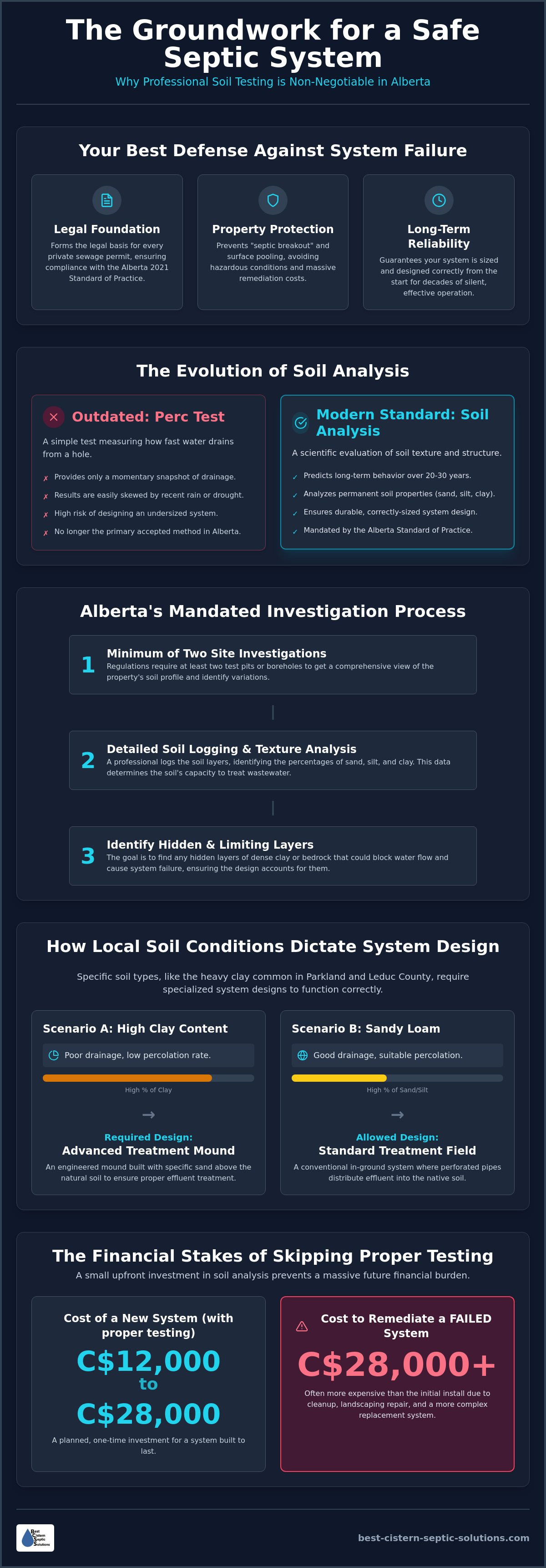
When you apply for a permit, the data provided by a professional soil analysis acts as the legal foundation for the entire design. Safety Codes Officers use this information to determine which type of system is appropriate for your specific lot. If the soil cannot treat the effluent effectively, the permit will be denied. This rigorous process exists to prevent contamination of groundwater and to ensure that rural properties remain safe for generations to come. It ensures that your system is sized correctly from the start, avoiding the stress of a premature failure.
The Alberta Private Sewage Systems Standard of Practice
The design and installation of these systems are governed by the Alberta Private Sewage Systems Standard of Practice (SOP) 2021. This document sets the minimum requirements that every property owner must follow to remain compliant. Historically, many contractors relied on a simple percolation test to see how fast water drained into a hole. While useful, Alberta has moved toward more detailed soil logging and texture analysis. This shift provides a complete profile of the sand, silt, and clay percentages in your soil, allowing for a design that accounts for seasonal changes and long-term durability. We work closely with local authorities to ensure every diagnostic report meets these high standards.
Protecting Your Property Investment
A professional soil test is a small investment that prevents a massive financial burden. If a system is installed in soil that cannot handle the effluent, you may experience "septic breakout," where wastewater pools on the surface of your yard. This creates a soggy, hazardous mess and often requires a complete system replacement. In Alberta, a new septic system can cost between C$12,000 and C$28,000, while a failed field can be even more expensive to remediate. By prioritizing septic system soil testing Alberta, you are ensuring that your infrastructure is built to last.
Properly understanding septic systems in Parkland County or Leduc County begins with the dirt. Every municipality has unique geological features, from heavy clay to sandy loam. We handle the technical diagnostics and permit alignment so you don't have to worry about the details. This proactive approach turns a complex regulatory requirement into a long-term asset for your rural property, providing you with a definitive, professional fix before the first shovel even hits the ground.
The Science of Soil: Percolation Rates vs. Soil Texture Analysis
Many property owners use the terms "perc test" and "soil logging" interchangeably, but they represent two very different approaches to understanding your land. A percolation test measures how fast water drops in a pre-soaked hole, providing a snapshot of drainage at one specific moment. While this was the industry standard for decades, modern septic system soil testing Alberta has shifted toward more comprehensive soil texture analysis. This scientific approach examines the precise percentages of sand, silt, and clay to predict how your soil will behave over twenty or thirty years, not just on the day of the test.
The current Alberta Private Sewage Systems Standard of Practice prioritizes texture and structure because they are permanent characteristics of your property. A perc test can be influenced by recent rainfall or seasonal droughts, potentially leading to an undersized system. By logging the soil profile, we gain a reliable understanding of the ground's long-term capacity to treat wastewater. Our team provides the detailed diagnostics needed for a reliable Septic Solution that stands the test of time.
Understanding Soil Texture and Structure
Soil texture refers to the size of the mineral particles in your dirt. Sandy loam is often considered ideal because it offers a perfect balance of drainage and filtration. In contrast, heavy clay is challenging because the tiny particles pack tightly together, slowing water movement to a crawl. Beyond texture, we look at "structure," which is the way soil particles clump together. Good structure creates natural channels for effluent to flow. We also look for "mottling," which are streaks of grey or bright orange in the soil. These spots are a clear warning sign of a high water table or poor drainage, even if the ground looks dry during the summer.
The Biological Treatment Process
Your septic field isn't just a disposal area; it's a living biological filter. Aerobic bacteria, which are essential for breaking down pathogens, thrive in the air spaces between soil particles. If the soil is compacted or over-saturated, these bacteria suffocate, and the treatment process stops. This is why we carefully evaluate the "Biozone" during our investigation. The Biozone is the living layer where effluent is purified. When the soil is correctly analyzed and the system is designed to match its natural rhythm, these bacteria work efficiently to keep your property safe and your groundwater clean. This methodical approach ensures your utility system remains a durable asset rather than a source of stress.
Test Pits vs. Boreholes: Alberta’s Soil Investigation Requirements
When you prepare for a new development or a system replacement, the physical investigation of your land is the most visible part of the process. In Alberta, a single hole in the ground is not enough to satisfy the safety codes. To ensure your long-term success, provincial regulations require at least two separate soil investigations within the area of your proposed treatment field. This rigorous approach to septic system soil testing Alberta ensures that the design accounts for the actual conditions of your property rather than an optimistic guess.
These investigations must occur in the exact footprint where the future septic bed will sit. It's common for soil characteristics to shift significantly within just a few meters. One corner of a yard might have decent drainage, while the other sits on a restrictive clay lens that could cause a total system backup. By identifying these variations early, we can align your project with the Alberta Private Sewage Systems Standard of Practice and avoid the stress of a permit denial or a failed inspection later on.
Why Test Pits are the Gold Standard
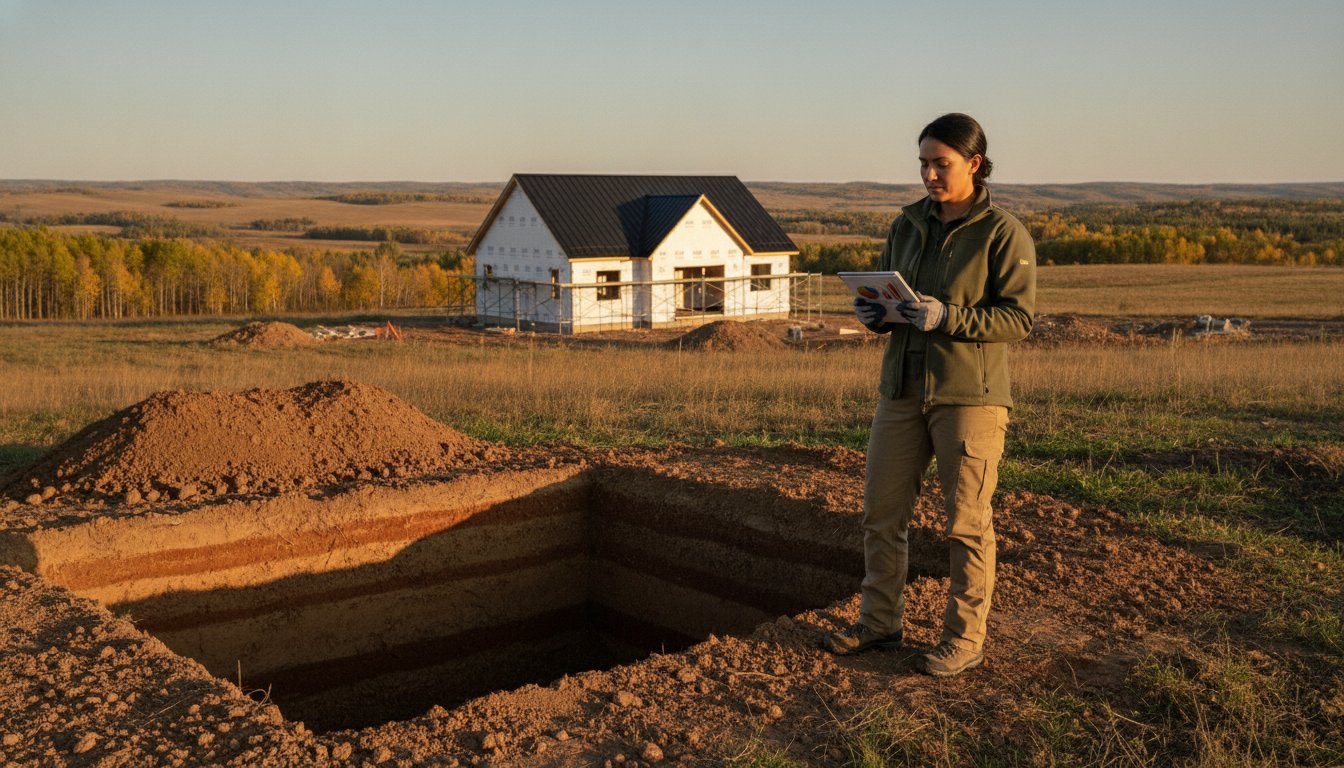
While boreholes are useful for confirming consistency across a large area, excavated test pits are widely considered the gold standard for accurate diagnostics. We typically dig these pits 2 to 3 meters deep using a backhoe or excavator. This depth allows a designer to physically see the "limiting layers," such as bedrock, high water tables, or dense clay, that might stop effluent from draining. Preparing your yard for this heavy equipment is a necessary step in the journey toward a reliable utility system. Seeing the full soil profile ensures that we aren't surprised by hidden geological features once the actual construction begins.
The 2-Investigation Rule Explained
The requirement for two investigations exists to protect your significant financial investment. A professional septic field installation can cost upwards of C$20,000, and relying on a single data point is a gamble most homeowners shouldn't take. By testing in two locations, we can identify "unsuitable" zones that might exist within a single lot. This data allows us to calculate the exact square footage required for your drainage bed. If the two holes show different results, we design for the most restrictive soil found. This methodical approach removes the guesswork, providing a definitive fix that keeps your household safe and your property value secure for decades.
How Site Conditions in Parkland and Leduc County Affect Design
North Central Alberta presents a unique set of geological challenges that directly influence the success of your private sewage system. While Southern Alberta may deal with sandy, arid conditions, the Edmonton region is notorious for its "Grey Wooded" soils and dense, heavy clay. These local site conditions are exactly why septic system soil testing Alberta is so vital. A design that works in one part of the province could fail spectacularly in Parkland or Leduc County if it doesn't account for the specific drainage limitations of our local landscape.
High water tables are another common hurdle, particularly in parts of Sturgeon County. If the ground is saturated just a few feet below the surface, a standard trench system cannot provide the vertical separation needed to treat effluent safely. In these cases, our diagnostics often reveal that a raised treatment mound is the only professional fix that ensures long-term property protection. By identifying these restrictive layers during the testing phase, we remove the guesswork and provide a design that aligns with the natural limitations of your land.
Managing Heavy Clay in the Edmonton Region
Clay-heavy soils require a specific technical approach known as a "lower loading rate." This essentially means we must provide more surface area for less water, as the tight pores in clay cannot absorb effluent as quickly as sandy loam. One of the greatest risks during construction in these areas is "smearing." If an excavator bucket scrapes wet clay, it can seal off the soil's natural pores, effectively creating a waterproof liner that prevents your system from draining. This is why we advocate for precise soil analysis and careful timing. On properties where the clay is particularly dense, we often recommend alternative designs, such as a sand treatment mound, which uses imported material to provide the filtration the native soil cannot manage on its own.
Winter Considerations for Soil and Piping
Alberta's deep frost line adds another layer of complexity to rural utility design. The frost depth can significantly impact the "active" biological layer of your soil, where the aerobic bacteria we discussed earlier perform their essential work. If a system is buried too shallow without proper insulation, the effluent can freeze, leading to a total system backup during our coldest months. Professional septic system soil testing Alberta should ideally be completed before the ground freezes to ensure we capture an accurate profile of the soil's structure. If you are dealing with an aging field, ensuring your septic system repair accounts for seasonal soil expansion and frost protection is the best way to secure your property's value. If you are planning a project on a challenging lot, our team provides the expert Septic Solutions needed to navigate these local conditions with confidence.
Professional Soil Analysis with Best Cistern Septic Solutions
At Best Cistern Septic Solutions, we provide comprehensive site diagnostics that meet every requirement of the Alberta Safety Codes. Our team specializes in the technical details of septic system soil testing Alberta, handling the difficult diagnostics that general service providers often overlook. We don't just record data; we bridge the gap between complex soil science and the practical realities of field construction. By understanding how the sand, silt, and clay on your property interact, we create a definitive fix that protects your home for decades.
We serve Spruce Grove, Stony Plain, and the greater Edmonton area with a grounded, detail-oriented approach. Our expertise allows us to identify potential risks before they become emergency failures. Whether you are building on a new rural lot or replacing an aging field, our goal is to provide you with a utility system that functions silently and reliably in the background. This methodical process ensures your property remains a safe, healthy environment for your family.
From Soil Test to Finished Permit
Translating a soil log into a high-performance system design requires both technical knowledge and local experience. We work closely with regulatory bodies in Parkland, Leduc, and Sturgeon County to ensure every permit application is accurate and compliant. This collaboration streamlines the approval process and ensures your system is "right-sized" for your household’s specific needs. A correctly sized system isn't just a regulatory requirement; it is a long-term asset that preserves your property’s value and removes the worry of future environmental issues. We take pride in performing these difficult tasks with a high level of sophistication, ensuring your design is perfectly matched to your land.
Book Your Professional Site Evaluation
Rural property owners trust us for comprehensive septic service in Edmonton because we prioritize transparency and thoroughness. Proactive septic system soil testing Alberta is the most effective way to prevent the stress of emergency repairs. By investing in a professional site evaluation today, you are securing the future of your rural utilities and ensuring your household remains protected. We act as your diligent partner in property care, providing the technical expertise needed to resolve even the most challenging soil conditions. Contact us to schedule your diagnostic visit and take the first step toward a permanent Septic Solution.
Securing Your Property’s Infrastructure on Solid Ground
Investing in your rural property requires looking beneath the surface to ensure your infrastructure is as resilient as the land itself. By moving beyond simple drainage checks and embracing detailed soil texture analysis, you align your project with the Alberta Private Sewage Systems Standard of Practice. This methodical approach identifies the hidden clay layers and high water tables that could otherwise compromise your investment. Professional septic system soil testing Alberta isn't just a hurdle for a permit; it's the definitive fix that ensures your household remains safe and your property value stays secure for decades.
Based in Spruce Grove, our team specializes in diagnosing failing fields and navigating the difficult soil conditions common in Parkland, Leduc, and Sturgeon County. We handle the complex diagnostics and county permit alignment so you don't have to face the bureaucratic process alone. When you choose a partner who understands the specific environmental needs of North Central Alberta, you gain the peace of mind that your utility systems are built to last. Book Your Alberta Septic Soil Investigation Today to ensure your project starts on solid ground. We look forward to helping you build a more reliable future for your home.
Frequently Asked Questions
How long does a septic soil test take in Alberta?
A professional soil investigation typically takes one full day on-site for the physical excavation and logging of the test pits. Once the field work is finished, it usually takes another 5 to 10 business days to receive the finalized technical report required for your permit application. This timeline ensures every soil layer is documented accurately according to provincial standards, providing a solid foundation for your system design.
Can I do my own soil testing for a septic permit?
No, property owners cannot perform their own soil testing to secure a private sewage permit. Alberta regulations require that a person holding a Certificate of Competency from the provincial government conducts the site evaluation and soil logging. This requirement ensures the data is technically accurate and legally compliant, giving you the peace of mind that your utility system is designed by a qualified expert.
What is the difference between a perc test and soil logging?
A percolation test specifically measures the speed at which water drains into a pre-soaked hole over a few hours. In contrast, soil logging is a more comprehensive analysis of the sand, silt, and clay percentages throughout the entire soil profile. While perc tests were common in previous decades, modern septic system soil testing Alberta relies on logging to predict how the ground will handle effluent over a twenty-year lifespan.
What happens if my soil is unsuitable for a standard septic field?
If your soil is deemed unsuitable for a standard trench, it simply means an alternative design is required to protect your property. We often resolve these challenges by designing a sand treatment mound or a packaged treatment plant that provides the filtration your native soil lacks. These advanced Septic Solutions ensure that even properties with heavy clay or high water tables can have a safe, reliable wastewater system.
Do I need a new soil test if I am replacing an old septic tank?
You generally don't need a new soil test if you are only replacing a tank that has reached the end of its lifespan. However, if the project involves any repairs or upgrades to the drainage field, a fresh soil investigation is mandatory under the 2021 Standard of Practice. This ensures the ground is still capable of treating the effluent effectively before any new field components are installed.
How much area do you need to dig for a test pit?
A standard test pit is usually the width of an excavator bucket and roughly 3 meters long. We dig these pits 2 to 3 meters deep to identify restrictive layers like bedrock or dense clay that could interfere with drainage. While this creates a temporary hole in your yard, we backfill the pits immediately after the logging is complete to keep your site safe and tidy.
Does the time of year affect soil testing results in Alberta?
Yes, the season can significantly impact the feasibility and accuracy of your site diagnostics. Spring testing is ideal for identifying the "worst-case" high water table, while winter frost can make excavation nearly impossible once the ground freezes deep. It's best to schedule your septic system soil testing Alberta during the late spring, summer, or fall to ensure the most accurate profile of your land's natural drainage.
Why is the Edmonton region soil particularly difficult for septic systems?
The Edmonton region is dominated by heavy clay and "Grey Wooded" soils that have very low permeability. These tiny soil particles pack together so tightly that they restrict both the movement of water and the flow of oxygen needed for beneficial bacteria to treat the effluent. This geological reality requires larger drainage fields and more precise engineering to ensure your system remains a durable, long-term asset for your property.


