
Did you know that 19% of Alberta households own an RV? With the highest ownership rate in the country, the demand for well-equipped sites is surging, yet the success of your development depends entirely on the infrastructure hidden underground. You've likely felt the stress of planning for peak capacity, knowing that a single backup during a busy long weekend could damage your reputation and your bottom line. It's a common concern, especially when you're trying to decode the strict requirements for high-strength wastewater treatment.
We've created this guide to help you master RV park septic system design Edmonton regulations require for 2026. You'll learn how to navigate the Alberta Private Sewage Systems Standard of Practice 2021 to create a permit-ready design that handles heavy surge loads with ease. We'll show you how to prioritize system integrity and durability, ensuring your investment remains a long-term asset for your property. By focusing on thorough planning and the right technical specifications, you can secure a system that lasts for decades and provides total peace of mind for you and your guests.
Key Takeaways
- Understand why RV parks require specialized commercial-grade engineering to manage the 500% load spikes common during Alberta’s peak holiday weekends.
- Navigate the Alberta Private Sewage Systems Standard of Practice 2021 to ensure your RV park septic system design Edmonton project remains fully compliant and permit-ready.
- Learn how to accurately calculate Daily Design Flow based on stall counts and hookup types to prevent costly system backups and overflows.
- Identify the most durable treatment field options, such as mounds or at-grade systems, designed specifically for the heavy clay soils found around Edmonton.
- Discover how proactive septic maintenance and regular inspections can protect your infrastructure, ensuring it remains a long-term asset for your property.
The Unique Challenges of RV Park Septic Systems vs. Residential
Designing a septic system for a campground is fundamentally different than for a single family home. In Alberta, the Safety Codes Council classifies RV parks as commercial or industrial loads because the waste they handle is far more concentrated. While a residential system manages a steady, predictable flow of daily activities, an RV park must survive extreme fluctuations in usage. This requires a specific approach to RV park septic system design Edmonton developers can trust to perform under pressure.
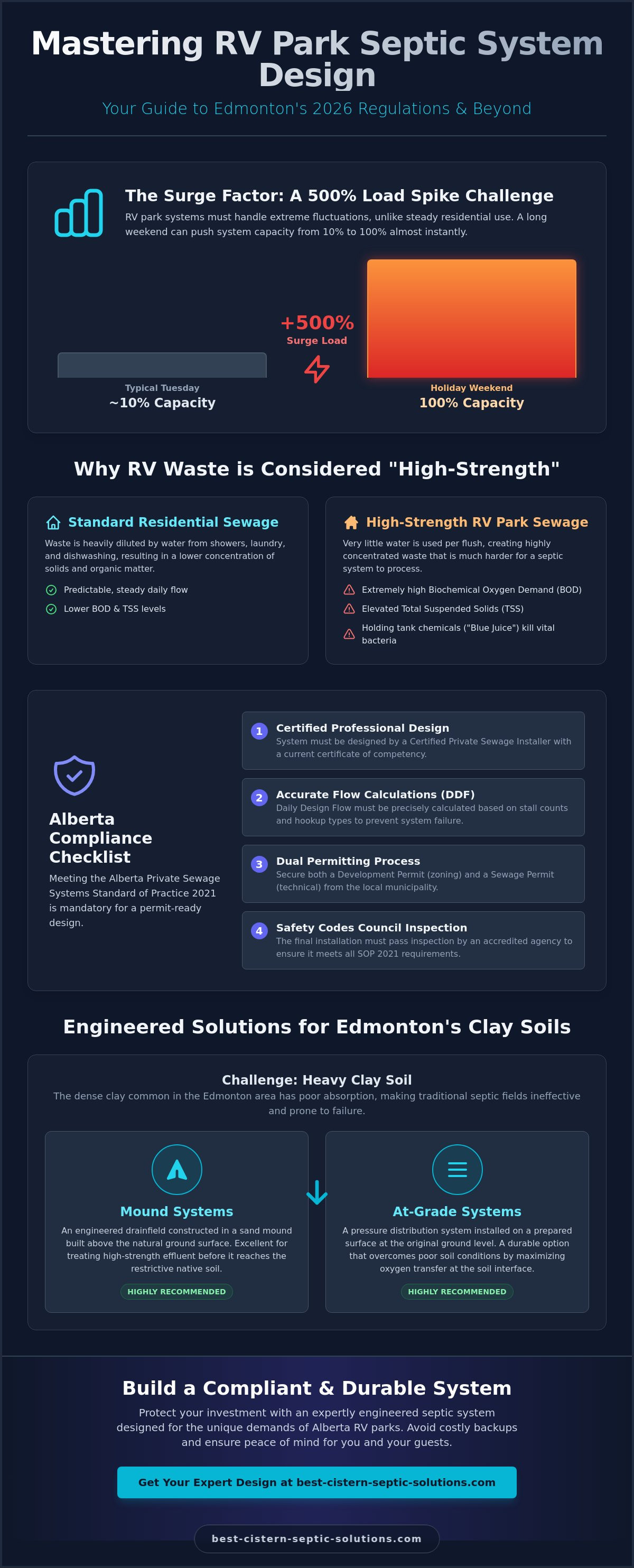
The "Surge Factor" is perhaps the most significant hurdle for any park owner. During a typical Tuesday in May, your system might be nearly dormant. However, on a hot July long weekend, occupancy often jumps from 10% to 100% in a matter of hours. This shift creates load spikes of 500% or more. Without a robust onsite sewage facility (OSSF) specifically engineered for these peaks, the infrastructure can quickly become overwhelmed, leading to backups right when you're at your busiest.
Why RV Waste is "High-Strength"
RV waste is technically defined as "high-strength" due to its chemical and physical makeup. Standard household sewage is diluted by frequent showers, laundry, and dishwashers. In contrast, RV guests use very little water per flush, which leads to high levels of Biochemical Oxygen Demand (BOD) and Total Suspended Solids (TSS). Additionally, many travelers use "blue juice" holding tank treatments. These chemical additives are designed to stop odors, but they also kill the beneficial bacteria needed for a healthy septic ecosystem. This makes the design of your system critical for long-term durability.
The Risk of Undersized Systems
An undersized or poorly planned system faces the immediate threat of hydraulic overloading. This occurs when the septic field can no longer absorb water at the rate it's being delivered. When this happens on a busy weekend, the results are both messy and expensive. You might find yourself facing the high cost of emergency intervention or, worse, environmental liability. Alberta Environment maintains strict standards for commercial sites, and failing to meet them can result in significant penalties. Investing in a properly scaled system is the best way to transform a potential liability into a reliable, long-term asset for your property.
Navigating Alberta’s Standard of Practice (SOP) for Campgrounds
Compliance is the foundation of any successful development. In Alberta, the primary regulatory framework is Alberta’s Standard of Practice (SOP), specifically the 2021 version that came into force on November 1, 2022. This document dictates every technical detail of your project, from the depth of the pipes to the mandatory setback distances from property lines and water bodies. For developers in the Edmonton area, the Safety Codes Council oversees the accredited agencies that perform inspections and issue permits. Meeting these standards isn't just a legal hurdle; it's a blueprint for a system that won't fail when your park is at full capacity.
Legally, you cannot design or install these systems without a Certified Private Sewage Installer who holds a current certificate of competency. This ensures that the professional handling your RV park septic system design Edmonton project understands the nuances of high-strength waste. Using a certified expert provides peace of mind that your permit application will move through the system without costly delays or rejections. It's about doing the job right the first time to protect your investment and the local environment.
Permitting in the Edmonton Capital Region
Each municipality near Edmonton has its own specific procedural nuances. Whether you're building in Parkland, Leduc, or Strathcona County, you must distinguish between a Development Permit and a Sewage Permit. The Development Permit addresses land use and zoning, while the Sewage Permit focuses on the technical mechanics of the system itself. You'll need to submit detailed documentation, including soil logs from professional testing, site maps showing all setbacks, and precise Daily Design Flow (DDF) calculations. In Edmonton, the base Septic Permit fee for 2026 is $300.00, plus a Safety Codes Council levy of 4% of the permit cost.
Compliance Checklist for Developers
Meeting the SOP requires balancing technical precision with environmental safety. Every RV park design must address four critical criteria: site suitability, soil capacity, wastewater strength, and hydraulic peak flow. Most modern campgrounds require "Level 2" treated effluent, which uses advanced treatment components to clean the water more thoroughly before it hits the soil. This is especially vital when dealing with the high-strength waste discussed in the previous section. Scheduling professional septic system inspections during the installation phase ensures every component matches the approved design. If you're feeling overwhelmed by these regulations, a professional septic maintenance plan can help you stay compliant long after the initial construction is finished.
Calculating Peak Flow and Waste Strength for Edmonton Parks
Calculating the correct load is where engineering meets the reality of your business operations. To secure a permit, your RV park septic system design Edmonton project must accurately determine the Daily Design Flow (DDF). This figure represents the total volume of wastewater your system must process during its busiest possible day. Relying on average usage numbers is a common mistake that leads to system failure; instead, you must design for a 100% occupancy scenario to ensure the field remains a long-term asset for your property.
The Alberta’s Standard of Practice (SOP) for Campgrounds provides specific volume requirements based on the type of stall you offer. For example, a stall with a water and sewer hookup requires a higher litre-per-day allocation than a basic tent site or a stall with only electricity. You must also factor in ancillary buildings that contribute to the total load. Bathhouses, guest laundry facilities, and staff housing all add to the cumulative DDF. Failing to account for these "hidden" flows can lead to hydraulic overloading during peak summer months.
Determining Your Peak Load
When determining your peak load, you can use the "Stall Count" method outlined in the SOP or provide historical meter data if you are expanding an existing park. Most new developments rely on the stall count to establish a baseline. Peak Daily Flow is the maximum volume of wastewater expected to enter the system in a 24-hour period. Designing for this maximum ensures that even on the busiest August long weekend, your drainage field isn't pushed beyond its limits. We often recommend flow equalization tanks for larger parks. These tanks act as a buffer, holding excess water during the morning rush and releasing it slowly into the treatment field over 24 hours to prevent flooding.
Accounting for Waste Concentration
Volume is only half of the equation; waste strength is equally vital. Because RV waste is more concentrated than residential sewage, you must apply "Strength Factors" to your design. This often means installing larger septic tanks than you might expect. A larger tank provides more time for solids to settle and for initial biological breakdown to occur, which is often a more cost-effective solution than moving to a complex advanced treatment unit. If your park features a communal kitchen or a small café, the SOP requires grease interceptors to prevent fats and oils from clogging your pipes. These proactive steps ensure your system remains clean, safe, and fully compliant with Alberta’s rigorous standards.
Choosing the Right Septic Field for Alberta Soil Conditions
Edmonton's geography presents unique hurdles that residential designs rarely encounter. The heavy clay soils, often referred to as "grey-wooded" soils in areas like Parkland County, don't drain as easily as the sandy loam found in other regions. This low permeability makes the selection of your treatment field the most critical phase of RV park septic system design Edmonton. If the soil can't absorb the water, the system will fail, regardless of how large your tanks are. We focus on matching the specific soil morphology of your site to a system that ensures long-term durability.
Treatment mounds are often the preferred choice for clay-heavy sites. They use a layer of specialized sand to treat effluent before it ever touches the native soil, providing an extra layer of protection for the environment. At-grade systems are an alternative if your soil is slightly more permeable, but they require a significantly larger footprint to handle commercial loads. For any RV park, pressure distribution is superior to gravity-fed systems. Pressure distribution uses a pump to send effluent to every square inch of the field simultaneously. This prevents the "puddling" effect that causes gravity systems to fail prematurely, making it a much more reliable asset for your property.
Alberta winters demand specific design choices to prevent freezing. You must account for deep frost lines by using high-density insulation over tanks and piping. In some cases, we integrate heat tapes on shallower lines to ensure the system remains functional during the shoulder seasons. These proactive measures remove the stress of potential winter backups and keep your infrastructure safe year-round.
Soil Testing: The Percolation Test vs. Sieve Analysis
A professional soil profile is the foundation of your design. While a simple percolation test measures how fast water drops in a hole, a detailed sieve analysis provides a scientific breakdown of soil texture and grain size. This data is what determines the exact size of your septic field installation. In areas like the North Saskatchewan River valley, high water tables add another layer of complexity. You need a design that maintains the mandatory vertical separation between your drainage pipes and the groundwater to stay compliant with Alberta regulations.
Advanced Treatment Options
When space is limited, Packaged Treatment Plants (PTPs) offer a compact alternative to traditional fields. These systems, along with sand or textile filters, clean the wastewater to a much higher standard before it reaches the soil. This "Level 2" treatment allows for a smaller drainage bed footprint, which is ideal for parks looking to maximize their stall count. While these mechanical components require a steady schedule of septic maintenance, they provide a sophisticated solution for challenging sites. If you're ready to start your project with a design built for Edmonton's climate, our team offers professional septic field installation to ensure your park is ready for the 2026 season.
The Best Cistern Septic Solutions: Your Edmonton Design Partner
Developing a campground involves high stakes, especially when managing high-strength wastewater. We bring extensive experience to commercial-scale septic systems across Alberta, providing the technical expertise required for large-scale operations. Our team manages the entire process for you. We handle everything from the initial soil profile analysis to the final Safety Codes inspection. This end-to-end service ensures your RV park septic system design Edmonton project moves forward without the stress of regulatory delays.
We focus on building long-term assets. This means we design systems that balance your upfront development costs with the need for 20 plus years of durability. Whether you're operating in Leduc, Parkland, or Strathcona County, we provide local support tailored to your specific site conditions. We don't just install a system and leave; we partner with you to ensure your infrastructure remains a reliable part of your business. Our goal is to provide a professional fix that removes future worries, allowing you to focus on guest satisfaction.
Why Local Expertise Matters
Local knowledge is vital for a smooth permitting process. We've built professional relationships with county inspectors across North Central Alberta, so we understand their specific preferences and expectations. Our designs specifically account for the region's deep frost lines and heavy clay, removing the guesswork from winterization. Because we're a local service provider, we're also here for the long haul. We offer comprehensive septic system repair and proactive maintenance to keep your park running during those critical summer peaks. This steady, methodical approach to upkeep prevents minor issues from becoming major disruptions.
Start Your RV Park Project Today
Our consultation process is designed to save you time and money. We cut through the technical jargon of the Alberta SOP to give you a clear, actionable plan. This "no-guesswork" approach ensures your design is permit-ready and built to handle the 500% surge loads discussed earlier in this guide. We take pride in performing these difficult tasks with sophistication and care, giving you the peace of mind to grow your business. If you're ready to move forward with a system designed for Edmonton's unique environment, contact us for a professional RV park septic consultation to secure the future of your development.
Secure Your RV Park's Infrastructure for the Future
Designing a robust wastewater system is a significant step toward the long-term success of your development. You've seen how critical it is to account for high-strength waste and peak surge capacity to ensure your infrastructure remains a reliable asset for decades. By adhering to the 2021 Alberta Private Sewage Systems Standard of Practice, you protect your investment from regulatory delays and environmental liability. Our team of Certified Private Sewage Installers (PS) brings the specialized expertise in RV park septic system design Edmonton developers need to thrive in our unique climate.
We proudly serve Parkland, Leduc, and Strathcona Counties, providing the local knowledge necessary to navigate specific county requirements and challenging soil conditions. Whether you're planning a new site or upgrading existing facilities, a professional fix is always available to give you total peace of mind. We take pride in performing these essential tasks with thoroughness and care. Request a Professional RV Park Septic Design Consultation today to start your project with confidence. Your durable, compliant system is just a conversation away.
Frequently Asked Questions
Can I use a standard residential septic tank for my RV park?
No, standard residential tanks are not designed to handle the high-strength waste produced by RVs. RV effluent contains much higher concentrations of solids and chemicals that can disrupt the biological processes in a smaller tank. Using a residential model often leads to premature failure and costly repairs because it lacks the capacity for adequate settling and treatment of concentrated waste.
What is the minimum setback distance for a septic field from a lake in Alberta?
The Alberta Private Sewage Systems Standard of Practice 2021 requires a minimum setback of 15 meters from the high-water mark of a lake. It's important to remember that local municipalities near Edmonton may have even stricter requirements to protect the environment. We always verify these specific distances during the initial site assessment to ensure your project remains fully compliant.
How much space does a septic mound for a 50-stall RV park require?
A septic mound for 50 stalls requires a substantial footprint, often spanning several thousand square feet depending on your specific soil texture. In the heavy clay soils common to North Central Alberta, the mound must be larger to ensure the ground can absorb the treated water. Accurate soil testing is the only way to determine the exact dimensions needed for your RV park septic system design Edmonton project.
Do I need a separate system for my campground bathhouse and RV hookups?
You don't legally need separate systems, but combining them requires a careful balance of waste strength and water volume. Some developers choose to separate them because bathhouse water is less concentrated and helps dilute the high-strength waste from RV stalls. We can help you decide if a unified system or separate components will better serve your property's long-term durability and maintenance needs.
How does the Alberta Standard of Practice 2021 affect existing RV parks?
Existing systems are generally grandfathered under the rules that were in place during their original installation. However, the 2021 SOP applies the moment you decide to expand your park, add more stalls, or perform a major repair. If you're planning any changes to your infrastructure, the entire system must be updated to meet the current standards to ensure it remains a safe and legal asset.
How do I prevent my RV park septic system from freezing in the winter?
Proper insulation and depth are the most effective ways to protect your system from Alberta’s deep frost lines. We use high-density polystyrene insulation over tanks and distribution lines to keep the system functional during the coldest months. Ensuring the pipes have a consistent slope is also vital, as it prevents standing water from collecting and freezing in the lines during the shoulder seasons.
What happens if my septic system fails during a busy weekend?
A system failure during a peak weekend requires an immediate professional inspection to identify the source of the problem. To avoid this stress, we recommend installing a septic alarm that provides an early warning of high water levels or pump issues. Many problems are mechanical in nature, such as an effluent pump replacement being needed, and can be resolved quickly if caught early by a monitoring system.
Is a cistern required for my RV park if I have a septic system?
A cistern is not a requirement for your septic system to function, but it's often a vital part of the park's overall utility design. Many rural developments install a cistern to ensure a steady supply of potable water for guests when well yields are low. While the septic system handles the waste, a cistern installation provides the storage needed to manage peak water demand during the busiest long weekends.


