
Starting your septic installation before your permit is approved won't just stall your project; it will instantly double your permit costs. It's a high price for a simple oversight, but it highlights why staying current with the new septic regulations Sturgeon County 2026 is so vital for every homeowner. We know that the technical shift from the 2021 Standard of Practice to today's local bylaws can feel overwhelming. You want a utility system that works silently and safely, not a source of legal or environmental stress that keeps you up at night.
You might feel confused about whether your property requires a Low-Pressure Sewer (LPS) holding tank or if a private drainage field remains the best fit for your specific soil conditions. This guide provides the clarity you need to move forward with confidence. We'll walk you through the mandatory permit steps, the specific setback requirements for buildings and wells, and how to avoid common installation errors that lead to failed inspections. You'll gain a clear roadmap to a compliant, high-performing system that serves as a long-term asset for your property and ensures your household's safety for years to come.
Key Takeaways
- Understand how the new septic regulations Sturgeon County 2026 integrate with the Alberta Safety Codes Act to keep your property compliant and legal.
- Identify the specific setback requirements and technical standards necessary to pass your mandatory county inspections.
- Determine if your property requires a Low-Pressure Sewer (LPS) system and learn the essential rules for managing municipal connections.
- Master the permit application process, from the initial professional soil evaluation to the final engineering design.
- Discover how professional installation protects your home's long-term value by preventing environmental risks and avoiding expensive bylaw penalties.
Navigating the 2026 Septic Regulatory Landscape in Sturgeon County
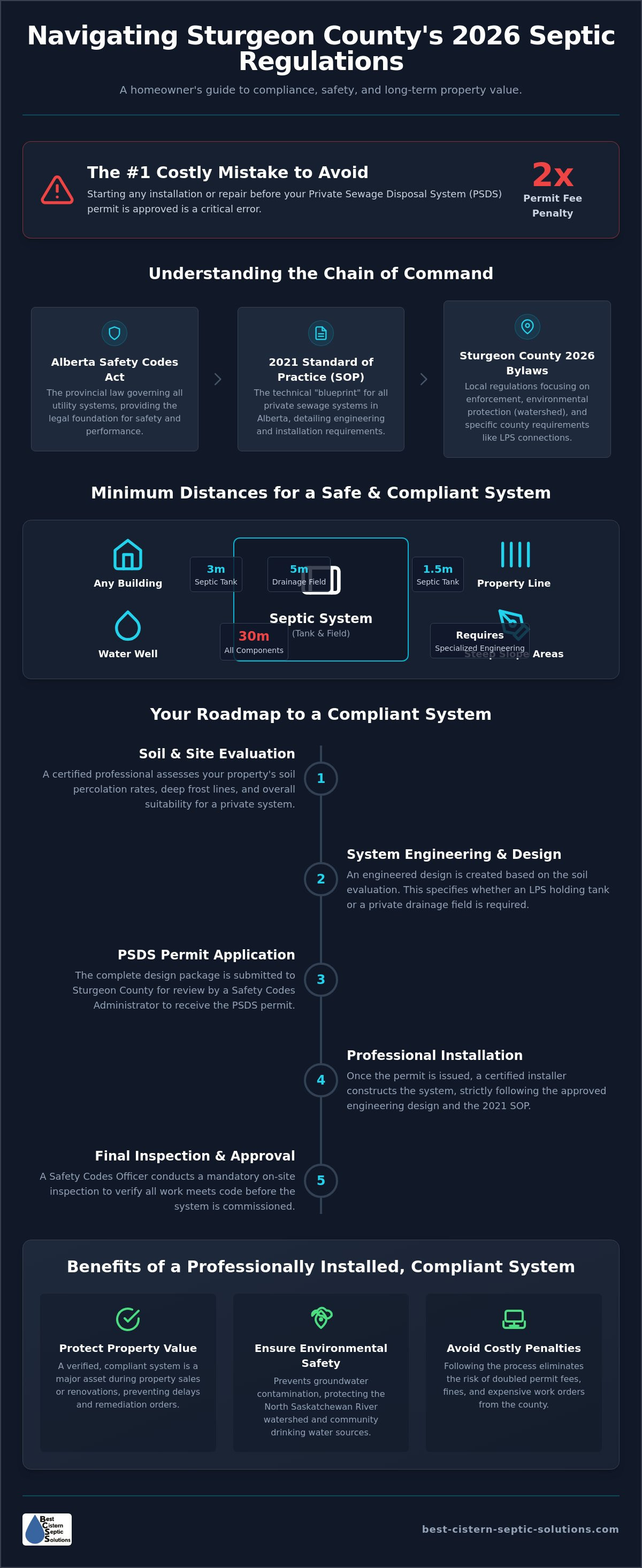
Sturgeon County has refined its approach to wastewater management to ensure every rural property remains a safe, long-term asset. The new septic regulations Sturgeon County 2026 operate under the authority of the Alberta Safety Codes Act. This provincial legislation provides a standardized framework for all on-site sewage facilities, ensuring they meet rigorous safety and performance criteria. For homeowners, this means that any project involving a septic tank installation or field repair requires a specific Private Sewage Disposal System (PSDS) permit. This permit is distinct from a standard plumbing permit, which typically only covers the internal piping within your home. Understanding this distinction is the first step toward a legal and durable installation.
The Safety Codes Act: Your Compliance Baseline
The Alberta Safety Codes Act isn't just a set of suggestions; it's the legal backbone for every utility system on your property. In 2026, Sturgeon County has increased its focus on ensuring that older systems meet these standards during property transfers. While you might have a "grandfathered" system that has functioned for decades, a sale or significant renovation often triggers a requirement for a modern inspection. If your system doesn't align with the current 2021 Standard of Practice, you may face remediation orders or fines. Starting construction without a permit is a costly mistake. The county enforces a penalty that doubles the permit fee for any work that begins before a safety code permit is issued. This methodical oversight ensures that every system in the county is built to a professional standard.
Why 2026 Regulations Focus on Environmental Durability
The primary driver behind the new septic regulations Sturgeon County 2026 is the protection of the North Saskatchewan River watershed. Local groundwater is a shared resource. Poorly designed systems can lead to nitrate contamination that affects entire communities. Because Alberta is experiencing more frequent, heavy rainfall patterns, drain field engineering must be more robust than in the past. This has led to a shift toward more rigorous soil testing and site evaluations.
A Safety Codes Administrator now oversees these projects with a detail-oriented eye. They ensure that every design accounts for specific soil percolation rates and deep frost lines. This professional oversight provides peace of mind that your system won't just pass a one-time inspection. Instead, it ensures your system remains a reliable part of your home's infrastructure for decades. By matching engineering to the county's unique soil-to-sewer interface, these regulations turn a potential liability into a verified property asset.
Core Compliance: The Alberta Private Sewage Standard of Practice (SOP)
While we're looking ahead at the new septic regulations Sturgeon County 2026, the technical foundation remains the 2021 edition of the Alberta Private Sewage Systems Standard of Practice. This document is the gold standard for every installer and inspector in the province. It provides the engineering blueprints that ensure your wastewater is treated safely before it ever reaches the environment. Adhering to these provincial standards isn't just about passing a one-time check; it's about building a system that remains a durable asset for your home. When you follow the SOP, you eliminate the technical guesswork that often leads to premature system failure or costly remediation orders.
Setback Requirements and Site Limits
Precision is vital when mapping out your property's utility footprint. The SOP dictates strict minimum distances to prevent cross-contamination and protect your home's foundation. For example, your septic tank must be at least 3 meters from any building, while the drainage field requires a 5-meter buffer. If your property includes a water well, every component of your septic system must maintain a 30-meter clearance to ensure your drinking water remains pristine. Slope also plays a critical role in design. Steeper terrain may require specialized engineering to prevent effluent from surfacing or migrating toward property lines. According to the SOP, a septic tank must maintain a minimum distance of 1.5 meters from any property line.
Tank Specifications for 2026 Compliance
Modern compliance requires high-quality materials that can withstand the weight of the earth and the corrosive nature of wastewater. All tanks must be CSA-certified concrete or polyethylene to ensure structural integrity. In Sturgeon County, two-stage tanks are the standard for most residential applications. These tanks use two separate chambers to allow solids to settle effectively, ensuring that only clear effluent moves into the secondary treatment stage or the effluent pump. This separation is crucial for the longevity of your field. Safety is also a top priority under the new septic regulations Sturgeon County 2026. Every tank must feature secure, bolt-down lids and access risers that extend to the surface, allowing for safe maintenance without the need for heavy excavation.
Ensuring your system meets these rigorous technical standards is the best way to avoid the stress of a failed inspection. If you're planning an upgrade or need to verify your current layout, a professional septic system inspection can give you a clear, honest assessment of your compliance. By using only certified components and following verified design paths, you can rest easy knowing your system is built for safety and long-term property preservation.
LPS vs. Private Disposal: Sturgeon County’s Unique Requirements
Sturgeon County features a mix of high-density subdivisions and isolated acreages. This geographic diversity means that the new septic regulations Sturgeon County 2026 apply differently depending on your property's specific location. In many newer developments or environmentally sensitive areas, the county mandates a Low-Pressure Sewer (LPS) system. This setup acts as a hybrid between a full private septic field and a traditional municipal sewer. While it provides a reliable way to manage wastewater, it comes with specific legal boundaries that homeowners must respect to maintain the integrity of the collective system. Understanding whether your property relies on the soil or a municipal force main is the first step in ensuring your utility setup remains a durable asset.
The Low-Pressure Sewer (LPS) Mandate
LPS systems use a two-stage tank on your property to settle solids. A specialized effluent pump then sends the liquid waste through a small-diameter force main to a municipal treatment facility. This is common in areas where traditional gravity sewers aren't feasible due to elevation or distance. A critical, often misunderstood rule in Sturgeon County is the "No-Touch" policy regarding the Curb Cock (CC) valve. This valve serves as the connection point between your private line and the county's force main. Legally, only Utility Wastewater Management Services (UWMS) staff are permitted to operate this valve. This restriction exists because improper handling can cause pressure surges that damage the entire neighborhood's infrastructure. Unauthorized operation can result in significant bylaw infraction fines. It's always best to leave this component to the county's specialized technicians to avoid legal and mechanical complications.
Choosing Private Drainage in Sturgeon County
For residents on larger, more isolated parcels, a septic field installation remains the primary solution. However, the heavy clay soils found throughout much of the region present unique challenges for traditional designs. Under the new septic regulations Sturgeon County 2026, there is a clear preference for treatment mounds over deep trenches in areas with restricted soil drainage. Mounds use layers of sand and fabric above the natural grade to treat effluent, preventing it from pooling in the clay or contaminating groundwater.
Organizations like the Alberta Onsite Wastewater Management Association advocate for these specialized designs because they protect the long-term health of the land. Determining whether your zone requires an LPS connection or a private mound is a fundamental part of the engineering phase. A professional site evaluation will clarify these requirements for you. This ensures your system is both legal and capable of handling your household's daily needs without environmental risk or future mechanical failure.
The 2026 Permit Path: From Soil Testing to Final Inspection
Obtaining a permit under the new septic regulations Sturgeon County 2026 isn't a hurdle to clear; it's a safety net for your property. This methodical process ensures that your system is designed specifically for your land's unique characteristics. By following a structured permit path, you transform a complex technical requirement into a manageable project. This journey moves from the raw earth of your property to a final certificate that validates your home's safety and value. Sturgeon County enforces a rigorous five-step process to maintain these standards.
- Step 1: Site and Soil Evaluation. A certified professional conducts a detailed assessment of your land, including digging test pits to analyze soil layers.
- Step 2: Engineering Design. Your system is designed based on soil percolation rates to ensure it can handle your household's wastewater volume.
- Step 3: Permit Submission. You submit the Private Sewage Disposal System (PSDS) permit application to the county for review.
- Step 4: Installation and Inspection. During the build, an "open-hole" inspection occurs where a Safety Codes officer verifies the components before they are covered.
- Step 5: Final Compliance. Once the backfill is complete and the system passes, you receive a Certificate of Compliance.
Why Soil Testing is the Most Critical Step
Don't confuse a simple "perc test" with a comprehensive soil profile. While a perc test only measures how fast water drops in a hole, a full soil evaluation looks at color, texture, and structure across multiple depths. Sturgeon County is well-known for its heavy clay soils. This clay acts as a natural barrier, meaning your system requires a larger footprint or a specialized treatment mound to work effectively. A failed soil test leads to a permit denial because it indicates the land cannot safely absorb effluent without risking surface ponding or groundwater contamination. Precision at this stage prevents the heartbreak of a system that fails just a few years after installation.
Working with the Safety Codes Administrator
The Safety Codes Administrator is a specialized expert who ensures your installation aligns with provincial safety standards. During the mid-installation inspection, they look for proper pipe bedding, correct tank leveling, and adherence to setback distances. Common reasons for inspection failure in our region include incorrect pipe slopes or the absence of a mandatory septic alarm.
This is also the ideal time to consider your total utility health. If you're upgrading your waste system, coordinating it with a professional cistern installation ensures your water supply and disposal systems work in harmony. A balanced system prevents pump strain and protects your home's mechanical integrity. If you're ready to secure your property's future, contact us for a professional septic tank installation that meets every 2026 requirement with ease.
Ensuring Long-Term Integrity with Professional Septic Solutions
Managing the complexities of the new septic regulations Sturgeon County 2026 doesn't have to be a source of stress for your household. Best Cistern Septic Solutions takes on the full regulatory burden, from initial engineering to the final backfill. We understand that your utility system is a vital component of your home's infrastructure. Attempting a DIY fix on a modern system often leads to more harm than good. A professional septic system repair ensures that every component aligns with the Alberta Safety Codes Act. This precision protects your investment and maintains your property value. Without a certified fix, you risk bylaw infractions that can surface during a property sale, potentially stalling a transaction or forcing expensive emergency upgrades.
Our deep experience with Sturgeon County's heavy clay and unique environmental factors is your best defense against system failure. We don't just install tanks; we engineer solutions that work with the land. This proactive approach turns a technical requirement into a long-term asset. By matching the right mechanical components to your property's specific soil profile, we remove the future worries that come with substandard installations. You deserve a system that operates silently and reliably for decades.
Beyond the Permit: Maintenance for Compliance
Compliance doesn't end once the final inspection is signed off. The updated 2026 guidelines recommend a bi-annual schedule for septic tank maintenance to ensure your effluent pump and alarms are functioning correctly. Regular upkeep prevents the slow build-up of solids that can clog a treatment mound or damage an LPS connection. These routine checks provide a documented history of care, which is invaluable when it's time to sell your home. It offers prospective buyers peace of mind that the property has been professionally managed and remains in peak condition. A well-maintained system is a secure system.
Ready for a Compliant System?
Starting your project with a professional site assessment is the most effective way to navigate the new septic regulations Sturgeon County 2026. We're committed to the safety of our neighbors and the preservation of the local watershed. Our team handles the technical details so you can focus on enjoying your rural lifestyle. Every system we design is built for durability, cleanliness, and total safety. We take pride in performing these essential tasks with a high level of care and transparency.
If you're planning a new build or need to bring an existing system up to code, we're here to help. Contact Best Cistern Septic Solutions for a regulatory-compliant quote and take the first step toward a worry-free utility system. Let us provide the professional fix that secures your property's future.
Securing Your Property’s Future with a Compliant System
Understanding the new septic regulations Sturgeon County 2026 is the best way to ensure your rural utility remains a long-term asset rather than a legal liability. By prioritizing a professional soil evaluation and following the structured permit path, you protect your home from environmental risks and costly bylaw fines. Whether your property requires a specialized treatment mound or a connection to a municipal force main, the right design ensures your system operates silently and safely for decades. Compliance isn't just about paperwork; it's about the security and health of your household.
As Certified Alberta Private Sewage Installers, we bring expert knowledge of local bylaws and a comprehensive design-to-installation service to every project. We handle the technical complexities so you can enjoy the peace of mind that comes with a professionally managed utility. If you're ready to verify your system's integrity or plan a new installation, we're here to help. Book Your Sturgeon County Compliance Inspection Today and let us provide the professional fix you need. Your property is in good hands with experts who understand the unique needs of Sturgeon County homeowners.
Frequently Asked Questions
Do I need a new permit to replace an old septic tank in Sturgeon County?
Yes, you must obtain a Private Sewage Disposal System (PSDS) permit before replacing a septic tank. Sturgeon County requires this permit for any significant alteration or installation to ensure the new tank meets current safety and setback standards, such as the 3-meter distance from buildings. Starting this work without an approved permit results in a penalty that doubles your standard permit fee.
What is the fine for operating my own CC valve on an LPS system?
Operating your own Curb Cock (CC) valve on a Low-Pressure Sewer system is a violation of local utility bylaws. Only Utility Wastewater Management Services (UWMS) staff are authorized to touch these valves to prevent pressure surges that could damage the municipal force main. While specific fine amounts vary based on the situation, homeowners are legally responsible for any infrastructure damages and bylaw infraction costs resulting from unauthorized valve operation.
How often does Sturgeon County require septic inspections in 2026?
Sturgeon County requires a mandatory "open-hole" inspection during the installation or repair of any system under the new septic regulations Sturgeon County 2026. This inspection occurs before the system is backfilled to verify it matches the approved engineering design. While the county doesn't mandate a fixed schedule for ongoing inspections, we recommend professional maintenance checks every two years to ensure your effluent pump and alarms are functioning as a durable asset for your home.
Can I design my own septic system if I follow the Alberta SOP?
No, you cannot design your own system for permit approval unless you are a certified private sewage installer or a professional engineer. The Alberta Safety Codes Act requires that all designs adhere strictly to the Private Sewage Standard of Practice and be backed by a professional soil evaluation. This ensures the system is correctly engineered for Sturgeon County's specific clay soil conditions and won't fail prematurely.
What is the difference between a Plumbing permit and a Private Sewage permit?
A Plumbing permit covers the pipes and fixtures inside your home, while a Private Sewage permit governs the tank, pumps, and treatment field outside. Rural homeowners often need both during a new build or major renovation. The Private Sewage permit is specifically focused on environmental safety, ensuring your system maintains the mandatory 30-meter clearance from water wells and appropriate distances from property lines.
How do new 2026 regulations affect property sales in Sturgeon County?
The new septic regulations Sturgeon County 2026 often trigger mandatory inspections or system upgrades during the property transfer process. If an inspection reveals a failing or non-compliant system, the county can issue remediation orders that must be resolved before the sale concludes. Having a valid Certificate of Compliance and a history of professional maintenance protects your property value and provides peace of mind to potential buyers.
Is a soil test mandatory for a simple septic field repair?
Yes, a site and soil evaluation is typically mandatory if the repair involves altering or extending the drainage field. Because Sturgeon County features heavy clay soils that restrict drainage, the Safety Codes Administrator must verify that the ground can still safely absorb effluent. This critical step ensures that your repair is a long-term fix rather than a temporary patch that risks future environmental contamination.
What happens if my septic system was installed before the 2021 Standard of Practice?
Systems installed before the 2021 Standard of Practice are generally considered compliant as long as they are functioning correctly and don't pose a health risk. However, if you plan a significant home renovation or if the system requires major repairs, you'll likely need to upgrade the components to meet current 2026 standards. These upgrades transform an aging utility into a modern, safe system that preserves the integrity of your household.


