
A septic system permit alberta is often viewed as a bureaucratic hurdle, but it's actually the most important insurance policy your rural property will ever have. It's natural to feel overwhelmed by complex legal terminology or the fear of facing a costly fine because of a simple paperwork error. You want your home's utility systems to be safe and durable, yet the friction between provincial regulations and local county rules can make the path forward feel uncertain. We believe that every technical challenge has a manageable resolution when you have the right expertise by your side.
We understand that your peace of mind depends on a system that works silently and stays compliant for decades. This guide offers a clear roadmap to mastering the Alberta septic permit process, ensuring you meet the 2021 Standard of Practice without the stress of trial and error. We'll walk you through the specific requirements for North Central Alberta counties, clarify when a professional designer is legally required, and show you how to turn technical requirements into long-term property assets. By the end of this guide, you'll have the confidence to move from application to installation with total clarity.
Key Takeaways
- Understand how the Alberta Private Sewage Systems Standard of Practice 2021 serves as the technical foundation for every legal installation.
- Identify the critical differences between homeowner and certified contractor permits to ensure your project meets provincial safety standards.
- Learn why a professional site evaluation and soil profile are the most important steps in securing a septic system permit alberta.
- Navigate county-specific application nuances in Parkland, Leduc, and Sturgeon to avoid common paperwork errors and administrative delays.
- Prepare for mandatory inspection stages to ensure your wastewater system remains a durable, long-term asset for your property.
Understanding the Alberta Private Sewage Systems Standard of Practice
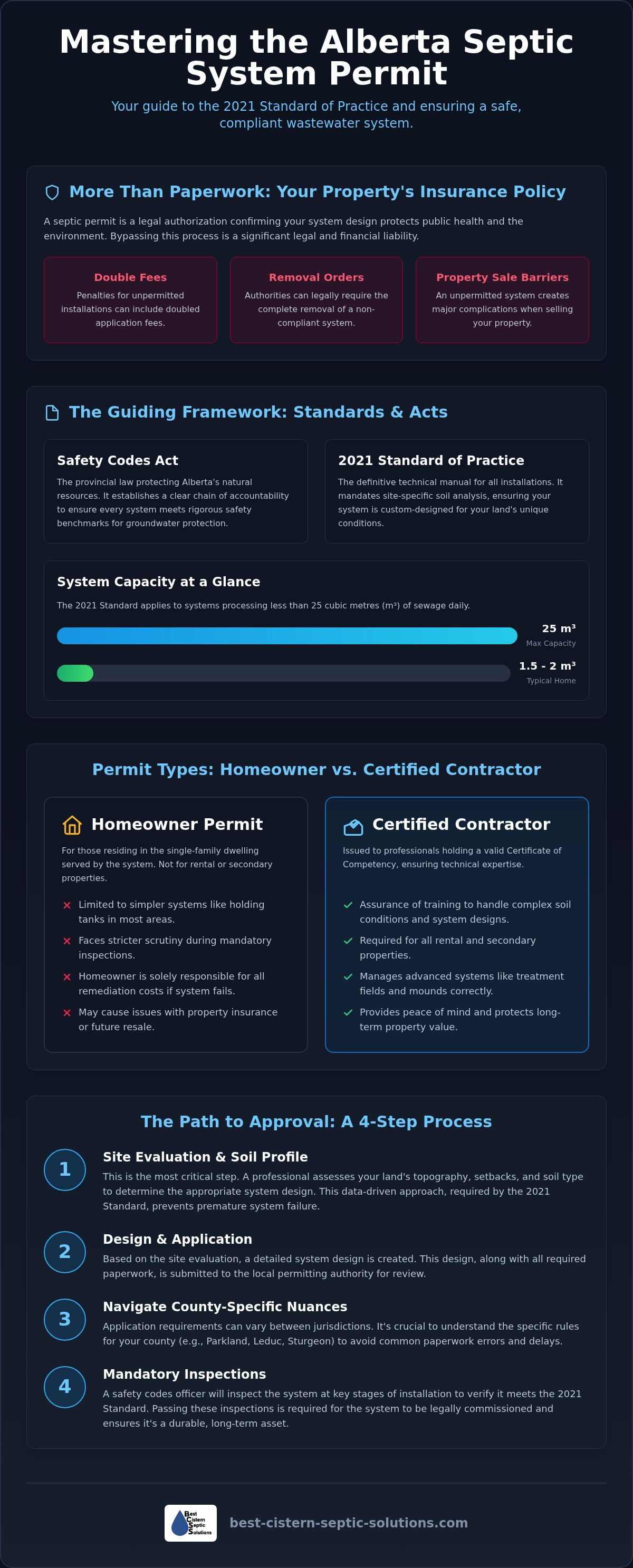
Obtaining a septic system permit alberta authorities mandate is the foundational step for any successful rural property development. A Private Sewage Disposal System (PSDS) permit is much more than a simple administrative hurdle; it's a legal authorization confirming that your wastewater system design protects the environment and public health. In 2026, the Alberta Private Sewage Systems Standard of Practice 2021 remains the definitive manual for these installations. This standard ensures that every tank and field is built to handle specific household loads while preventing groundwater contamination. Choosing to bypass this process isn't just risky; it's a legal liability. Installations performed without a permit can result in double application fees, mandatory system removal, and significant barriers when you eventually try to sell your property.
The Safety Codes Act and Your Property
The Safety Codes Act is the overarching provincial legislation that governs how we manage rural wastewater. It acts as a shield for Alberta's natural resources, ensuring that your neighbor's sewage doesn't become your groundwater problem. This Act establishes a clear chain of accountability, starting with the Safety Codes Council and extending to local accredited agencies and municipal safety code officers. These entities work together to verify that every septic system permit alberta homeowners apply for meets rigorous safety benchmarks. When you follow this process, you aren't just following the law; you're securing the long-term integrity of your household's most vital utility. This structured oversight provides peace of mind that your system is a safe, durable asset for your home.
Scope of the 2021 Standard of Practice
The 2021 Standard of Practice covers a wide range of technologies, including septic tanks, treatment fields, and specialized mounds. It applies specifically to systems that process less than 25 cubic metres of sewage daily. For most homeowners, this capacity is more than enough. A typical single-family home in North Central Alberta usually produces between 1.5 and 2 cubic metres of effluent per day, meaning your property falls well within these provincial guidelines. Understanding how a typical septic system works helps clarify why the 2021 update was so transformative. It moved away from generic designs and focused on site-specific soil analysis. By requiring detailed soil logs and site evaluations, the standard ensures that your system is custom-built for the unique drainage conditions of your land, preventing premature failure and ensuring years of worry-free service.
Permit Types: Homeowner vs. Certified Contractor Permits
Understanding the distinction between permit types is essential for a smooth project. While many believe they can handle every aspect of rural property development, the septic system permit alberta offers comes with specific categories that dictate who can perform the work. A homeowner permit is available if you reside in or intend to reside in the single-family dwelling served by the system. However, this is not a license for total DIY installation. Even with this permit, your system design must still align with the Alberta Private Sewage Systems Standard of Practice. In contrast, a Certified Contractor Permit is issued to professionals who hold a valid Certificate of Competency. This certification is your assurance that the installer has the technical training to manage complex soil conditions and advanced system mechanics.
Limitations of Homeowner Permits
Homeowner permits are restricted by both geography and complexity. You can only apply for this permit for your primary residence; secondary properties or rental units require a certified professional. Technically, most municipalities limit homeowner-installed systems to simpler setups like holding tanks. Attempting to design and install a soil-based treatment field without professional certification often leads to stricter scrutiny during the mandatory inspection phases. Safety code officers frequently apply a higher level of oversight to homeowner installations to ensure environmental safety isn't compromised. If the system fails to meet provincial standards, the homeowner is solely responsible for the cost of remediation.
Choosing the DIY route can also create long-term complications for your property's value. Many insurance providers in Alberta now request proof of professional installation before covering rural properties. If you cannot produce a permit signed by a certified installer, you might face insurance denial or higher premiums. Resale complications are equally common. During a real estate transaction, a buyer's home inspector will look for the completion certificate associated with your permit. A system installed without professional oversight can become a significant liability that stalls a sale or forces a price reduction.
The Advantages of Professional Permitting
Working with a certified expert opens the door to more efficient and advanced system designs. Technologies like At-Grade systems or advanced treatment plants often require technical calculations that exceed the scope of a homeowner permit. These systems are designed to maximize the longevity of your drainage field and protect your soil's health. When a professional handles your septic system permit alberta application, they take on the burden of technical filing and regulatory compliance. This ensures your project moves forward without the stress of administrative delays. For those looking for a reliable partner, Best Cistern Septic Solutions manages the entire technical assessment and permit submission process. This professional oversight transforms a complex legal requirement into a long-term asset for your household, providing the security that your system is built to last.
The Septic Permit Application Process in North Central Alberta
Securing a septic system permit alberta requires a methodical approach that begins long before you log into a municipal portal. In North Central Alberta, counties like Parkland use the PLANit system to streamline applications, but the digital form is only as good as the technical data you provide. You'll need to gather a comprehensive documentation package, including detailed plot plans, professional system designs, and verified soil logs. Once your permit is issued, remember the 90-day rule. Work must typically commence within 90 days of approval to remain valid. If the project is abandoned for more than 120 days, your permit may expire, requiring a new application and additional fees.
Step 1: The Site Evaluation
A successful septic field installation always begins with a thorough site evaluation. While older regulations relied on simple percolation tests, the current Alberta Private Sewage Systems Standard of Practice mandates soil profile pits. These pits allow a professional to examine the soil layers at depth, identifying restrictive layers or high water tables that could lead to system failure. We also map out essential setbacks during this phase. Your system must maintain specific distances from property lines, water wells, and seasonal water bodies to prevent contamination. This technical precision ensures your system remains a durable asset rather than a future liability.
Step 2: Designing for Compliance
After the soil data is collected, the design phase begins. Safety Codes Officers in North Central Alberta reject "one size fits all" designs because every property has unique hydraulic loading rates. Your system type, whether it's a treatment mound or an at-grade field, must match your soil's specific texture and drainage capacity. A complete application package includes a detailed plot plan showing the exact location of all components relative to your home and property boundaries. This level of detail is essential for a successful septic system permit alberta approval. By focusing on these technical details early, you avoid the frustration of a rejected application and move closer to a professional, compliant resolution for your home's wastewater needs.
County-Specific Nuances: Parkland, Leduc, and Sturgeon
While provincial standards provide the framework, the actual execution of a septic system permit alberta homeowners need happens at the municipal level. Each county in North Central Alberta has its own administrative style and local environmental challenges. Parkland County has fully integrated the PLANit portal for 2026, requiring all applications to be submitted digitally. This system streamlines the process but demands precise technical data from the start. In contrast, Leduc County often requires your septic permit to be synchronized with your building and development permits. You can't view the wastewater system in isolation from your home's construction timeline in these jurisdictions.
Sturgeon County places a heavy emphasis on protecting the North Saskatchewan river basin. If your property is near the river valley, you'll face stricter environmental reviews to ensure zero runoff. For those moving from the Edmonton Capital Region to a rural acreage, this transition can be jarring. You're moving from a municipal system to being the manager of your own utility. Understanding these local nuances is the difference between a smooth approval and a frustrating rejection.
Local Enforcement Agencies
You might wonder who actually reviews your application. In many North Central Alberta counties, the review process is handled by accredited agencies rather than direct county staff. These agencies employ safety code officers who specialize in wastewater technical inquiries. Processing times vary by season; spring and summer often see longer wait times due to the construction boom. Most agencies allow for permit extensions, but you must request these before the initial 90-day window closes. A quick call to your local agency can clarify current lead times and specific documentation preferences.
Regional Site Challenges
Local knowledge is your best defense against system failure. Parkland County is known for specific zones with high water tables. These conditions may necessitate an At-Grade system or a treatment mound rather than a traditional field. Leduc and Sturgeon counties frequently feature heavy clay soils. These soils have low hydraulic loading rates, meaning your system must be larger to effectively process effluent. A design that works in sandy soil will fail in clay, leading to a rejected permit or a saturated yard. If you're feeling overwhelmed by these regional requirements, Best Cistern Septic Solutions provides the local expertise needed to navigate these county-specific hurdles with ease.
Ensuring Your System Passes Inspection
Passing the final inspection is the moment your septic system permit alberta requirements are officially satisfied. It's the technical "green light" that transforms your construction project into a legal, operational utility. In 2026, the inspection process remains rigorous to ensure every installation protects the environment. You'll navigate two primary stages: the open-trench inspection and the final cover inspection. The open-trench phase is critical because it allows the safety codes officer to verify the system's internal mechanics before they're buried. Once the inspector signs off on this stage, you can proceed with backfilling and the final site restoration.
What Inspectors Look For
Inspectors follow a methodical checklist based on the 2021 Standard of Practice. They start with the septic tank itself, verifying it's level and sits on at least 150mm of approved bedding material like sand or pea gravel. This prevents the tank from shifting or cracking over time. Next, they examine the pipe slope from the house to the tank and from the tank to the distribution box. A precise slope is vital for gravity-fed systems to prevent blockages. In the drainage field, they check for distribution uniformity. This ensures that effluent is spread evenly across the entire field rather than saturating one specific spot. The most common reason for failure in 2026 is a deviation from the approved design. If you change a component's location or type without notifying the agency, the inspector cannot issue an approval.
Finalizing the Process
Once the physical work passes, the administrative cycle concludes with the submission of "As-Built" drawings. These are updated plans that show exactly where every pipe and tank is located on your property. This document is a vital long-term asset; you'll need it for future property sales and for establishing a long-term maintenance schedule. After the county accepts these records, you'll receive your Certificate of Completion. This document is your proof of compliance for property insurance providers; it's often required to maintain your coverage. Passing the inspection is a major milestone, but it's just the beginning of your system's lifecycle. To protect your investment, your next step is to transition into a routine of professional septic maintenance. Regular check-ups prevent small mechanical issues from becoming expensive repairs, ensuring your system remains safe and efficient for decades.
Securing the Long-Term Value of Your Alberta Property
Navigating the technical requirements for a septic system permit alberta provides is about more than just paperwork. It's about protecting your land and your family's health for decades. By adhering to the 2021 Standard of Practice and understanding the specific soil conditions in Parkland, Leduc, or Sturgeon County, you transform a complex legal necessity into a reliable property asset. You now have a roadmap for site evaluations and professional designs that prevent costly failures and ensure your system passes every mandatory inspection stage with ease.
You don't have to manage this technical journey alone. As Certified Private Sewage Installers, we specialize in handling the intricate assessments and permit submissions that modern regulations demand. We serve homeowners across North Central Alberta with comprehensive design and inspection services that prioritize durability and peace of mind. If you're ready to start your project, Contact Best Cistern Septic Solutions for Stress-Free Permitting & Installation. We'll handle the technical details so you can focus on enjoying the security of a professionally managed rural home.
Frequently Asked Questions
Do I need a permit to repair an existing septic field in Alberta?
Yes, a private sewage disposal system (PSDS) permit is mandatory for any significant alteration or replacement of an existing septic field. While routine maintenance like cleaning a filter doesn't require a permit, any work that changes the system's design or capacity falls under provincial regulation. This ensures that repairs meet the 2021 Standard of Practice, protecting your land from environmental damage. Always consult a certified professional before starting repairs to confirm if a permit is necessary.
Can I pull a septic permit myself as a homeowner in Parkland County?
You can apply for a homeowner permit in Parkland County if you reside in or intend to live in the single-family dwelling served by the system. However, this option is generally limited to soil-based systems on your primary residence. Even as a homeowner, your application must include a professional site evaluation and a design that complies with provincial codes. Many residents find that having a certified contractor pull the septic system permit alberta authorities require ensures technical accuracy.
How long does it take to get a septic permit approved in Leduc County?
Approval timelines in Leduc County typically range from two to four weeks, depending on the complexity of your site and the current volume of applications. Because Leduc often requires septic permits to align with building and development permits, the review process involves multiple departments. Ensuring your documentation is complete, including detailed soil logs and plot plans, is the most effective way to prevent administrative delays and move your project forward on schedule.
What happens if I install a septic system without a permit?
Installing a system without a permit carries significant legal and financial risks. In many North Central Alberta counties, the penalty for work done without a permit is double the original application fee. Beyond fines, you may be forced to uncover or remove the system to prove compliance. This can also lead to insurance denials and major complications during property resale, as buyers require a valid Certificate of Completion to secure financing for the home.
Does a septic permit cover both the tank and the field?
A standard private sewage disposal system permit covers the entire installation, including the septic tank and the treatment field or mound. The application requires technical details for every component to ensure they work together as a single, cohesive unit. If you're only replacing a specific part, such as a tank, you still need a permit to ensure the new component is compatible with the existing drainage field and meets current provincial safety standards.
Are permit requirements different for holding tanks versus treatment fields?
Yes, the requirements vary based on the complexity of the system. Holding tanks generally have a simpler application process and lower permit fees because they don't involve soil-based treatment. However, they still require municipal approval and must meet specific setback requirements. Treatment fields or mounds require a more intensive application package, including professional soil profiles and hydraulic loading calculations, to ensure the soil can safely process effluent over the long term.
How much does a septic permit cost in the Edmonton area for 2026?
Permit fees vary by municipality across the Edmonton region for 2026. For example, Parkland County currently charges $270 for the installation of a treatment field or mound, while Sturgeon County's fee is $370. Holding tank permits are typically less expensive, often ranging between $80 and $165 depending on the jurisdiction. These fees are set by local bylaws and are subject to annual adjustments, so it's best to verify the current schedule with your local accredited agency.
Who is responsible for scheduling the septic inspection?
The permit holder is responsible for contacting the local accredited agency to schedule all mandatory inspections. If a certified contractor pulled the septic system permit alberta requires, they will typically coordinate with the safety codes officer to ensure the open-trench inspection happens before any components are buried. Homeowners who pull their own permits must manage this timeline themselves, ensuring that work doesn't proceed to the final cover stage until the inspector has provided a formal sign-off.


