
On a working Alberta farm, a septic system isn't just a utility; it's a critical piece of infrastructure that must be armoured against livestock and heavy equipment to maintain your property's long-term value. When you're managing acres of land, the last thing you want is the stress of a crushed field or a contaminated water source. You likely feel that meeting the specific farm septic system requirements Alberta mandates under the 2021 Standard of Practice (SOP) is a moving target, especially when balancing agricultural operations with residential safety.
It's frustrating to decipher technical setbacks while worrying about whether your setup can withstand the weight of a harvest truck. This guide provides a clear roadmap to legal compliance and a system designed to last 20 years or more. We'll walk through the essential 2026 regulations, including critical setback distances and the specific steps required for successful permit approval in Parkland or Leduc County. By the end of this guide, you'll have the technical clarity needed to protect your land and ensure your utility systems remain a silent, reliable asset for decades.
Key Takeaways
- Learn the specific 15-metre setback requirements for wells and dugouts to ensure your agricultural water supply remains safe and uncontaminated.
- Discover why selecting the right system type, such as a treatment mound or at-grade system, is essential for protecting your field from heavy farm machinery.
- Understand the step-by-step process for meeting farm septic system requirements Alberta when applying for permits in Parkland, Leduc, or Sturgeon County.
- Identify the mandatory documentation, including soil reports and site plans, you must provide to ensure a successful regulatory inspection.
- Establish a proactive maintenance schedule to transform your septic system into a long-term property asset that prevents future environmental risks.
The Alberta Private Sewage Standard of Practice: What Farmers Must Know
Understanding the provincial rules is the first step toward long-term peace of mind on your property. The Alberta Private Sewage Systems Standard of Practice (SOP) 2021, which came into force on November 1, 2022, serves as the primary rulebook for every installation. While these regulations apply to both urban and rural settings, the farm septic system requirements Alberta landowners must follow are often more complex due to site-specific agricultural factors. The Safety Codes Council acts as the provincial watchdog, ensuring that every system meets strict safety and environmental benchmarks to protect the surrounding landscape.
The Safety Codes Council plays a vital role by training and certifying the professionals who work on your land. They ensure that every installer understands the physics of effluent treatment and the chemistry of soil absorption. Because agricultural land faces unique pressures like heavy equipment traffic and livestock proximity, you need a Certified Master Installer to design your system. These experts understand how septic systems work in a working farm environment, moving beyond basic residential designs to create a solution that remains durable despite the rigors of farm life.
Key Regulatory Changes in the 2021 SOP Update
The 2021 update introduced several shifts that directly impact farm owners. First, soil profile requirements are now much stricter. You must have a thorough soil evaluation conducted at the exact site of the proposed field before any design begins. These changes aim to protect groundwater, which is often the lifeblood of a working farm. The requirement for a detailed soil profile means that "one size fits all" designs are no longer acceptable. Your installer must analyze soil texture and structure at multiple depths to ensure proper drainage.
If your land sits in a high-risk area, such as near a creek or dugout, the updated standards for secondary treatment ensure that the water returning to the earth is as clean as possible. Additionally, the SOP now emphasizes documentation. Landowners are encouraged to maintain detailed logs of their system's performance and service history. Keeping these records isn't just about compliance; it's a proactive way to track the health of your infrastructure and catch small issues before they require a major septic field repair.
Why 'Grandfathered' Systems Often Fail Modern Inspections
Many multi-generational farms in Alberta still rely on "straight-discharge" pipes or old cesspools. While these might have functioned for decades, they no longer meet modern safety standards and pose significant environmental risks. These outdated systems can contaminate local water sources and lead to soil degradation. If you're planning to expand your operations or pass the land to the next generation, these hidden risks can become a major hurdle.
Selling a farm with a non-compliant system can lead to significant legal liabilities or delayed closings. Buyers and lenders in 2026 are more diligent than ever about environmental compliance. A professional septic system inspection is the most reliable way to identify these hidden gaps. This assessment provides a clear picture of your system's health and ensures your property remains a secure, high-value asset. It's a small step that offers a definitive, professional fix for any regulatory concerns.
Critical Setback Distances for Farm Septic Fields in Alberta
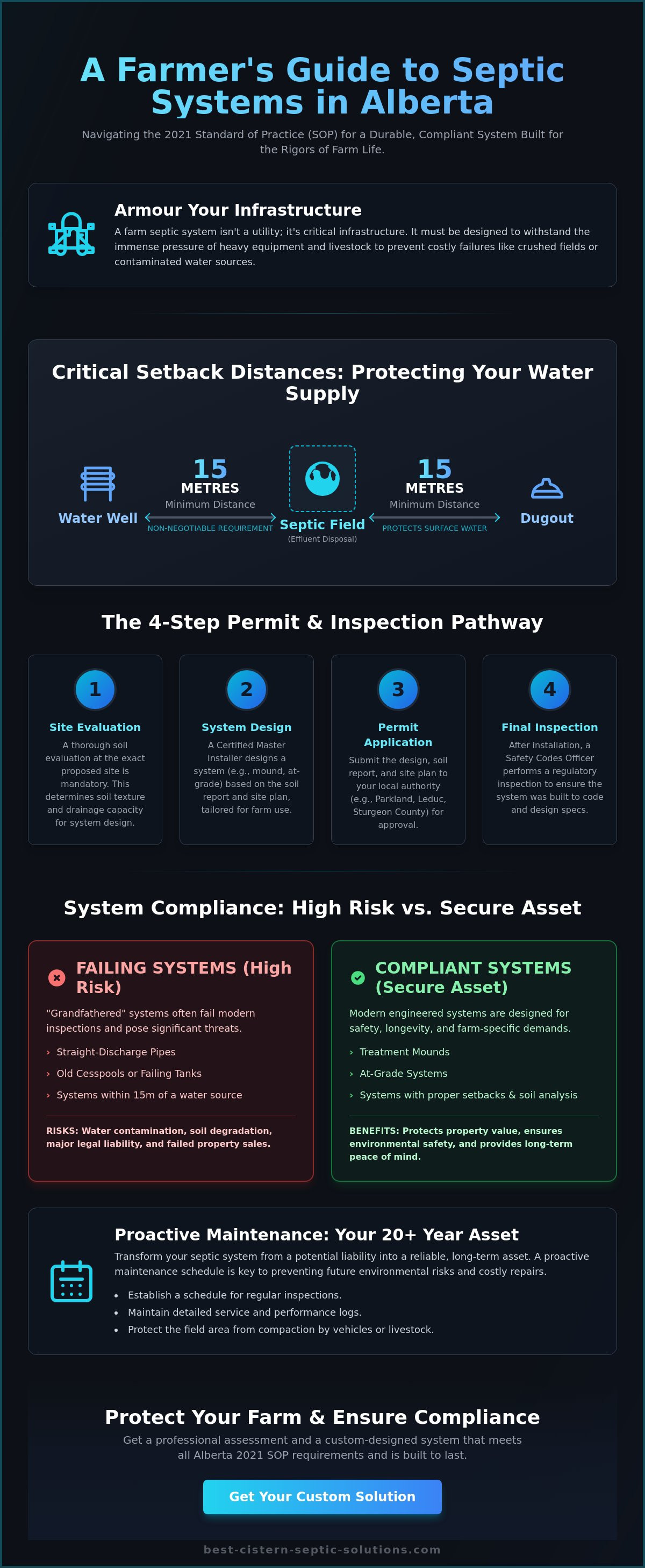
Spatial planning on a farm requires more than just convenience. It's about long-term safety and infrastructure protection. The Alberta Private Sewage Systems Standard of Practice dictates exactly where your components can sit to prevent environmental contamination. For instance, you must maintain a minimum of 15 metres between your effluent disposal component and any water well or dugout. This distance is non-negotiable. It prevents pathogens from migrating into your drinking or irrigation water. When planning your layout, meeting the farm septic system requirements Alberta enforces ensures your household stays healthy and your property remains compliant.
Property lines also carry strict rules that landowners must respect. Depending on whether you have a conventional treatment field or a specialized mound, setbacks can range from 1.5 to 10 metres from your boundaries. You must also consider what's happening underground. Protecting the water table is a top priority. Alberta codes require a specific vertical separation between the bottom of your septic field and the high water table or an impermeable soil layer. This vertical buffer acts as a final filter, purifying effluent before it reaches groundwater. These distances aren't just suggestions; they're calculated safeguards for your land's health.
Setbacks for Livestock and Agricultural Operations
Livestock present a unique challenge to septic integrity that urban systems never face. Manure storage areas and feedlots should be kept well away from your septic components to avoid overwhelming the soil's natural filtration capacity. Perhaps most importantly, you must keep heavy animals off the soil mantle covering your field. Hoof pressure causes soil compaction, which destroys the oxygen flow needed for aerobic bacteria to treat waste. Similarly, ensure that runoff from large barn roofs is diverted away from the septic bed. Excess water can saturate the soil, leading to premature failure and the need for a professional septic field repair to restore proper function.
Boundary Rules and Neighbouring Properties
Legal complications arise quickly if septic effluent crosses property lines. In Alberta, you're responsible for ensuring all treated wastewater stays within your boundaries. This becomes tricky on smaller parcels or farms with existing easements. Utility corridors or shared access roads can limit your placement options significantly. If your farm borders a public road or highway, additional setbacks apply to prevent interference with provincial infrastructure. Mapping these variables early in the design phase prevents costly relocation projects later on. Taking the time to measure accurately ensures your system remains a long-term asset rather than a source of boundary disputes.
Choosing the Right System for Agricultural Land
Selecting a system that survives the daily demands of a working farm requires a specialized approach. While residential properties might prioritize aesthetics, agricultural land requires a design focused on durability and volume. Most Alberta farms choose between treatment mounds and at-grade systems. Mounds are often the preferred choice when dealing with the high water tables or heavy clay soils common in the region. They provide an extra layer of sand for filtration before effluent reaches the natural soil. At-grade systems are less intrusive but require specific soil conditions and a protected location away from heavy traffic. Following the Alberta Private Sewage Systems Standard of Practice ensures your chosen system can handle these specific agricultural loads without risking environmental contamination.
On a farm, the location of your system is often more critical than the specific tank type. A heavy tractor or harvest truck can crush lateral lines or compact the soil in seconds, leading to a total system failure. If you run a farm-based business, such as a commercial greenhouse or a multi-family operation, your wastewater volume will be significantly higher than a standard household. In these cases, you might also need to integrate a cistern and a reliable cistern pump to ensure consistent water pressure and volume. Meeting the farm septic system requirements Alberta mandates ensures your infrastructure remains a long-term asset rather than a liability during peak operational seasons.
The Role of Soil Texture in System Selection
Soil texture determines the loading rate, which is the amount of effluent the ground can safely absorb per day. In Parkland or Sturgeon County, a detailed soil profile is the mandatory first step. Alberta is known for its heavy clay, which has a very low loading rate. This means landowners often face requirements for larger field sizes to compensate for slow drainage. If you ignore the loading rate, the soil becomes saturated, oxygen is cut off, and the field eventually fails. A professional soil analysis ensures your field is sized correctly for your specific acreage.
Armouring Your System Against Farm Activity
Protection is the final piece of a successful installation. Treat your septic field as a permanent no-drive zone. Fencing the area remains the most effective way to keep cattle, horses, and heavy machinery from damaging the soil mantle. When planning your septic field installation, always include a site map that accounts for future farm expansion. You don't want to find out years from now that a new grain bin or calving barn is slated for the exact spot where your septic field sits. Planning for these invisible boundaries today preserves your property's value for decades.
The Permitting and Inspection Process in North Central Alberta
Applying for a Private Sewage Permit is the essential bridge between your technical design and a legal, functional system. In regions like Parkland County, Leduc County, or Sturgeon County, the process begins with submitting a comprehensive application package to the local safety codes office. You'll need a detailed site plan, a professional soil evaluation report, and a system design that matches the specific farm septic system requirements Alberta mandates for your soil type. These documents prove to the county that your system won't contaminate local groundwater or encroach on protected setbacks. A thorough application is the best way to ensure your project moves forward without administrative delays.
The inspection process happens in two critical stages. The 'Rough-In' inspection occurs when the tanks and piping are set but not yet covered. The inspector verifies that the components match the approved plan and that the materials meet provincial standards. The 'Final' inspection follows once the field is complete and the site is ready for final grading. Once approved, you receive a Certificate of Compliance. You should keep this document for 20 years or more. It serves as definitive proof of your system's integrity during future land sales or when you apply for permits for new agricultural buildings near the installation.
Working with Local County Authorities
Each municipality has its own rhythm and review timelines. For example, Parkland County might process applications at a different speed than Sturgeon County during the busy spring construction season. To ensure a smooth approval, you must work with a Certified Master Installer who carries a valid certificate of competency from Alberta Municipal Affairs. Permits often face rejection because of incomplete site maps or failing to account for the mandatory 15-metre setback from farm dugouts. A professional partner ensures these technicalities are handled correctly the first time, providing you with the peace of mind that your infrastructure is fully compliant.
Cost Expectations for Farm Permits and Inspections
Budgeting for the administrative side of your project is a straightforward part of property management. In Sturgeon County, the 2026 fee for a permit covering septic fields or mounds is $370.00, plus a 4% Safety Codes Council levy. Holding tanks for low-pressure lines are typically less, costing around $160.00. While these fees are fixed by the municipality, the real value comes from choosing a professional septic system repair over a full replacement if your existing infrastructure allows for it. Investing in a mandatory soil analysis early on prevents the much higher costs of a system that fails due to improper sizing or poor placement. If you're ready to secure your property's infrastructure, contact Best Cistern Septic Solutions to start your professional site evaluation.
Maintaining Compliance and Protecting Your Farm's Future
Maintenance is more than just a routine chore; it's a security measure for your agricultural land. Keeping up with the farm septic system requirements Alberta enforces ensures that your daily operations remain uninterrupted and your property value stays intact. A failing system is a significant liability that can halt farm production and drain financial resources. By treating your septic infrastructure as a vital long-term asset, you protect the health of your soil and the safety of your household. It's about creating a predictable environment where your utilities function silently in the background.
Developing a seasonal rhythm is the best way to stay ahead of potential issues. In the spring, walk your field to check for pooling water or unusual odors that might indicate soil saturation. During the fall, ensure your effluent filter is clean and your septic alarm is fully functional. These small, methodical steps prevent the need for a major septic field repair later on. Septic alarms are particularly important on a farm. They act as an early warning system, alerting you to high water levels or pump malfunctions before waste backs up into your home or saturates your treatment field. Best Cistern Septic Solutions specializes in septic alarm installation, providing the technical security you need to focus on your harvest rather than your plumbing.
Winter Septic Care for Alberta's Climate
Alberta winters present the ultimate test for any mechanical system. When temperatures drop to -40°C in the Edmonton region, line freeze-ups become a genuine threat to your property's comfort. One of the most important rules is to never plow snow off your septic field. Snow acts as a natural insulation layer that prevents frost from driving deep into the ground and freezing your lateral lines. If your system relies on an effluent pump to move waste to a mound or at-grade field, ensure it's in peak condition before the first frost. A reliable pump ensures a steady flow of warm water from the house, which is your best defense against ice blockages during a deep freeze.
Long-Term Asset Protection
Consistent septic tank maintenance is the most effective way to avoid the high costs associated with a total field replacement. Beyond the mechanical benefits, keeping accurate service records is essential for future property sales or family farm transfers. Buyers in 2026 want to see a documented history of care before they commit to a rural purchase. A well-designed and meticulously maintained Alberta farm septic system can reliably serve a property for 25 to 30 years. Best Cistern Septic Solutions remains a dedicated partner for local farmers, offering the expertise needed to ensure your system remains a silent, durable, and compliant part of your farm's success for decades to come.
Securing Your Agricultural Infrastructure for the Decades Ahead
Managing a farm involves balancing countless moving parts, and your utility systems shouldn't be a source of constant worry. By understanding the farm septic system requirements Alberta enforces, you've taken the first step toward long-term property security. We've explored the necessity of strict setbacks from dugouts, the importance of soil-specific designs, and the protective measures required to keep heavy machinery from damaging your investment. These technical standards aren't just red tape; they're the blueprint for a system that serves your family and your business reliably for 30 years or more.
Our team at Best Cistern Septic Solutions brings specialized expertise in North Central Alberta soil conditions to every project. As Certified Master Installers, we focus exclusively on rural and agricultural properties to ensure every installation or repair meets provincial codes and your specific operational needs. We take pride in performing difficult tasks with a high level of sophistication, ensuring your property remains a high-value asset for the next generation.
Secure your farm’s future with a professional septic consultation today. You deserve the peace of mind that comes with knowing your essential utilities are handled by experts who value the health of your land as much as you do.
Frequently Asked Questions
Do I need a permit to replace an existing farm septic tank in Alberta?
Yes, you must obtain a Private Sewage Permit before replacing a septic tank or any other major component. Provincial regulations treat a tank replacement as a significant alteration, requiring a certified professional to ensure the new installation meets current safety codes. This process protects your property's environmental integrity and ensures the new tank is properly sized for your household's wastewater needs.
What is the minimum distance a septic field must be from my farm's water well?
A septic field must be located at least 15 metres away from any water well or dugout on your property. This specific distance is a critical part of the farm septic system requirements Alberta enforces to prevent pathogens from leaching into your drinking or irrigation water. Maintaining this buffer zone is one of the most effective ways to ensure the long-term safety of your farm's water supply.
Can I install my own septic system on my farm in Parkland County?
No, you cannot legally install your own septic system in Parkland County unless you hold a valid certificate of competency from Alberta Municipal Affairs. Provincial law requires that only certified contractors design and install private sewage systems. This ensures that every system is built to withstand local environmental pressures and meets the rigorous technical standards required for a successful final inspection.
How does the Alberta 2021 Standard of Practice affect my existing farm system?
The 2021 Standard of Practice primarily affects new installations or systems undergoing major repairs. If your current system is functioning correctly, you aren't required to upgrade it immediately. However, if you plan to expand your farm dwelling or if the system begins to fail, the entire setup must be brought into compliance with the updated 2021 standards to ensure continued safety and legality.
What happens if a farm septic system fails an inspection during a property sale?
If an inspection reveals a failure during a sale, the system typically must be repaired or replaced to meet current 2026 codes. Lenders and buyers often require a Certificate of Compliance before finalizing a mortgage or property transfer. Addressing these issues with a professional repair or a new installation ensures the sale proceeds smoothly and protects the seller from future legal liabilities related to environmental contamination.
Is a treatment mound better than a traditional septic field for Alberta farms?
A treatment mound is often the superior choice for Alberta farms with heavy clay soil or high water tables. While traditional fields work well in sandy soil, mounds provide an extra layer of sand for effluent filtration, which is essential in many parts of North Central Alberta. Choosing the right system depends entirely on your specific soil profile and the daily wastewater volume your farm generates.
How much does a soil profile test cost for a new farm septic system?
A professional soil profile test for a new farm septic system typically costs between $300 and $500. This mandatory evaluation involves digging test pits to analyze soil texture, structure, and color at various depths. The results dictate the loading rate of your field, ensuring the system is sized correctly to prevent premature failure and protect your land's future value.
Can heavy farm machinery drive over a septic field if the pipes are buried deep?
No, you should never drive heavy farm machinery over a septic field. Even if pipes are buried deep, the weight of tractors or harvest trucks causes soil compaction. This crushes the tiny air pockets in the soil that aerobic bacteria need to treat effluent. Once the soil is compacted, the field can no longer absorb water, leading to a total system failure that requires a costly replacement.


