
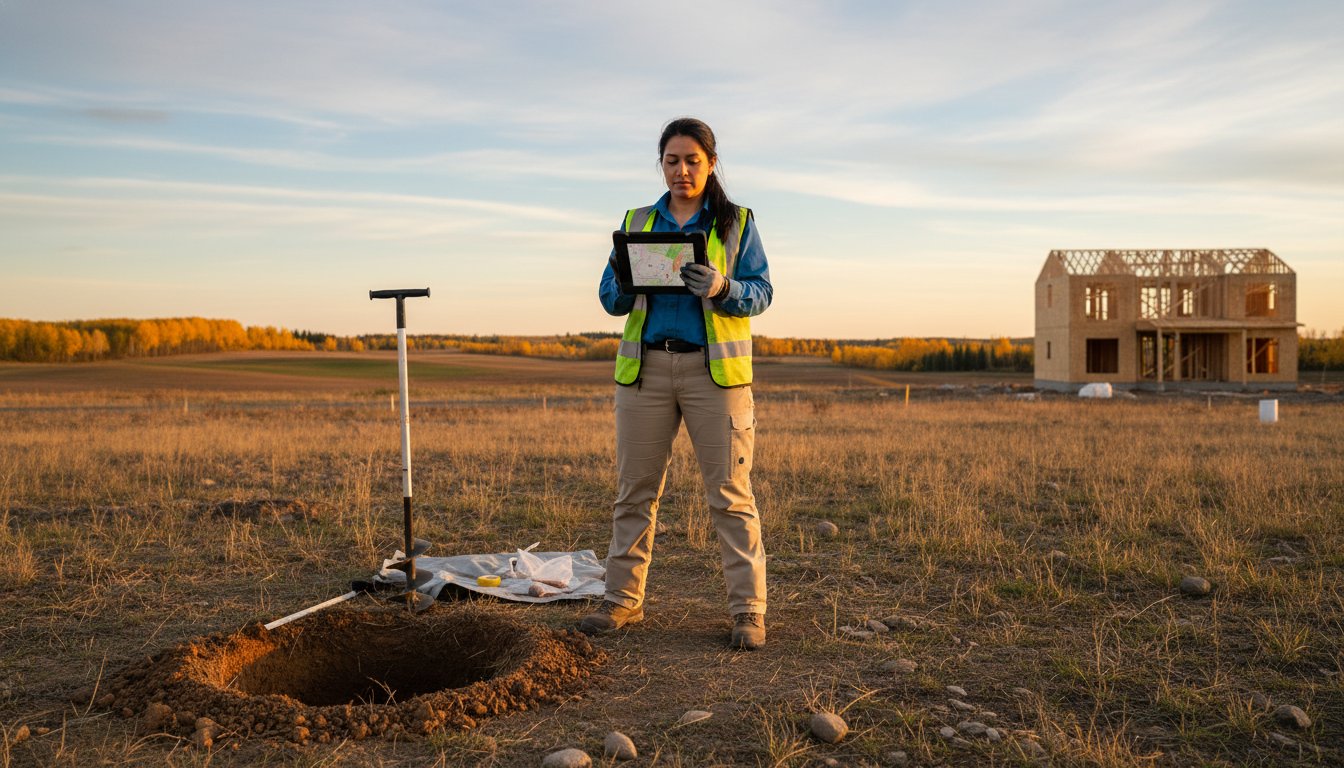
The "perc test" you're looking for might actually be the most important insurance policy you never knew you needed. When you start researching the cost of perc test in Parkland County, it's easy to feel overwhelmed by the region's reputation for heavy clay and complex drainage. You likely want a simple number; yet, you're probably worried that hidden fees or soil surprises will derail your project before the first shovel hits the dirt. We understand that transparency is the first step toward a successful build and long-term property security.
This 2026 guide provides the clarity you need to move forward with confidence. You'll discover the current industry pricing for professional site evaluations and the mandatory permit fees required by Parkland County's PLANit system. We break down the vital difference between a basic percolation test and a full Site Evaluation to ensure you meet the Alberta Private Sewage Systems Standard of Practice. By following these steps, you'll know exactly how to prepare your land and avoid the costly setbacks of a failed inspection later on. Every manageable resolution starts with the right data, and we're here to help you secure your home's future.
Key Takeaways
- Understand the legal necessity of a perc test under the Alberta Private Sewage Systems Standard of Practice to ensure your system meets mandatory environmental safety codes.
- Get a transparent look at the 2026 industry standards for the cost of perc test in Parkland County and the specific technical reporting included in a professional evaluation fee.
- Learn how local factors like heavy clay soil and property accessibility can influence the complexity, duration, and final design requirements of your site evaluation.
- Follow a clear, step-by-step roadmap of the professional testing process, ranging from historical groundwater data reviews to physical on-site topography mapping.
- See how accurate soil data serves as a long-term asset for your property, allowing for a custom septic design that prevents future failures and protects your household’s safety.
What is a Perc Test and Why is it Mandatory in Parkland County?
Many homeowners begin their land development journey by asking What is a Perc Test. In its simplest form, this test measures the rate at which soil absorbs liquid. However, in Parkland County, it's much more than a simple hole in the ground with a stopwatch. It's the technical foundation of your entire waste management system. While the term "perc test" is still used colloquially, modern Alberta regulations have shifted toward a more thorough "Site Evaluation." This comprehensive approach ensures that your septic system remains a long-term asset rather than a hidden liability.
The Alberta Private Sewage Systems Standard of Practice (SOP) mandates these evaluations to protect our local environment. Parkland County features a unique mix of geographical challenges, from the rolling hills of the north to the dense, stubborn clay found in many residential pockets. A professional evaluation identifies these soil layers, ensuring that the effluent from your home is treated safely before it ever reaches the groundwater. Because the cost of perc test in Parkland County is a relatively small portion of your total build budget, it's the most effective way to prevent a multi-thousand dollar system failure later on.
The Science of Soil Absorption
Effective sewage treatment happens in the soil, not just the tank. When effluent leaves the tank, it enters the soil where natural bacteria filter out harmful pathogens. In areas like Spruce Grove or Stony Plain, the high clay content can act like a seal, preventing water from moving. If the soil is saturated during a wet Alberta spring, test results can be misleading. A professional tester looks beyond the surface, identifying the "limiting layer" where water stops draining. This precision prevents groundwater contamination and ensures your household stays safe and dry through every season.
Legal and Regulatory Requirements in 2026
Under the Safety Codes Act, every new or replacement septic system requires a permit. You cannot obtain a Parkland County development permit without a documented site evaluation performed by a certified professional. These regulations exist to ensure every property in the Alberta capital region maintains high health and safety standards. When you factor in the cost of perc test in Parkland County, you're paying for a legal guarantee that your project complies with provincial law. This step is essential for securing your property's permits through the PLANit Parkland system, making it a non-negotiable part of your construction timeline.
Breaking Down the Cost of a Perc Test in 2026
When budgeting for your new build or system upgrade, the cost of perc test in Parkland County is often the first technical figure you'll encounter. In North Central Alberta, a professional site evaluation and system design typically range between $500 and $2,500. This investment covers far more than just digging a few holes. It represents the professional analysis required to ensure your property can safely manage wastewater for decades to come. While it's tempting to look for the lowest possible quote, an incomplete test can lead to design errors that result in premature system failure, costing you significantly more in the long run.
It's also important to factor in the mandatory administrative fees required by the local government. For 2026, Parkland County permit fees for the installation or replacement of a private sewage disposal field are set at $270.00. If you're only installing or replacing holding tanks, the fee is $162.00. These costs are separate from the professional labor but are essential for staying compliant with the Alberta Private Sewage Systems Standard of Practice. By following these provincial standards, you protect your property value and the surrounding groundwater.
Labour and Equipment Components
A modern site evaluation is a labor-intensive process. It requires mobilizing heavy equipment, such as a backhoe, to the site to create deep-hole soil profiles. This allows a certified installer to examine the soil layers several meters down, identifying "limiting layers" that a simple hand auger might miss. You're paying for the machinery, the operator's time, and the expertise of a professional who can distinguish between various clay and silt compositions. A thorough evaluation usually takes a half-day or more to complete properly.
Reporting and Design Fees
The physical work on your land is only half the job. After the site visit, the professional must translate the raw data into a formal Site Evaluation Report. This document is a prerequisite for your permit application via PLANit Parkland. It includes topography mapping, soil logs, and a custom design tailored to your land's specific absorption rates. While the cost of perc test in Parkland County covers the physical digging, the real value lies in this data interpretation. Working with a partner who provides comprehensive septic solutions ensures that your testing data is used to build a system that is both durable and safe for your family.
Factors That Influence Perc Test Pricing in Alberta
While we have established the general price ranges for professional evaluations, your specific property features dictate where you fall on that spectrum. The cost of perc test in Parkland County isn't a fixed figure because the land itself isn't uniform. Every site presents a different set of variables, from the depth of the frost line to the physical makeup of the earth beneath your feet. Understanding these factors helps you plan your budget with precision and avoid unexpected surcharges during the development phase.
Soil composition remains the primary driver of testing complexity. Parkland County is well known for its diverse geography. While one lot might feature sandy loam that drains with ease, another just a few kilometers away could be sitting on a thick layer of heavy clay. Clay particles are microscopic and tightly packed, which slows the movement of water significantly. When a tester encounters these conditions, they must often perform additional soil profiles to find a suitable location for a treatment field. This extra time and labor naturally influence the final invoice.
The 'Clay Factor' in Parkland County
According to the Alberta Private Sewage Systems Standard of Practice, heavy clay soils require a more conservative hydraulic loading rate, which necessitates precise and often extended percolation measurements to ensure long-term system viability. In these "difficult" soils, a standard test might take twice as long as one performed in well-draining sand. We don't rush this process. Taking the time to get an accurate reading in clay-heavy areas prevents your future septic field from becoming a saturated, failing mess.
Accessibility also plays a role in your total investment. If your property is in a remote corner of Sturgeon or Leduc County, travel time for the technician and the mobilization of heavy equipment like a backhoe will add to the cost. We recommend clearing a visible, stable path to the testing site before the professional arrives. This simple preparation reduces the time spent on-site and ensures the equipment can reach the necessary locations without delay.
Seasonal Timing and Accessibility
The calendar is another factor that savvy homeowners should consider. Testing in the dead of an Alberta winter often incurs a "winter tax" because the frozen ground is significantly harder to penetrate. This requires more fuel, specialized equipment, and additional labor hours. Conversely, the peak of "the big melt" in late spring can result in high water tables that might skew results or make the site too muddy for heavy machinery.
Finally, lot size and complexity can impact the cost of perc test in Parkland County. If you own a large acreage and want to explore multiple potential build sites, the professional will need to perform multiple sets of tests. While this increases the initial evaluation fee, it provides you with the flexibility to choose the best location for your home and utility systems. Investing in thorough data now ensures your property remains a safe, functional asset for the next thirty years.

The Site Evaluation Process: What to Expect
Understanding the sequence of a professional site evaluation helps demystify the cost of perc test in Parkland County. This is a methodical, five-step journey designed to transition your project from a concept to a permitted reality. While the physical digging is the most visible part, the process actually begins long before any equipment arrives on your property. Each phase ensures that your future septic system is built on a foundation of verified data rather than guesswork.
- Step 1: Desktop Review – We analyze local groundwater records and historical soil data from the Alberta Geological Survey to identify potential regional challenges.
- Step 2: On-Site Visual Assessment – A technician maps your property's topography, identifying slopes, vegetation patterns, and required setback distances from wells or property lines.
- Step 3: Soil Profile Pits – This is the "Deep Hole" phase where a backhoe excavates pits to reveal the soil layers and any limiting conditions.
- Step 4: Physical Testing – We conduct percolation or permeameter tests at the specific depth of the proposed field to measure exactly how fast the soil can process effluent.
- Step 5: Final Reporting – All data is compiled into a formal Site Evaluation Report, which is the technical document required for your Parkland County permit application.
By following this structured path, we remove the uncertainty that often accompanies rural development. The result is a clear roadmap for your installation that prioritizes both environmental safety and system longevity. If you are ready to begin this process, our team provides comprehensive septic solutions to ensure your site evaluation meets every provincial standard.
Deep Hole Testing vs. Surface Perc
Modern Alberta regulations require looking much deeper than a standard surface "perc" test. We must examine the soil 2 to 3 metres below the surface to identify the "limiting layer." This layer might be bedrock, a high groundwater table, or dense clay that prevents drainage. Identifying this layer is critical; it determines whether you can use a standard gravity-fed field or if your land requires a more complex mound system. Knowing this early prevents the catastrophic failure of a system that cannot properly drain.
Preparing Your Property for the Tester
You can help manage the cost of perc test in Parkland County by preparing your site before the technician arrives. Start by contacting Utility Safety Partners (formerly Call Before You Dig) to mark any underground lines. Ensure there is a clear, wide path for a backhoe or skid-steer to reach the testing area. Finally, have your Land Title and any existing site plans or maps ready. This preparation allows the professional to work efficiently, focusing their time on technical analysis rather than clearing brush or searching for property markers.
Moving from Testing to Installation with Best Cistern Septic Solutions
The data gathered during your site evaluation is only as valuable as the design it produces. When you look at the cost of perc test in Parkland County, remember that this fee is the starting point for a system that must function flawlessly for the next twenty to thirty years. At Best Cistern Septic Solutions, we don't just hand you a report; we use that technical data to create a robust, site-specific plan. By acting as a single partner for both septic system inspections and your eventual installation, we maintain a seamless flow of information. This continuity eliminates the "lost in translation" errors that often happen when a designer and an installer aren't on the same page.
Transparency is at the heart of our service model. We believe that homeowners deserve a clear path forward without the stress of hidden fees or sudden design changes halfway through the build. Our technical precision ensures that the quote you receive is based on the reality of your soil, not a best-case guess. This grounded approach provides the peace of mind that your essential utility systems are being handled by experts who understand the specific residential needs of Parkland County. We take pride in performing these difficult tasks with a high level of sophistication and care.
Why Design Matters More Than the Test
A successful septic field installation requires more than just knowing how fast water drains. We account for critical local factors like Parkland County's frost depth to ensure your pipes and treatment areas remain protected during the harshest Alberta winters. A well-designed system becomes a long-term asset that preserves your property value and protects your family's health. We treat every project as a property preservation task, ensuring the invisible benefits of our work, like a dry yard and a safe household, last for decades.
Get Started with a Professional Assessment
Booking your 2026 site evaluation is a straightforward process. Whether you're building near Spruce Grove, Stony Plain, or on a remote acreage, we're ready to help. To prepare for your initial consultation, please have your Land Title and any existing site plans available. This allows us to hit the ground running and provide an accurate assessment of your needs. A professional test is the most cost-effective insurance you can buy. While the cost of perc test in Parkland County is a small upfront investment, it's the only way to prevent a catastrophic $25,000 system failure in the future. We're here to ensure your project starts, and stays, on solid ground.
Building Your Future on Solid Ground
Starting your project with a thorough site evaluation ensures your home sits on a foundation of safety and long-term durability. We've explored how the cost of perc test in Parkland County is an investment in your property's future, covering everything from mandatory municipal permit fees to the technical deep-hole testing required by provincial law. By identifying soil limitations early, you avoid the stress and expense of system failures that often arise from guesswork. Every manageable resolution starts with accurate data and professional oversight.
As Certified Level II Private Sewage Installers, we've served Parkland County for over a decade. Our comprehensive reports are trusted and accepted by all local municipalities, streamlining your permit process through PLANit Parkland. We take pride in providing a professional fix that removes future worries, allowing you to focus on the joy of building your home. We treat your property with the diligence it deserves, ensuring your essential systems remain a long-term asset.
Book Your Professional Parkland County Site Evaluation Today and move forward with the confidence that your septic system is designed to last. We look forward to being your proactive partner in property preservation.
Common Questions About Parkland County Perc Testing
How long is a perc test valid in Parkland County for a new build?
A site evaluation report is generally considered valid as long as the site conditions haven't changed. If you've added fill, regraded the land, or if significant time has passed since the initial testing, Parkland County may require a new assessment to ensure the data remains accurate for your permit application. It's best to check with a certified installer before assuming old data is still usable for a 2026 build.
Can I perform my own perc test to save on professional costs?
You cannot perform your own percolation test for the purpose of obtaining a permit. Parkland County requires that all private sewage work, including the initial site evaluation, be conducted by a certified Private Sewage Installer. This regulation ensures that every system adheres to the Alberta Private Sewage Systems Standard of Practice, protecting the environment and ensuring your long-term property safety.
What happens if my soil 'fails' the percolation test?
Soil doesn't truly "fail" a test; instead, the results dictate which type of system is necessary for your land. If your soil has a very slow absorption rate due to heavy clay, a standard gravity-fed field might not be an option. In these cases, we design a more complex solution, such as a treatment mound, to handle the effluent safely. This ensures your project can move forward regardless of the initial soil findings.
Is a perc test required for a septic tank replacement if the field is staying?
A full site evaluation is usually not required if you are only replacing a septic tank and the existing field is functioning correctly. However, you still need to obtain a private sewage permit through the PLANit Parkland system. If there are signs of field stress or if you are upgrading the system's capacity, a professional might recommend a new soil profile to prevent future issues.
How much extra does it cost to test for a septic mound system?
The cost of perc test in Parkland County for a mound system is similar to a standard field, but it may require more soil profile pits. Because a mound requires a specific footprint and soil depth, the technician needs to find the most suitable location on your lot. This might involve extra machine time and labor to ensure the site can support the elevated treatment area.
Does the size of my house affect the cost of the perc test?
The size of your house impacts the scope of the testing because a larger home requires a larger treatment area. A house with five bedrooms generates more effluent than a two-bedroom cottage, necessitating a more extensive soil assessment to find enough suitable land for the field. While the base professional fee remains steady, the time spent on-site may increase for larger residential projects.
What is the difference between a perc test and a soil mantle test?
A percolation test measures the speed of water absorption, while a soil mantle or profile test examines the physical layers of the earth. In Alberta, we use both to get a complete picture of your land. The profile test identifies "limiting layers" like bedrock or groundwater, while the perc test confirms how much effluent that specific soil can process per day.
Will a perc test damage my existing landscaping or lawn?
A site evaluation does involve some disruption because we must excavate soil profile pits with a backhoe or skid-steer. However, professional installers work diligently to minimize the footprint and backfill the holes once the data is collected. We treat your land with care, ensuring that the temporary disruption leads to a permanent, reliable utility system for your household.


